
Your age is not a pass-or-fail test for facelift surgery. The question “Am I a good candidate for a facelift?” has no age-only answer: your health, facial changes, goals, and readiness for recovery also matter. Most facelift patients are between 40 and 70 years old, though age alone doesn’t determine candidacy.
It’s natural to look for a clear age range when deciding whether surgery may suit you. But facelift candidacy depends on more than age: the changes you want to address and the outcome you expect are key parts of the decision.
This article explains the signs and personal considerations that can help you assess whether a facelift may be appropriate. You’ll learn how age, overall health, smoking, weight stability, expectations, and recovery plans factor into the decision, and why a careful evaluation considers your facial anatomy as well as your goals.
Key Takeaways
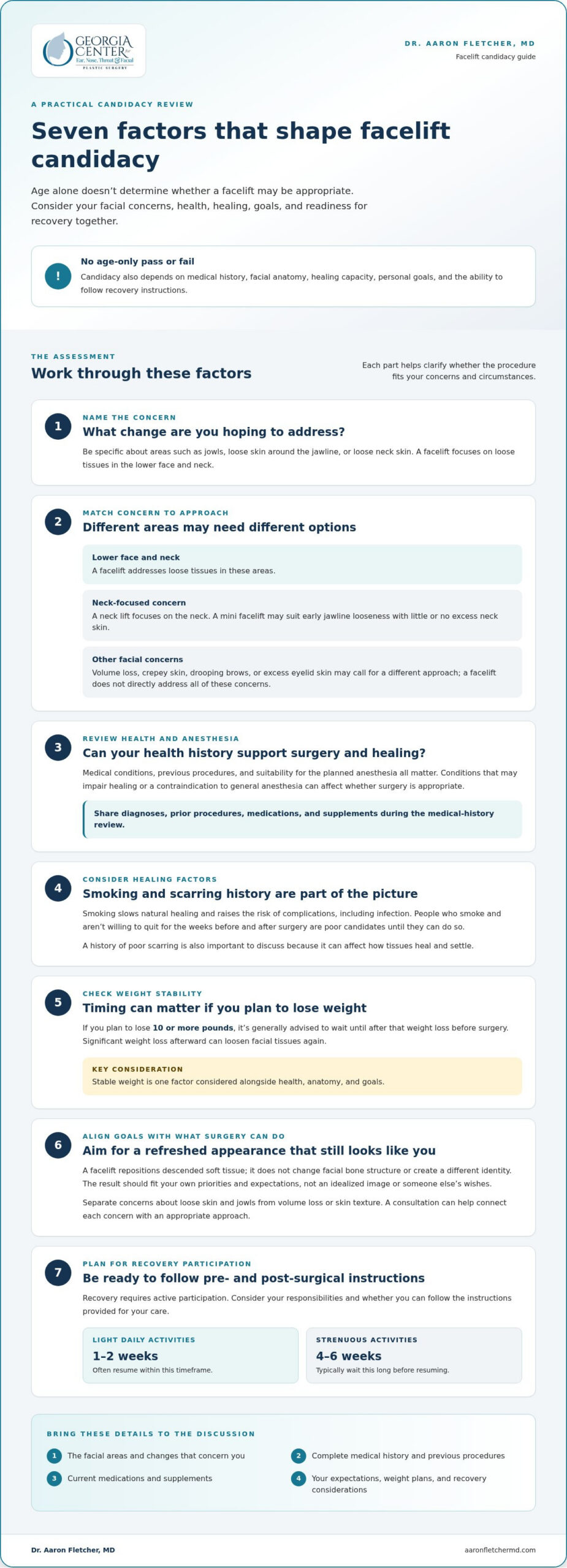
- Assess your overall health, facial anatomy, weight stability, and healing factors together rather than relying on age alone.
- Clarify which changes matter to you: a facelift primarily addresses looseness in the lower face and neck, while other concerns may call for a different approach.
- Set goals around a refreshed appearance, not a different identity, and consider whether your expectations align with what surgery can address.
- Be prepared to discuss smoking, medical conditions, medications, and supplements because they can affect healing and surgical risk.
- Plan recovery around your responsibilities: light daily activities often resume within one to two weeks, while strenuous activities typically wait four to six weeks.
Who is a good candidate for a facelift?
A suitable candidate is generally healthy, has facial aging concerns a facelift can address, and can follow recovery instructions. Age alone doesn’t determine eligibility; medical history, healing capacity, facial anatomy, and personal goals matter, too.
If you’re asking, “Am I a good candidate for a facelift?”, signs to consider include loose skin around the jawline or neck and a stable weight. Your facial structure also helps shape a suitable result. Skin texture and a history of poor scarring matter because they can affect how tissues heal and settle.
A facelift targets loose tissues in the lower face and neck. A neck lift focuses on the neck, while a mini facelift may suit people with little or no excess neck skin and very early looseness around the jawline. Nonsurgical treatments may help address some facial-aging concerns, while a facelift is designed to address loose tissues.
In the United States, facelift cost varies with the case, including the procedure’s scope, anesthesia, and facility. An individual price is provided after a quote request. A facelift performed for cosmetic reasons is generally not covered by insurance; coverage depends on the plan and medical indication.
Health and Surgical Eligibility
Surgical eligibility depends on whether your medical condition and history support undergoing surgery and healing afterward. A medical-history review helps identify conditions that may impair healing or raise surgical concerns. Share diagnoses, previous procedures, and current medications and supplements; withholding these details can increase risk. The assessment also considers whether the planned change suits your facial anatomy and goals.
Healing Capacity and Anesthesia
Healing capacity is your body’s ability to recover from surgical changes, while anesthesia suitability concerns whether you can safely undergo the planned anesthetic. A contraindication to general anesthesia can affect whether a facelift is appropriate. Discuss medical conditions, medications, supplements, and any history of poor scarring. These details help clarify risks and whether the anticipated improvement is worth the recovery process.
Weight stability is another practical consideration. If you plan to lose 10 or more pounds, it’s generally advised to wait until after that weight loss before surgery. Significant weight loss afterward can loosen facial tissues again. Patients should also be prepared to follow pre- and post-surgical instructions, since recovery requires active participation.
A consultation is an opportunity to describe the specific changes that concern you, such as jowls or loose neck skin. Bring a complete medical history and medication list, and be ready to discuss your expectations. These details help distinguish concerns suited to tissue tightening from those that may call for a different approach.
Realistic expectations
A facelift can improve sagging skin from the cheeks to the jaw, jowls, loose neck skin, and wrinkles around the nose and mouth. It repositions descended soft tissue; it doesn’t create a different identity or change facial bone structure.
A facelift doesn’t directly restore lost facial volume or treat crepey skin. Fillers may address volume loss and deeper folds, while upper-face concerns such as drooping brows or excess eyelid skin are usually treated with other procedures.
Results should support your existing appearance, not recreate an earlier version of yourself. Facelift surgery can typically make a patient look five to ten years younger, but it doesn’t return someone in their 40s to the appearance they had at age 21.
Before treatment, identify the specific change you hope to see. Someone concerned about jowls and loose neck skin, for example, may have different goals from someone bothered by drooping brows. A consultation can connect each concern with an appropriate procedure, rather than assuming one operation treats every facial area.
Realistic expectations also mean choosing surgery for your own reasons. Goals shaped mainly by another person’s wishes or an idealized image can create a mismatch between the desired and achievable outcome. Consider whether you want a refreshed appearance that still looks like you.
To prepare, describe your priorities in concrete terms:
- Name the facial areas that concern you, such as the lower face, neck, or eyelids.
- Separate loose skin and jowls from volume loss or skin texture concerns.
- Explain what a natural-looking change means to you, using examples from your own appearance.
- Discuss recovery and your readiness to follow surgical instructions, including guidance related to smoking.
These points help keep the conversation focused on your anatomy and priorities. A board-certified surgeon can explain which changes a facelift can address and which may require a different approach. If your main concern is upper-face aging, for example, a facelift alone may not meet your goal; a brow lift or blepharoplasty addresses a different area.
The neck also belongs in the discussion. Treating lower-face aging while overlooking loose neck skin may leave the overall result short of your aesthetic goal. Be candid about what you expect to change, and ask how the proposed approach relates to each concern. A facelift consultation can help you discuss those priorities and understand how they inform a personalized plan.
Smoking and medical conditions
People who smoke and aren’t willing to quit for the weeks before and after surgery are poor candidates until they can do so. Medical conditions that impair healing or contraindications to general anesthesia can also make a facelift unsuitable.
Smoking slows the body’s natural healing process and raises the risk of complications, including infection. This matters in facial surgery because healing affects treated tissues and incision sites. If you’re considering surgery, discuss your smoking honestly, including whether you can pause smoking throughout the recommended period.
Quitting isn’t something to leave until the day before surgery. The relevant period includes the weeks before and after the procedure. If you expect difficulty stopping, raise that concern during the surgical discussion rather than assume smoking won’t affect eligibility. The goal is to determine whether you can follow instructions that support healing.
Medical history is another part of the picture. Conditions that interfere with healing may raise surgical concerns, while a contraindication to general anesthesia can affect whether the procedure is appropriate. A history review should include current diagnoses, previous procedures, and any known healing problems. This helps distinguish a manageable health consideration from one that could make surgery unsafe.
Medications and supplements matter, too. Some may increase surgical risks, so provide a complete list rather than stopping or changing anything on your own. Include prescribed medicines, over-the-counter products, and supplements. The review can identify which items require specific instructions before or after surgery.
Disclose your alcohol habits as part of an accurate health history. Discuss how often you drink and any concerns about changing that pattern during surgical preparation or recovery. This gives the care team relevant context without relying on assumptions about your lifestyle.
Before a consultation, prepare a concise health summary. Include:
- Current medical conditions and previous surgeries.
- Smoking status and your ability to stop before and after surgery.
- All medications, vitamins, and supplements you take.
- Alcohol habits and any prior difficulty with healing or scarring.
These details help determine whether the expected improvement in your lower face is worth proceeding with surgery. Don’t conceal a concern because you fear it will automatically rule out surgery. A clear account allows the surgical team to assess healing capacity, anesthesia considerations, and relevant risks together. If a condition or smoking habit needs attention first, postponing surgery may be safer than proceeding before addressing those factors.
Anesthesia and recovery considerations
Recovery planning is part of deciding whether facelift surgery fits your life, not an afterthought. Consider the procedure’s duration, anesthesia assessment, time away from demanding activities, and support during early healing. A clear plan helps you judge whether the expected cosmetic improvement fits your responsibilities.
Risks and recovery effects include bruising, swelling, and stiffness in the neck and shoulders. These symptoms may last from a few days to a week. Smoking increases the risk of infection after surgery, so smoking status matters when considering healing and potential complications.
Anesthesia suitability is another factor. A contraindication to general anesthesia can affect facelift candidacy, so your medical history and current medications are relevant to the assessment. Your health and the procedure’s anesthesia plan need to be considered together, rather than assuming everyone can undergo the same approach.
Procedure duration varies with its extent. A facelift mini-lift may take 1½-2 hours, while a standard lower face and neck lift may take up to 3 hours or more. These distinctions can help you understand why a procedure tailored to your anatomy may involve a different operating time.
Recovery usually takes about 10-14 days. Most patients can return to light daily activities within one to two weeks, then typically resume more strenuous activities after four to six weeks. These milestones are not interchangeable: everyday tasks may be manageable before exercise or physically demanding work is appropriate.
Plan your calendar around those stages. Avoid scheduling important events within the first 6 weeks after surgery, especially events involving photographs. Bruising or swelling may still affect your appearance, and stiffness can make the face and neck feel less comfortable during early recovery.
Before choosing a date, consider whether you can arrange help with routine responsibilities and allow time for activity restrictions. A job requiring physical effort, for example, may need more planning than desk work. Follow the surgeon’s pre- and post-surgical instructions precisely, as they guide preparation and recovery.
Skin quality, including elasticity, helps indicate how tissues may drape after surgery, while the planned treatment area influences the procedure’s scope. A neck lift and a lower-face procedure address different areas, so clarify which regions are included. The most useful recovery plan reflects the actual procedure, your health, and your daily obligations.
Typical age for facelift surgery
There is no minimum age for considering facelift surgery in the United States. Most patients are between 40 and 70 years old, but age alone doesn’t establish candidacy. Most facelift surgeries are performed on patients aged 50 years and older, while patients as young as 40 years may qualify depending on skin quality.
These ranges describe common patterns, not a required window. A person in their 40s with visible signs of aging may have different needs from someone in their 60s. The relevant question is whether facial changes, health, and goals align with what surgery can address.
Age doesn’t show how much looseness exists or where it appears. One person may notice early laxity along the jawline, while another is concerned about the neck. Skin quality and facial anatomy help determine which techniques may fit; age alone cannot answer that.
For older adults, medical history and ability to undergo anesthesia remain important parts of the evaluation. A healthy person in their 70s may have a different surgical profile from a younger person with conditions that affect healing. Age should prompt a thorough health assessment, not an automatic yes or no.
Timing can also relate to weight stability and personal readiness. Someone planning to lose 10 or more pounds is advised to wait until after losing the weight. That practical consideration can matter more than choosing surgery at a particular age, since later weight loss may loosen facial tissues again.
To find a board-certified plastic surgeon near you, search by location and consider board certification, facelift experience, and a track record you trust. A consultation should clarify the surgeon’s approach, how the proposed techniques relate to your facial concerns, and how anesthesia and recovery fit your health.
Rather than aiming to look younger by a specific number of years, describe the changes you want addressed. Facelift surgery can typically make a patient look five to ten years younger; it doesn’t recreate an earlier appearance or change bone structure. A realistic goal is a refreshed version of your own face.
Use age as context, then weigh health, facial changes, and expectations together. If you’re ready to discuss how those factors relate to your goals, discuss your facelift goals.
Dr. Aaron Fletcher, MD: Facelift
Dr. Aaron Fletcher, MD, offers facelift surgery for people seeking to address visible aging in the lower face and neck. As a board-certified otolaryngologist and facial plastic surgeon, he can discuss how your facial concerns, health, goals, and recovery considerations relate to candidacy.
A consultation can clarify whether a facelift suits the areas you want to address. Excess upper-eyelid skin, for example, may call for a different approach, such as blepharoplasty. Understanding these distinctions helps you consider a plan that aligns with your priorities instead of expecting one procedure to address every concern.
If you’re ready to discuss your goals and questions, visit aaronfletchermd.com.
Make Your Next Step a Thoughtful One
The question “Am I a good candidate for a facelift?” is easier to approach as a focused conversation about your priorities. Consider what you hope to change, what you want to preserve, and which questions would help you understand your options. You don’t need to arrive with a final decision. A consultation can clarify whether surgery fits your goals and what further discussion would be useful.
Dr. Aaron Fletcher, MD, offers facelift surgery, blepharoplasty, and rhinoplasty. These procedures address different facial concerns, so describing the areas that matter to you can help shape a relevant discussion. Your individual circumstances guide whether a particular approach is appropriate.
If you’re ready to discuss your goals and explore your options, contact Dr. Aaron Fletcher, MD. Taking time to ask thoughtful questions is a constructive step toward making a decision that feels right for you.
Frequently Asked Questions
Can non-surgical treatments replace a facelift?
Nonsurgical treatments can address selected signs of aging, but they don’t replace the tissue repositioning performed during a facelift. Fillers, for example, can target volume loss or deeper folds, while neuromodulators address certain expression lines. These options provide targeted, temporary changes rather than tightening descended tissues in the lower face and neck. The best fit depends on whether your main concern is volume, lines, skin texture, or laxity.
Are there non-surgical options I should consider before committing to a facelift?
Yes. For early facial aging, fillers, neuromodulators, or skin resurfacing are nonsurgical options to discuss. Start by identifying the feature you want to change, such as a specific fold or uneven skin texture. Then consider whether a targeted, temporary treatment aligns with your goals. These options address different concerns, so they aren’t interchangeable with surgery that repositions loose tissue.
Can a facelift address concerns around my eyes and forehead as well?
A standard facelift focuses on the lower face and neck, not the eyes or forehead. Drooping brows and excess upper-eyelid skin are typically addressed with a brow lift or blepharoplasty. If your main concern is hooded eyelids, for example, a facelift alone won’t target that area. Describing each concern separately helps clarify which procedure addresses the facial region you want treated.
Can’t I just have a mini-facelift?
A mini facelift may suit someone with very early jawline looseness and little or no excess neck skin. It isn’t automatically the better choice just because the procedure sounds smaller. The key question is whether its scope addresses your anatomy and goals. If loose neck skin is a central concern, a more extensive approach may be a better fit than a limited lift.
How long is the procedure and what is recovery like?
Duration depends on the procedure’s extent: a mini-lift may take 1½-2 hours, while a standard lower-face and neck lift may take up to 3 hours or more. Recovery usually takes about 10-14 days. Most patients resume light daily activities within one to two weeks, with more strenuous activities typically resuming after four to six weeks. Plan work and responsibilities around those stages.
How long is the recovery period after facelift surgery?
Recovery usually takes about 10-14 days, although returning to light routines and resuming strenuous activity follow different timelines. Most patients can return to light daily activities within one to two weeks; more strenuous activities typically wait four to six weeks. Bruising, swelling, and neck or shoulder stiffness can last from a few days up to a week. Avoid scheduling important events within the first 6 weeks, especially photo events.
What are the risks of a facelift?
Risks include healing complications, infection, and effects related to anesthesia. Smoking slows natural healing and increases infection risk, while medical conditions, medications, and supplements can affect surgical considerations. A history of poor scarring matters in planning, too. Share your complete medical history and current medication and supplement list so these factors can be considered together before you decide whether surgery fits your circumstances.
Will a facelift look natural, or will people be able to tell I had surgery?
A facelift aims to tighten and resuspend facial soft tissues, not change your identity or bone structure. A natural-looking goal is a refreshed version of your own appearance, not an entirely different face. Your anatomy, skin characteristics, and selected technique all inform the plan. Discuss what “natural” means to you, such as maintaining familiar features while addressing specific areas of looseness.