What if the right time for a facelift has less to do with your age than with the changes you’re noticing in your face? It’s understandable to wonder whether you’re too young to consider surgery or have waited too long. But asking “what is the best age for a facelift” doesn’t have one universal answer. People experience facial aging differently, and a birthday alone can’t determine whether surgery is appropriate.
This article explains which personal factors matter more than a number, including your facial concerns, health, expectations, and readiness to consider surgery. It also covers how to prepare for a consultation and what questions can help you decide whether the timing feels right for you.
The goal isn’t to set a deadline for surgery. It’s to help you understand what you want assessed, what a surgeon may consider, and how to make a thoughtful decision without feeling pressured to act before you’re ready.
Key Takeaways
- There’s no single answer to “what is the best age for a facelift.” Treat age ranges as context, not eligibility rules.
- Identify the facial or neck changes you want to discuss, and describe the outcome you hope to achieve.
- Discuss your health, healing considerations, expectations, and goals with a qualified surgeon. Age alone can’t establish candidacy.
- Prepare questions before a consultation so you can understand whether the procedure and timing align with your priorities.
- A consultation with Dr. Aaron Fletcher, MD can provide an opportunity to discuss your concerns, goals, health, and whether facelift surgery is appropriate.
What Is the Best Age for a Facelift? The Direct Answer
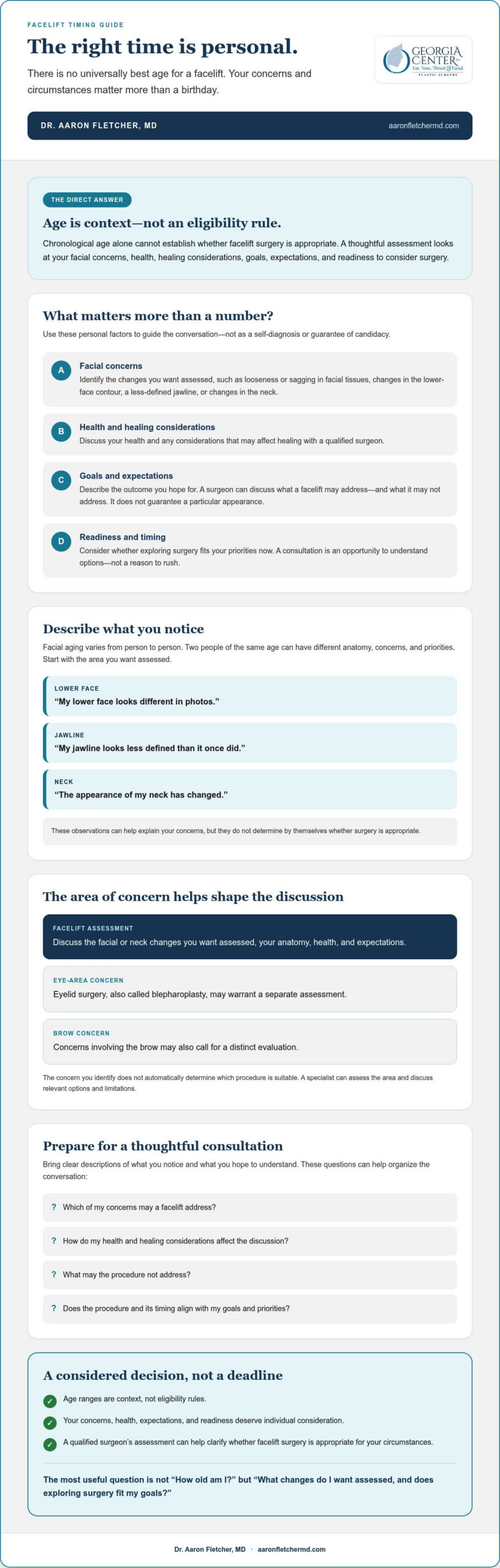
There is no universally best age for a facelift. The right timing depends on your facial concerns, health, goals, and readiness to consider surgery, not a birthday or age cutoff. Chronological age can provide context, but it can’t establish whether you’re a suitable candidate. That requires an individualized assessment by a qualified surgeon.
Facelift surgery, also known as rhytidectomy, is planned around the concerns a person wants to address. For a neutral overview of the procedure and its terminology, see Rhytidectomy (facelift). The decision to consider surgery is personal: two people of the same age may have different facial anatomy, concerns, health considerations, and expectations.
Is there a typical age range for facelift patients?
People often hear that facelift patients tend to fall within a particular age range. Such descriptions may reflect patterns in a specific practice or group, but they aren’t eligibility rules. Without current, reputable clinical evidence to support a specific range, it’s more useful to focus on the individual than to treat an age band as a recommendation, minimum requirement, or guarantee of suitability.
An average can’t tell you whether surgery fits your circumstances. If you’re outside a commonly discussed range, don’t assume you’re automatically too young or too old. Instead, consider what changes you notice, what you hope to address, and whether surgery may be appropriate after a clinical evaluation.
Why age alone cannot decide facelift timing
Chronological age measures time, not the location or degree of facial changes. People age differently, so those with the same birth year may have distinct anatomy and priorities. One person may be concerned about changes along the lower face, while another may have different concerns or may not be considering surgery at all.
A qualified consultation considers your concerns, health, healing considerations, and expectations. A surgeon can discuss whether the procedure aligns with your goals and what it may not address. This conversation isn’t a promise of candidacy or a reason to rush. It’s an opportunity to understand your options and make a considered decision.
So, if you’re asking “what is the best age for a facelift,” the most useful answer is that age alone can’t determine readiness. Your concerns and personal circumstances matter more than a number, and a careful assessment can help clarify whether the timing feels right for you.
How Facial Aging and Facelift Goals Affect the Right Timing
Facelift planning starts with the changes you want to discuss, not an age bracket. Facial aging varies from person to person and doesn’t follow a predictable schedule. Genetics, skin characteristics, and other individual factors can influence how changes appear. As a result, two people of the same age may have different concerns and goals.
Which changes might prompt someone to explore a facelift?
Some people seek an assessment because of facial laxity, meaning looseness or sagging in facial tissues, or changes in the contours of the lower face and neck. You might notice that your jawline looks less defined than it once did, or that the appearance of your neck has changed. These observations can help you explain your concerns, but they can’t establish on their own whether surgery is appropriate.
A facelift consultation considers your anatomy and the areas that concern you, along with your health and expectations. The American Society of Plastic Surgeons outlines factors relevant to good candidates for a facelift. A surgeon can assess whether your concerns align with what the procedure may address and discuss its limitations. A facelift doesn’t address every facial feature or guarantee a particular appearance, so describe your priorities clearly.
When another facial procedure may be more relevant
Not every concern around the face points to the same procedure. If your main concern is around your eyes, eyelid surgery, also called blepharoplasty, may warrant a separate assessment. Concerns involving the brow may also call for a distinct evaluation. This doesn’t mean one procedure is automatically more suitable. The first step is identifying which area you want assessed. For an overview of eyelid surgery, read this guide to blepharoplasty.
As you consider what is the best age for a facelift, describe the change you notice rather than judging yourself against a timeline. For example, you might explain that your lower face looks different in photos or that your neck is the area you’d most like assessed. This gives a surgeon a useful starting point for discussing your goals, anatomy, and whether facelift surgery is worth considering.
If you’d like to explore your concerns in a specialist consultation, you can learn more about discussing facelift goals with Dr. Aaron Fletcher.
Am I Too Young or Too Old for a Facelift? Candidacy Beyond Age
Age alone doesn’t establish whether you’re suitable for a facelift or rule surgery out. If you’re concerned that you’re too young or too old, start by considering whether your concerns, health, expectations, and readiness can be assessed carefully by a qualified surgeon. No online checklist can provide medical clearance or replace that conversation.
What factors matter more than a number?
A surgeon considers your facial anatomy and the changes you want to address, along with your health history and individual circumstances. Be prepared to discuss medical conditions, medications, and any factors that may affect surgery or healing. The surgeon can explain which details need further evaluation. Don’t assume that a particular age automatically makes surgery safe or unsuitable.
Your understanding of the procedure matters, too. A thoughtful discussion should cover potential risks, recovery, and realistic limitations, including what a facelift may not change. Your goals should be clear enough to discuss, but they don’t need to be perfectly formed before you seek information. You might simply explain that you want to know whether a particular concern can be addressed, rather than expect a guaranteed result.
The American Society of Plastic Surgeons’ guidance on facelift candidacy also emphasizes that suitability involves more than age. An experienced surgeon must assess your individual clinical picture. General guidance can help you prepare questions, but it can’t determine your candidacy.
When is it reasonable to wait or reconsider?
Waiting can be a considered choice, not a failure to act. If you’re uncertain about what you want to change, hoping for an outcome surgery can’t promise, or feeling pressured to decide quickly, take time to clarify your priorities. You should feel able to ask questions and understand the answers before making a decision.
Health concerns may also need evaluation before elective surgery is considered. Only a clinician familiar with your circumstances can advise what that means for you. This article can’t determine whether surgery is appropriate or when it should happen. If you feel rushed or insufficiently informed, seeking another qualified opinion is reasonable.
Dr. Aaron Fletcher is a board-certified otolaryngologist and facial plastic surgeon who offers facelift surgery. A consultation can be a setting to discuss your goals, health considerations, and questions without treating age as a reason to rush. You can learn more about facelift candidacy and consultation as you consider your next steps.
How to Decide Whether Facelift Timing Fits Your Goals
Before a consultation, put your concerns into words. You don’t need to decide in advance whether surgery is right for you. Preparing specific questions can help you understand whether a facelift, another approach, or waiting better fits your priorities. If you’re still asking “what is the best age for a facelift,” focus first on what you hope to address and what you need to know to make an informed choice.
A short preparation framework
- 1. Name the changes. Describe the facial areas you’d like assessed in your own words. For example, note whether your concern is the lower face, jawline, or neck.
- 2. Clarify your goal. Explain what you hope to look or feel different, while recognizing that surgery has limitations and can’t promise an exact appearance.
- 3. Prepare your health history. Make a list of health conditions, medications, and relevant prior procedures. Ask what information or further evaluation the surgeon needs before making a recommendation.
- 4. Write down your questions. Bring notes about risks, recovery, alternatives, and what a facelift may not address. A guide to finding a board-certified facelift specialist can also help you prepare to evaluate a surgeon.
Questions to bring to a facelift consultation
Ask which procedure, if any, may address your concerns and why. You can also ask how your health history informs the recommendation, what risks and recovery considerations are relevant to you, what limitations to expect, and whether alternatives or waiting are worth discussing. These questions help you understand the reasoning behind a plan, not just its name.
How to recognize an informed, unpressured decision
A considered decision leaves room for questions. The surgeon should discuss uncertainties, individual variation in results and recovery, and realistic limitations without guaranteeing an outcome. You should understand what is being proposed and feel comfortable taking time to reflect, ask follow-up questions, or seek another opinion. If you leave unsure about the recommendation, continue the conversation rather than rushing into a commitment.
When you’re ready to discuss your concerns and questions with a facial plastic surgeon, you can request a facelift consultation with Dr. Aaron Fletcher.
Choosing the Right Facelift Timing With Dr. Aaron Fletcher
A consultation can turn a general question about timing into a specific discussion of your concerns and options. Dr. Aaron Fletcher is a board-certified otolaryngologist and facial plastic surgeon who offers facelift surgery. An evaluation is an opportunity to consider whether your goals, health, and individual circumstances make further discussion of surgery appropriate. It doesn’t need to be an age-based sales pitch.
What an individualized facelift evaluation should clarify
Start with what you’ve noticed and what you hope to address. Rather than relying on a broad description such as “I look older,” explain which areas draw your attention and what you’d like the surgeon to assess. An examination gives the surgeon an opportunity to consider your facial anatomy alongside your stated goals.
Your medical history and expectations are also part of the picture. Be ready to discuss relevant health information and ask what else the surgeon may need to know before making a recommendation. The conversation should clarify whether a facelift may be appropriate for your concerns, whether another option warrants consideration, or whether it makes sense to wait. Any recommendation depends on an individual examination and your circumstances, not age alone.
Use the appointment to ask about the reasoning behind a proposed plan, its potential risks and limitations, and any questions that remain unanswered. You don’t need to leave with an immediate decision. A clear explanation should help you understand the considerations and weigh them against your priorities.
A thoughtful next step if you are considering surgery
Exploring a consultation doesn’t commit you to having surgery. It can be a way to understand your concerns more clearly, hear a specialist’s assessment, and decide whether you want to consider the next step. If something feels unclear, ask for clarification. If you need time to reflect, take it.
The question “what is the best age for a facelift” can be a useful starting point, but it can’t settle the decision for you. A thoughtful evaluation considers your facial concerns, goals, and health, then gives you information to consider without promising a particular outcome. If you’d like to discuss whether an evaluation may be appropriate, discuss facelift goals with Dr. Aaron Fletcher. Personal readiness matters more than a birthday.
Take the Next Step at Your Own Pace
The answer to “what is the best age for a facelift” isn’t a particular birthday. Timing is a personal decision shaped by your concerns, health, goals, and readiness to understand the procedure’s possibilities and limitations. A consultation can help you explore those factors without obligating you to move forward.
A conversation with a qualified specialist can help you clarify what you’d like assessed and whether an evaluation is appropriate for your circumstances. You deserve clear answers and space to consider them.
If you’re ready to discuss your questions and goals, discuss your facelift goals with Dr. Aaron Fletcher. Take the time you need to make an informed decision that feels right for you.
Frequently Asked Questions
What is the best age to get a facelift?
There is no single age that is best for everyone. If you’re asking what is the best age for a facelift, the more useful question is whether your concerns, health, expectations, and goals make surgery worth discussing. Age ranges, when mentioned, offer general context rather than candidacy rules. A qualified surgeon can assess your individual circumstances and discuss whether a facelift may be appropriate now, later, or not at all.
Is 40 too young to get a facelift?
Not necessarily, but being 40 doesn’t establish whether a facelift is appropriate. A surgeon needs to understand which facial changes concern you, assess your anatomy, and consider your health and expectations. Ask whether a facelift suits those concerns, what benefits and risks are relevant, and what limitations or alternatives to consider. An individual assessment is more useful than comparing your age with other people’s or relying on a general age guideline.
Can you be too old to get a facelift?
There is no universal upper age cutoff that determines facelift candidacy. Age alone can’t establish that surgery is suitable or unsuitable. A surgeon will need to consider your overall health, medical history, healing considerations, goals, and examination findings. Discuss your individual risks and whether elective surgery is appropriate with a qualified surgeon. Don’t assume you’re eligible or ineligible based only on your age or someone else’s experience.
How do I know if I am ready for a facelift?
Readiness means more than noticing a facial change. Consider whether you can describe what you want assessed, understand that results and recovery vary, and are prepared to discuss risks and limitations. A consultation should include your health history and an examination. If you feel uncertain, pressured, or unclear about what surgery can address, pause and ask questions. You don’t need to decide before you understand the recommendation.
What happens if I get a facelift too early?
“Too early” has no universal age definition. The key question is whether a facelift addresses a concern that matters to you and whether its potential benefits and limitations fit your goals. An individualized assessment can clarify whether your anatomy and concerns align with the procedure, or whether waiting or another approach deserves discussion. Avoid deciding by comparing your age with other patients. Those comparisons can’t determine your candidacy.
Does a facelift stop facial aging?
No. A facelift addresses specific facial concerns, but it doesn’t stop the natural aging process or prevent every future change. Individual results vary, and no particular appearance or permanent outcome should be assumed. During a consultation, ask what the procedure can and cannot address, what recovery involves, and how your goals and health inform planning. Clear answers can help you form realistic expectations before deciding whether surgery is right for you.
Should I wait until I am older to get a facelift?
Not automatically. Waiting may or may not fit your circumstances. The decision depends on your concerns, health, expectations, and a qualified surgeon’s assessment. A consultation can help you understand whether surgery is appropriate to consider now or whether postponing it makes sense. Seeking information doesn’t commit you to surgery. Take time to consider any recommendation, ask follow-up questions, and proceed only when you feel informed and comfortable with your decision.