
What if the cheek fullness you notice isn’t coming from the buccal fat pads at all? Buccal fat pad removal targets a specific pocket of deep cheek fat, so it may not address fullness caused by other aspects of your facial structure. Wanting more definition is understandable, but removing fat permanently can also create a hollow or unbalanced appearance, particularly as your face changes with age.
Deciding whether surgery suits you takes more than following a beauty trend or focusing on one feature. Your anatomy, facial proportions, existing volume, health history, and long-term goals all matter. A careful assessment can help identify what may be contributing to cheek fullness and whether surgery is a reasonable option.
This article explains what buccal fat pad removal can and can’t change, what a surgeon may consider when assessing candidacy, and which alternatives to discuss. It also covers recovery, potential risks, why the result is permanent, and questions to bring to a consultation. The aim is to help you discuss your options with clearer expectations.
Key Takeaways
- Buccal fat pad removal targets deep cheek fat, but may not address fullness caused by other features of your facial structure.
- Candidacy depends on an individualized assessment of facial proportions, goals, health history, and long-term expectations, not a checklist or trend.
- Ask how the procedure may affect facial balance over time and whether another approach may better align with your goals.
- Recovery and visible changes vary. Discuss what to expect during healing and when results can be assessed.
- Before deciding, ask about your surgeon’s experience, your personal risks, and the follow-up care available.
What Buccal Fat Pad Removal Changes, and What It Cannot Change
If you’re interested in more defined cheeks but cautious about permanently removing facial volume, start by understanding what the operation targets and what it leaves unchanged. That distinction can help you ask more useful questions without assuming a particular feature has only one cause.
Where the buccal fat pad sits in the cheek
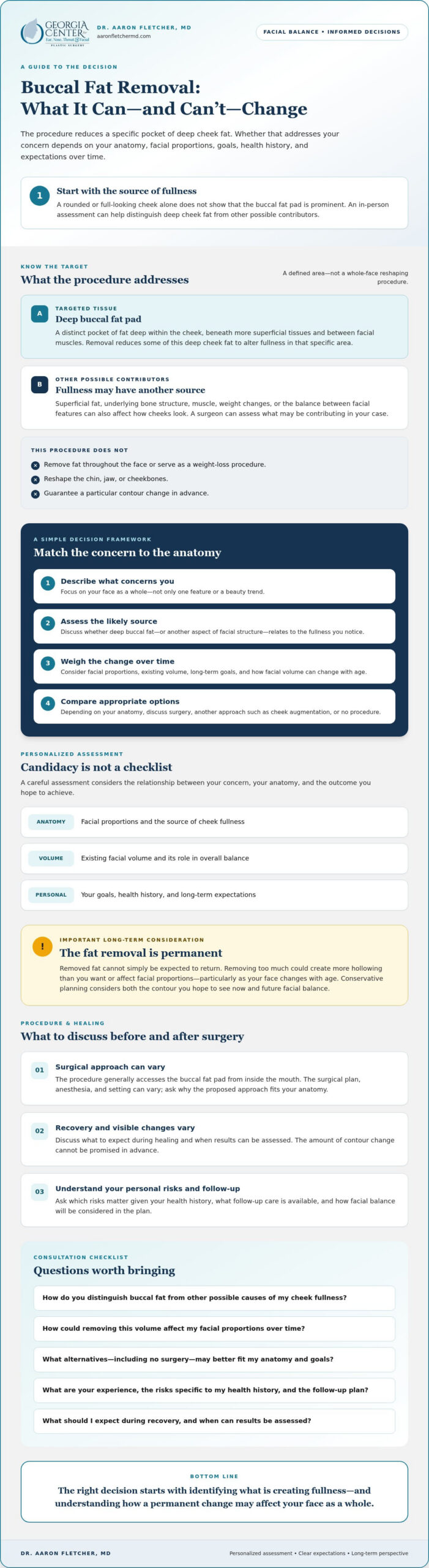
The buccal fat pad is a distinct pocket of fat deep within the cheek, beneath more superficial tissues and between facial muscles. It differs from the layer of fat closer to the skin. Its size and position can influence the lower cheek, but they’re only part of a complex facial structure. A rounded or full-looking cheek alone doesn’t show that the buccal fat pad is prominent.
For a general overview of the procedure and the anatomy involved, see Buccal fat extraction. A clinician can explain how general descriptions relate to your individual facial anatomy.
What the procedure is intended to address
Buccal fat pad removal reduces some of the deep cheek fat, with the aim of changing fullness in that specific area. The amount of contour change can’t be determined from a photograph or promised in advance. A surgeon needs to assess your face and consider your concerns alongside your overall proportions and goals.
Cheek fullness may also relate to superficial fat, underlying bone structure, muscle, or how different facial features balance one another. Weight changes may affect facial appearance, but this operation isn’t a weight-loss procedure and doesn’t remove fat throughout the face. It also doesn’t reshape the chin, jaw, or cheekbones. Because the procedure addresses a defined area, it may not resolve a concern caused by another feature.
That distinction matters: removing deep cheek fat when it isn’t the source of fullness may not create the change you want. An in-person assessment can help connect what you see with the underlying anatomy, clarify the procedure’s limits, and determine whether another approach, including no surgery, better fits your goals. Start by describing what concerns you about your face as a whole, rather than making a decision based on a trend or one feature.
How Buccal Fat Removal Works, and Why Surgical Judgment Matters
Understanding the procedure involves more than knowing that cheek fat is reduced. The key question is whether the targeted tissue relates to your concern and how changing it could affect facial balance. Buccal fat pad removal is surgery that reduces a portion of the deep fat pocket in the cheek to alter lower-cheek fullness in selected patients. It isn’t a universal solution for rounded cheeks or a way to reshape the entire face.
What happens during a high-level surgical overview
The operation is performed by a qualified surgeon in an appropriate clinical setting. It generally involves accessing the buccal fat pad from inside the mouth, but the surgical plan, anesthesia, and setting can vary. Ask the surgeon to explain the approach being considered for you, why it fits your anatomy, and what preparation and follow-up it involves. The American Society of Plastic Surgeons also provides an overview of the procedure and patient considerations.
Why facial proportions influence surgical planning
Cheek shape affects the appearance of the whole face, along with features such as the jaw, chin, and cheekbones. A surgeon should consider how those features relate rather than assessing cheek fullness in isolation. Your goals, existing facial volume, health history, and the source of fullness all inform whether surgery is worth discussing. Depending on your anatomy, cheek augmentation surgery or no procedure may be more relevant.
Conservative planning matters because removed fat cannot simply be expected to return, while facial volume can change over time. Removing too much could create more hollowing than you want or affect your facial proportions. A careful assessment considers both the contour you hope to see now and how reducing volume may affect facial balance later. There is no single aesthetic ideal for every face.
Before deciding, prepare specific questions: Which area concerns you? What change are you seeking? What would you consider an acceptable outcome? Ask how the surgeon distinguishes buccal fat from other possible causes of fullness, which alternatives apply to your case, and which risks matter given your health history. To explore whether your goals and anatomy may align with surgery, learn more about buccal fat pad removal with Dr. Aaron Fletcher, a board-certified otolaryngologist and facial plastic surgeon.
Who May Be a Candidate for Buccal Fat Removal, and Who Should Pause?
A procedure’s popularity doesn’t make it appropriate for every face. Individual anatomy and personal goals matter more than trend popularity when considering buccal fat pad removal. A consultation can help determine whether the fullness you notice relates to the buccal fat pad, another facial feature, or a combination of factors. It isn’t a checklist you can use to approve yourself for surgery.
Questions that help clarify whether consultation may be appropriate
Consider what specifically concerns you. Is the fullness localized to the lower cheek, or might your overall facial shape, cheekbones, or jawline be contributing? What change are you hoping to see, and how would you feel if the result were subtle rather than dramatic? These questions can help you explain your goals, but they can’t establish candidacy.
A qualified clinician needs to assess your facial anatomy in person and review relevant health history before discussing whether surgery may suit you. Be ready to explain your expectations and ask what the procedure can realistically address, what it cannot change, and which risks or alternatives apply to your circumstances.
When alternatives or a pause deserve discussion
Waiting, gathering more information, or choosing no procedure are all valid options if you’re uncertain about your goals or the likely effect on facial balance. Consider pausing if your concern is difficult to define, you feel pressured to act because of a trend, or the proposed change doesn’t fit how you want your face to look over time. A careful surgeon should make room for these questions rather than rush you toward a decision.
Facial volume can change with age, though the timing and extent differ from person to person. A surgeon can discuss how that possibility factors into planning without claiming to predict your individual appearance. If your concern is a lack of cheek volume rather than fullness, cheek augmentation is a separate surgical conversation that may be more relevant. The appropriate option depends on an assessment, not a standard facial ideal.
Before proceeding, ask the clinician to explain the reasoning behind any recommendation and how alternatives compare with your goals. A thoughtful consultation should leave you better informed, whether you decide to explore surgery or take more time. You don’t need to decide before you understand the options.
Recovery, Results, and Long-Term Changes After Buccal Fat Removal
Healing after buccal fat pad removal varies. Early swelling or other temporary changes can make it difficult to judge the eventual cheek contour, so don’t treat the first days of recovery as a preview of the settled result. Your surgeon can explain which changes are expected in your case and when it may be appropriate to assess your appearance.
What patients should ask about during recovery
Before surgery, ask for clear, personalized instructions and make sure you know how to contact your treating team with concerns. Ask:
- Which symptoms are expected during healing, and which should prompt a call?
- What should I do if pain, swelling, or another symptom worsens rather than improves?
- What guidance applies to eating, oral hygiene, activity, and follow-up in my situation?
These details can depend on your procedure and health history. Follow your surgeon’s instructions rather than relying on a generic online recovery schedule. If something concerns you, contact your treating clinician instead of trying to diagnose it yourself. Your surgeon should review possible complications and explain which symptoms warrant prompt attention.
How to think about results over time
Give healing time to progress before drawing conclusions about facial balance. The timing of visible changes varies, so ask your surgeon what milestones to expect and when they can assess the result. An early photograph may capture swelling rather than the final contour. Follow-up visits are an opportunity to discuss how healing is progressing and raise concerns.
Facial appearance and volume can also change with age. No clinician can predict exactly how your face will change, but this is worth discussing before a permanent procedure. Ask how the planned reduction relates to your existing facial volume and long-term expectations, including what to consider if the result looks more hollow than you intended.
For more background, review a comprehensive buccal fat removal guide alongside individualized advice from your surgeon. To discuss recovery expectations and facial balance with Dr. Aaron Fletcher, learn about buccal fat pad removal.
How to Choose a Surgeon and Prepare for a Buccal Fat Removal Consultation
A thoughtful consultation should explain the reasoning behind a recommendation, not simply confirm a decision you’ve already made. Check that the surgeon’s credentials and experience are relevant to facial surgery. Ask how often they perform buccal fat pad removal and how they assess cheek anatomy. Dr. Aaron Fletcher is a board-certified otolaryngologist and facial plastic surgeon with nearly a decade of surgical experience.
Questions to bring to a consultation
Write down your concerns and questions beforehand. A useful discussion should address both the changes you’re seeking and the limits of surgery. Consider asking:
- How do you determine whether my cheek fullness is related to the buccal fat pad?
- How would my facial proportions and existing volume affect your recommendation?
- What risks are most relevant to my health history, and what alternatives should I consider?
- What should I expect during recovery, and what follow-up arrangements are recommended?
- How do you plan conservatively, including with regard to facial changes over time?
Look for explanations that connect the proposed plan to your anatomy and goals. You should understand the potential benefits, risks, alternatives, and uncertainties before signing consent. If a term or recommendation is unclear, ask for an explanation in plain language.
How to make an informed next-step decision
Compare the quality of each surgeon’s explanation, not dramatic before-and-after images or promises of a particular result. Notice whether the surgeon listens, answers directly, and discusses reasons you might not be a suitable candidate. You should have room to consider the information, ask follow-up questions, and decide without pressure. If risks, recovery, or follow-up arrangements remain unclear, request clarification before moving forward.
A consultation is an opportunity to explore your options, not a commitment to surgery. Dr. Fletcher’s practice offers buccal fat pad removal and cheek augmentation surgery, so facial balance and your stated goals can be part of the conversation. If you’re ready to discuss your anatomy, questions, and expectations with a specialist, arrange a consultation with Dr. Fletcher.
Make Your Next Step an Informed One
Considering buccal fat pad removal starts with understanding what the procedure can and cannot address. Cheek fullness may have more than one cause, so candidacy depends on a clinician’s assessment of your anatomy, goals, health history, and expectations. Before deciding, discuss long-term considerations, recovery, risks, and alternatives, including how facial volume may change over time.
A consultation is a chance to ask questions and understand your options, not an obligation to proceed. Dr. Aaron Fletcher is a board-certified otolaryngologist and facial plastic surgeon with nearly a decade of surgical experience. His practice offers buccal fat pad removal and cheek augmentation surgery, which may be discussed in the context of your individual facial balance.
If you’re ready to explore whether surgery aligns with your goals, arrange a consultation with Dr. Fletcher. A thoughtful conversation can help you move forward with greater clarity, whether that means considering surgery or taking more time to decide.
Frequently Asked Questions
What is buccal fat pad removal?
Buccal fat pad removal is surgery that reduces some of the deep fat located within the cheek. Its aim is to change fullness in that specific area, not slim the entire face or alter every facial feature. The procedure is performed by a qualified surgeon, and an in-person assessment helps determine whether the buccal fat pad may contribute to your concern. Cheek fullness can have several causes, so appearance alone isn’t enough to identify the source.
Who is a good candidate for buccal fat removal?
A suitable candidate is determined through an individualized clinical assessment, not a checklist or a general rule about face shape. A surgeon considers your cheek anatomy, facial proportions, health history, goals, and expectations. It helps to clarify whether your concern is localized cheek fullness or another feature affecting facial shape. If you’re unsure what’s causing the fullness, have limited facial volume, or feel pressured by a trend, discuss those concerns before considering surgery.
Is buccal fat removal permanent?
Yes. Fat removed during buccal fat pad removal is not expected to grow back, so the change is generally considered permanent. That doesn’t mean your face will look exactly the same throughout life: facial volume and contours can change with aging and other factors. Ask your surgeon how permanence relates to your goals and what uncertainties to consider over the long term. Understand these points before consenting to surgery.
What are the risks of buccal fat pad removal?
Potential risks include infection, bleeding, injury to nearby structures such as nerves or the salivary duct, asymmetry, persistent discomfort, and an overly hollow appearance. Swelling and jaw stiffness may also occur during healing. Specific risks depend on your anatomy, health, and surgical plan, and no list can predict your individual experience. Ask your surgeon which complications are most relevant to you, what symptoms need prompt attention, and how follow-up is arranged.
How long does recovery from buccal fat removal take?
Recovery varies, and there isn’t one timeline that applies to every patient. Swelling and other early healing effects can make it difficult to judge cheek contour at first; visible changes continue as healing progresses. Your surgeon can explain what to expect based on the planned procedure and your health, including when to resume usual activities and when results can be assessed. Follow your clinician’s instructions for care, activity, and follow-up rather than a generic online schedule.
Can buccal fat removal make the face look hollow as it ages?
It can contribute to a hollow appearance in some people, particularly if too much cheek volume is removed or facial volume decreases with age. That doesn’t mean it will happen to every patient, and no one can predict exactly how an individual face will change over time. Ask your surgeon how conservative planning, your existing facial volume, and long-term changes factor into the recommendation. It’s reasonable to pause if you remain uncertain about that trade-off.
What should I ask a surgeon before buccal fat removal?
Ask how the surgeon evaluates your cheek anatomy and whether the procedure addresses the concern you’ve described. Discuss their experience with the surgery, your personal risks, alternatives, expected recovery, and follow-up arrangements. Ask how they plan conservatively and account for possible facial changes over time. You should receive clear answers about benefits, limitations, and uncertainties, with enough time to consider your options. If anything is unclear or you feel pressured, ask for clarification before deciding.