
What if the most challenging part of your facial contouring journey isn’t the surgery itself, but the patience required to see your true reflection emerge? It’s completely natural to feel a surge of anxiety when you look in the mirror during the first forty-eight hours and see temporary swelling rather than the refined jawline you envisioned. This initial response is a standard part of the healing process, yet it often causes concern for those unprepared for the “chipmunk cheek” phase. Understanding the nuances of buccal fat removal recovery is the first step in transforming that uncertainty into a sense of calm, informed control.
We’ve developed this clinical guide to help you navigate every phase of your healing with total confidence. You’ll gain a clear perspective on the surgical timeline, from the immediate care of intraoral incisions to the final settling of your mid-face architecture. We’ll explore essential dietary protocols to protect your sutures and professional techniques for minimizing inflammation while ensuring the safety of delicate internal structures like the parotid duct. This roadmap provides a predictable path toward results that are both natural and structurally sound, giving you the clarity needed for a seamless transition to your new profile.
Key Takeaways
- Understand why swelling often peaks on the second day and how to manage the initial seventy-two hours of inflammation with clinical precision.
- Learn the specific dietary transition from clear liquids to soft foods to protect your intraoral incisions during the first week of healing.
- Discover how a meticulous ENT perspective ensures a safe buccal fat removal recovery by protecting the parotid duct and vital facial structures.
- Identify the specific “red flags” that require immediate surgical attention and how to distinguish them from standard post-operative sensations.
- Gain clarity on when the final “shadow” of cheek definition will emerge as the internal architecture of the face settles over several months.
The Initial Phase: What to Expect in the First 72 Hours
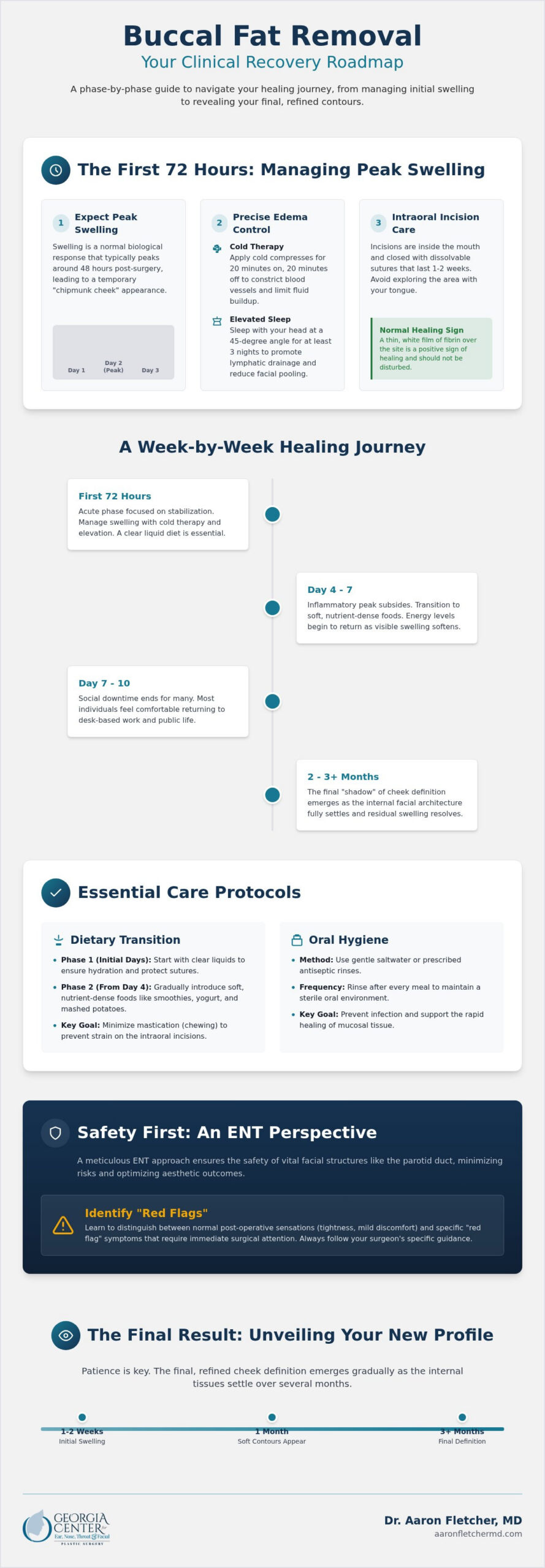
The first seventy-two hours of your buccal fat removal recovery represent a period of rapid physiological adjustment. Immediately following the procedure, you’ll likely experience a combination of numbness from the local anesthetic and a distinct sensation of tightness within the mid-face. This tightness is a natural result of the internal tissues reacting to the surgical removal of the fat pads. While discomfort is typically mild, the sensory changes can feel unusual as the nerves begin to settle. It’s common to feel a sense of fullness that mimics the “chipmunk cheek” appearance, even before the swelling reaches its maximum point.
Many patients are surprised to find that they look more swollen on the second day than they did immediately after the surgery. This “peak swelling” phenomenon is a standard biological response. The body’s inflammatory markers reach their highest concentration approximately forty-eight hours after the initial incision. Understanding the Buccal Fat Pad Anatomy helps explain this; since the fat is located deep between the buccinator and masseter muscles, the surrounding tissues must work through a significant amount of localized edema before the new contours become visible. Staying calm during this phase is essential, as the fullness is temporary and strictly protective.
Managing Immediate Post-Surgical Edema
The cheeks are highly vascular and contain a complex network of vessels that respond quickly to surgical trauma. To manage this response with clinical precision, we focus on two primary strategies: thermal regulation and gravity. Cold therapy is your most effective tool during the first two days. Apply cold compresses to the external cheeks for twenty minutes at a time, followed by a twenty-minute rest. This helps constrict blood vessels and limits the volume of fluid that enters the tissue spaces. Always use a soft cloth barrier to protect the skin from direct ice contact.
Sleeping positions play a critical role in how quickly fluid clears from the face. You should sleep with your head elevated at a forty-five-degree angle for at least the first three nights. This position facilitates lymphatic drainage, preventing fluid from pooling in the mid-face architecture. Avoid sleeping on your side, as this can put uneven pressure on the incision sites and exacerbate swelling on one side of the face.
Protecting the Intraoral Incisions
Because the incisions for this procedure are located inside the mouth, they require a specific type of care. We use fine, dissolvable sutures designed to thrive in the moist environment of the oral cavity. These sutures typically remain in place for one to two weeks before they naturally break down. It’s vital that you don’t “explore” the incision sites with your tongue. Mechanical irritation from the tongue or fingers can disrupt the delicate mucosal edges and delay the closure of the wound. Healthy healing often involves a thin, white film of fibrin forming over the site; this is a normal part of the oral healing process and should not be mistaken for a sign of concern.
A Comprehensive Buccal Fat Removal Recovery Timeline
The journey from the operating room to the final aesthetic result involves a series of physiological milestones. During the initial seventy-two hours, the focus remains on stabilization. Managing oral hygiene is paramount during this acute phase; we typically recommend gentle saltwater or specific antiseptic rinses after every meal to keep the intraoral environment sterile. By day four, the inflammatory peak begins to subside, allowing for a gradual transition from a liquid-only diet to soft, nutrient-dense foods that require minimal mastication. This shift is a positive sign that the mucosal lining is beginning its initial stage of closure.
Adhering to established Post-Operative Care Protocols ensures that your progress remains on track. By the end of the first week, many patients find that their energy levels return and the most visible swelling begins to soften. While you may still feel some internal tightness or localized numbness, the external appearance often resembles a slightly fuller version of your pre-surgical self. This makes social interactions more comfortable, though the final contoured profile is still several weeks away.
The First Week: Social Downtime and Physical Rest
Most individuals feel confident returning to public life and desk-based work between day seven and day ten. If your profession involves strenuous physical labor or heavy lifting, we advise waiting at least two full weeks to prevent a spike in blood pressure that could trigger secondary swelling. It’s common to notice slight asymmetry during this stage. One side of the face may hold edema longer than the other, particularly if you’ve favored one side while resting, but this usually resolves as the lymphatic system recalibrates. If you have questions about your specific progress, speaking with a clinical expert can provide the reassurance you need.
Long-Term Healing: The Road to Final Definition
The true refinement of buccal fat removal is a test of patience. Between months one and three, the residual edema deep within the tissue layers finally dissipates. This is the “settling” phase, where the skin begins redraping over the newly contoured mid-face architecture. The “shadow” or hollowed definition under the cheekbones gradually sharpens as the internal scar tissue matures and softens. Your buccal fat removal recovery concludes with follow-up appointments designed to monitor this structural evolution, ensuring the outcome aligns with the meticulously planned surgical goals and provides a harmonious, natural look.
Post-Operative Dietary and Oral Care Protocols
Success in your buccal fat removal recovery depends heavily on the physical environment within your mouth during the first ten days. Because the incisions are located internally, every meal presents a potential risk for mechanical trauma or bacterial introduction. We implement a strict dietary protocol to ensure the mucosal lining heals without disruption. During the first twenty-four hours, you must remain on a liquid-only diet. This eliminates the need for mastication, allowing the initial fibrin clots to stabilize over the suture lines. Focus on high-protein shakes and electrolyte-rich fluids to support tissue repair while maintaining systemic hydration.
As you move past the first day, the introduction of soft foods must be methodical. Avoid anything sharp, such as crusty bread or chips, which can physically puncture or snag a stitch. Similarly, spicy and acidic foods are prohibited for the first week. These substances can cause significant stinging and may stimulate excessive salivation, which puts unnecessary pressure on the area near the parotid duct. Maintaining a neutral, non-irritating environment allows the surgical site to remain calm and helps prevent secondary inflammation.
The Tiered Dietary Progression
We categorize the return to normal eating into three distinct phases to minimize surgical risk. Phase one covers the first twenty-four hours of liquids only. Phase two, typically lasting from day two through day five, focuses on “no-chew” soft foods like Greek yogurt, lukewarm pureed soups, and mashed avocado. These provide essential nutrients without requiring jaw movement that might stretch the incision sites. Phase three begins around day six, where you can introduce soft solids like flaky fish or overcooked pasta. If you experience any pulling or discomfort at the incision site, immediately revert to the previous phase.
Advanced Oral Hygiene for Surgical Success
Maintaining a sterile environment is critical, yet standard brushing can be too aggressive for the first few days. We recommend a gentle salt-water rinse protocol: combine half a teaspoon of salt with eight ounces of warm water and bathe the mouth every few hours, especially after consuming liquids. This helps maintain a healthy osmotic balance and clears debris without mechanical friction.
You should avoid the molar area when brushing for at least seventy-two hours. Use a soft-bristled brush and proceed with extreme caution as you approach the back of the mouth. Crucially, do not use straws during the first week. The suction created by using a straw can dislodge delicate sutures or interfere with the healing of the deep tissue layers. Following these meticulous steps ensures your buccal fat removal recovery remains uncomplicated and efficient, and for patients seeking professional support with their oral health, Stoddard Dental Square offers expert care to help maintain a healthy recovery environment.
A successful buccal fat removal recovery is a collaborative effort between the surgeon’s technical precision and the patient’s adherence to post-operative guidelines. While the procedure is often described as straightforward, it requires a deep understanding of mid-face vascularity and nerve distribution. Optimizing your results means moving beyond simple wound care and focusing on the biological environment that supports tissue remodeling. By prioritizing safety and patience, you ensure that the final contour is both elegant and structurally sound.
Identifying “red flags” early is a vital component of this process. While mild swelling and soreness are expected, you should contact your surgical team immediately if you experience a sudden spike in temperature, foul-tasting drainage, or asymmetrical swelling that feels hard to the touch. These can be early indicators of localized infection or a hematoma. Vigilance during the first ten days allows for rapid intervention, keeping your healing trajectory on a predictable path toward a refined profile.
Clinical Safety and Anatomy
The buccal fat pad sits in a complex anatomical neighborhood, sharing space with the parotid duct and several branches of the facial nerve. An ENT-trained surgeon brings a specialized perspective to this area, as they’re intimately familiar with the internal structures of the oral cavity and salivary system. Meticulous dissection during the procedure is the best way to minimize trauma, which directly translates to a shorter and more comfortable recovery period.
Choosing a practitioner with dual board certification ensures that your journey is grounded in clinical excellence. This expertise is particularly relevant when considering how facial plastic surgery should harmonize with your unique bone structure. A “less is more” philosophy is often the safest approach; over-resection can lead to a hollowed or gaunt appearance as the face naturally loses volume with age. A conservative, skilled removal preserves the youthful architecture of the face while providing the desired definition.
Lifestyle Factors in Healing
Your daily habits significantly influence the speed of mucosal repair. Smoking is strictly prohibited, as nicotine constricts blood vessels and starves the incision sites of oxygen. Alcohol should also be avoided for at least two weeks; it acts as a vasodilator, which can exacerbate swelling and increase the risk of post-operative bleeding. Staying hydrated and prioritizing nutrient-dense, high-protein liquids will provide the building blocks your body needs to knit the internal tissues back together.
Physical rest is equally important. Strenuous exercise should be avoided for three weeks to prevent a rise in blood pressure that could disrupt the healing site. Interestingly, even though the incisions are internal, you should avoid prolonged sun exposure and excessive heat. UV rays and high temperatures can increase global facial inflammation and prolong the time it takes for edema to resolve. If you’re ready to refine your profile with a board-certified expert, we invite you to schedule a consultation for buccal fat removal to begin your personalized journey.
The Final Result: Life After Buccal Fat Removal
The final aesthetic outcome of your procedure usually becomes fully apparent between three and six months post-surgery. Patients often find that while the earlier stages of your buccal fat removal recovery were defined by managing edema, this period is characterized by the subtle emergence of the “shadow” in the sub-malar region. This definition isn’t just a surface change; it’s the result of the skin and underlying musculature finally settling over the refined internal architecture. The result should look natural, providing a chiseled appearance that looks like a permanent contour rather than a surgical intervention.
Many individuals discover that refining the lower face highlights other features in a way they hadn’t anticipated. For instance, a rhinoplasty can work in tandem with fat pad removal to create a more balanced profile, ensuring that the nose and cheeks harmonize perfectly. Maintaining these results requires a commitment to weight stability and skin health. Significant fluctuations in weight can alter the remaining facial fat deposits, potentially masking the surgical results. As you age, maintaining skin elasticity through proper nutrition and professional skincare ensures the skin continues to drape elegantly over the contours.
Synergistic Procedures for Facial Definition
Combining fat removal with blepharoplasty addresses the entire mid-face, revitalizing the eyes while sharpening the cheekbones. This dual approach creates a comprehensive facial rejuvenation that looks refreshed rather than “operated on.” Chin augmentation is another synergistic option that can further elongate the jawline, maximizing the impact of the newly revealed hollows. We evaluate the need for mid-face volume in later years as part of a holistic aging strategy, ensuring your results remain sophisticated as your face naturally evolves.
Final Expectations and Satisfaction
The difference between a “sunken” appearance and a “contoured” one often comes down to patient selection and surgical restraint. A gaunt look is usually the result of over-resection, which is why we prioritize a conservative approach that respects your future facial volume. The psychological transition is often profound; most patients report a boost in confidence as they embrace a facial structure that feels more aligned with their aesthetic goals. This journey, supported by a structured buccal fat removal recovery, culminates in a transformation that is as enduring as it is subtle. Ultimately, the value of a meticulous, expert-led recovery is found in the quiet confidence of a result that looks like it has always been part of your natural beauty.
Embarking on Your Journey to Refined Definition
Navigating the path to a more contoured profile requires both clinical guidance and patient patience. We’ve explored how the initial seventy-two hours of inflammation transition into a period of refined settling, where your new facial architecture slowly emerges. By adhering to meticulous dietary protocols and prioritizing oral hygiene, you protect delicate internal structures while ensuring a smooth healing trajectory. It’s a collaborative process that rewards discipline with sophisticated, lasting results.
The success of your buccal fat removal recovery relies on the synergy between surgical excellence and your dedicated post-operative care. Choosing a double board-certified surgeon with specialized ENT and facial plastic expertise ensures that your results are natural, balanced, and structurally sound. This methodical approach minimizes risks to the parotid duct and facial nerves, allowing you to focus on the exciting transition to your new reflection with total peace of mind.
If you’re ready to explore how this procedure can harmonize your features, we invite you to Schedule a Consultation with Dr. Fletcher to Discuss Your Facial Contouring Goals. Your journey toward lasting, sophisticated definition begins with a personalized plan built on expertise and care. We look forward to supporting you every step of the way.
Frequently Asked Questions
How painful is the recovery from buccal fat removal?
Most patients experience minimal pain, describing the sensation as a feeling of tightness or mild soreness rather than acute distress. Because the procedure is performed through internal incisions, there is no external skin irritation or stinging. Discomfort typically peaks within the first forty-eight hours and is effectively managed with over-the-counter medication. Most individuals find they can discontinue pain management within three to five days as the initial inflammation subsides.
When can I return to the gym after my cheek reduction surgery?
You should wait at least three weeks before resuming strenuous exercise or heavy lifting. While light walking is encouraged within the first few days to promote circulation, high-intensity activities can spike blood pressure and exacerbate mid-face swelling. This elevation in pressure also increases the risk of a hematoma. Gradually reintroduce your fitness routine while monitoring for any sensations of pulling or throbbing at the surgical sites to ensure a safe transition.
Will I have visible scars on my face after the procedure?
No visible external scars will remain because the procedure is performed entirely through small incisions inside the mouth. These incisions are placed within the oral mucosa, making them completely invisible once they have healed. This internal approach is a hallmark of the procedure, ensuring your aesthetic refinement remains discreet. A skilled surgeon ensures these internal sites are positioned to avoid irritation and facilitate a seamless buccal fat removal recovery.
How long do the dissolvable stitches stay in my mouth?
Dissolvable sutures typically remain in place for seven to fourteen days before they naturally break down and disappear. You don’t need to have them professionally removed. During this time, it’s essential to avoid manipulating them with your tongue or fingers to prevent premature displacement. If a stitch feels loose or falls out after the first week, it is usually not a cause for concern, as the mucosal tissue heals remarkably fast.
Can I drink coffee or hot tea during my recovery?
You should avoid very hot beverages for the first forty-eight to seventy-two hours of healing. High temperatures can increase blood flow to the surgical area, potentially exacerbating swelling or causing discomfort at the incision sites. Lukewarm coffee or tea is acceptable after the first day, provided you avoid using a straw. The suction created by a straw can disrupt the sutures or the delicate fibrin clots forming over the internal wounds.
What happens if I accidentally eat something crunchy too soon?
Eating crunchy or sharp foods prematurely can physically snag a suture or puncture the healing mucosal tissue. If this happens, rinse your mouth gently with warm salt water and inspect the area for bleeding or increased pain. While a single minor incident rarely causes significant damage, repeated trauma can lead to inflammation or localized infection. Contact your surgical team immediately if you notice any sudden changes in the wound appearance or persistent bleeding. For residents in the Greater Manchester area needing urgent advice on oral tissues or dental repairs, Greenlane Dental Practice can provide the necessary emergency care.
Swelling is frequently asymmetrical during the first week of healing. One side of the face may appear fuller than the other due to differences in local lymphatic drainage or even your sleeping position. This is a standard part of the physiological response and doesn’t indicate an uneven surgical result. As the edema continues to dissipate over several weeks, the contours will gradually harmonize and reveal the final, balanced facial architecture you envisioned.
When will I see the final “contoured” look in my cheeks?
While initial results are visible once the major swelling subsides around week three, the final contoured look takes three to six months to fully mature. This timeline allows the internal tissues to soften and the skin to redrape over the new mid-face structure. Patience is key during your buccal fat removal recovery, as the most refined “shadow” definition only appears after the residual deep-tissue edema has completely resolved and the architecture has settled.