
Achieving a defined facial structure isn’t always about weight loss. It’s often a matter of the specific anatomy within your midface. You might find that despite your best efforts, a persistent roundness masks your natural bone structure and leaves you feeling “baby-faced” well into adulthood. This fullness is often tied to the buccal fat pad, a localized pocket of tissue that remains stubbornly resistant to diet and exercise. It’s a common concern, and it’s natural to feel a disconnect between your physical fitness and your facial profile.
Our goal is to guide you through the clinical reality of facial contouring with the transparency and precision you deserve. You’ll learn how board-certified surgical expertise can refine your appearance while prioritizing long-term facial balance and volume management. We will examine the intricate anatomy of the cheek, the vital role of an ENT-trained surgeon in protecting midface structures, and the advanced protocols that ensure natural-looking outcomes in 2026. This journey is about more than a trend. It’s about providing the education and security you need to make an informed decision for your future self.
Key Takeaways
- Gain a comprehensive understanding of the buccal fat pad’s anatomical function and why its precise management is essential for preserving long-term facial harmony.
- Identify the specific physiological markers, including zygomatic prominence and skin elasticity, that determine suitability for surgical refinement.
- Discover the clinical advantages of an intraoral approach, which utilizes internal access to ensure a recovery process free from visible external scarring.
- Learn how a conservative, expert-led strategy prevents over-hollowing by balancing immediate contouring with the natural volume requirements of the aging face.
- Explore how strategically pairing midface reduction with complementary procedures can create a more defined and balanced facial framework.
Understanding the Buccal Fat Pad: Anatomy and Aesthetic Function
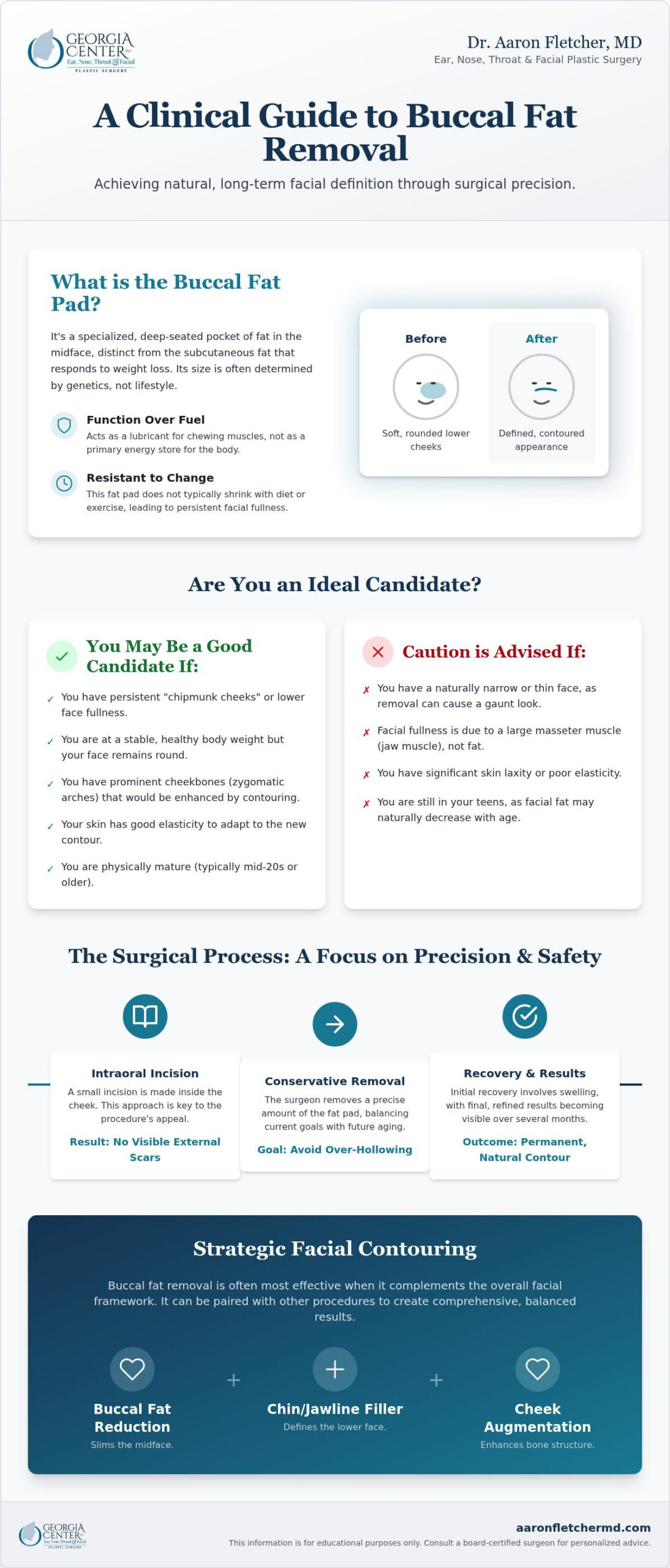
To understand why certain facial features persist despite a healthy lifestyle, we must look closely at the underlying anatomy. The buccal fat pad is a specialized, encapsulated pocket of adipose tissue located deep within the midface. Unlike the fat that sits just beneath your skin, this specific compartment serves a functional purpose. It acts as a biological lubricant, facilitating the smooth movement of your masticatory muscles as you chew. This specialized role means it’s structurally different from the fat your body typically burns for energy.
Many patients feel frustrated when rigorous exercise fails to slim their cheeks. This occurs because these pads are physiologically distinct from subcutaneous fat stores. They don’t diminish through a calorie deficit or cardiovascular training alone; even when optimizing body composition through PeptivaFit, these specific pads remain largely unchanged. From an aesthetic perspective, the volume of this pad dictates the transition between the cheekbones and the jawline. It’s the primary factor that determines whether a face appears soft and round or takes on a more defined, angular profile.
The Location and Structure of the Buccal Space
The Anatomy of the Buccal Fat Pad reveals its precise positioning between the buccinator muscle and the masseter muscle. It’s important to distinguish this from subcutaneous facial fat, which is more superficial and widely distributed. The buccal fat pad is a deep-seated fat pocket that does not respond to traditional weight loss. Because it’s encased in a thin membrane, it remains a stable anatomical feature. This stability is why it requires surgical precision rather than lifestyle changes to modify.
Aesthetic Evolution: From “Baby Face” to Facial Definition
During adolescence, prominent cheek volume is often perceived as a sign of youth, frequently referred to as a “baby face.” As you move into your late twenties, your facial structure naturally begins to lean out. This transition often reveals the underlying bone structure, creating a more sophisticated and contoured adult appearance. However, for some individuals, genetic factors keep these pads large even as they mature. If your parents or siblings share a similar midface fullness, it’s likely a hereditary trait rather than a result of fluctuating weight. Identifying this genetic predisposition helps us determine if buccal fat reduction is the most effective way to achieve your desired facial definition.
Determining Candidacy: Who Benefits Most from Buccal Fat Reduction?
Determining if you’re a suitable candidate for volume reduction requires a nuanced understanding of facial harmony. It isn’t merely about wanting a slimmer face. It’s about the intricate interplay between your skeletal framework and soft tissue. For instance, individuals with prominent zygomatic arches, or cheekbones, often see the most dramatic and aesthetically pleasing results. The removal of the underlying volume creates a natural shadow that emphasizes these bone structures, resulting in a more sculpted appearance. Conversely, if your skin lacks sufficient elasticity, the midface may not “snap back” as intended, which can lead to a lack of definition rather than the desired contour.
We also must differentiate between adipose tissue and the masseter muscle. Jaw muscle hypertrophy can create a wide lower face that’s often mistaken for excess buccal fat. During a clinical evaluation, we meticulously assess these variables to ensure the correct anatomical feature is being addressed. As noted by the American Society of Plastic Surgeons on cheek reduction, precise patient selection is the most critical factor in achieving a successful, long-term outcome. If you’re curious about how your unique anatomy would respond to treatment, you can schedule a personalized assessment to explore your options.
The Ideal Facial Profile for Buccal Lipectomy
The ideal candidate typically presents with localized fullness in the lower cheeks, sometimes referred to as “chipmunk cheeks.” This fullness remains even when the individual is at a stable, healthy weight. If you naturally have a narrow or thin face, this procedure is generally discouraged. Removing volume from an already lean structure can lead to a prematurely aged appearance. We prioritize patients who have reached physical maturity, usually in their mid-twenties, when facial fat patterns have stabilized.
The Aging Factor: Planning for Your 40s, 50s, and Beyond
A primary concern for many is whether they’ll look gaunt as they age. This is where a “Conservative Removal” philosophy becomes vital. Rather than removing the entire fat pad, we focus on subtle refinement that preserves enough volume to support the skin as it naturally thins over time. Dr. Fletcher utilizes his deep understanding of midface anatomy to predict how your results will evolve. By prioritizing a “less is more” approach, we ensure your reflection remains elegant and balanced through your 40s, 50s, and beyond. This foresight prevents the irreversible hollowing that can occur with more aggressive, trend-driven techniques.
The Surgical Process: Precision, Safety, and Artistic Refinement
Precision is the hallmark of modern facial plastic surgery. Under the advanced safety protocols of 2026, we prioritize a seamless patient experience that minimizes downtime while maximizing aesthetic harmony. You’ve got options regarding your comfort level during the procedure. While many patients choose local anesthesia combined with light sedation for a relaxed, awake experience, others prefer general anesthesia for a deeper state of rest. This flexibility ensures the surgical plan aligns with your personal comfort and medical history.
Choosing a surgeon with dual board certification in otolaryngology and facial plastic surgery provides a distinct advantage. The midface is a complex network of functional structures. An ENT-trained surgeon possesses a microscopic understanding of these layers, allowing for a level of anatomical precision that protects your long-term health. We don’t just remove tissue. We treat the delicate landscape of the cheek with the intent of preserving the underlying mechanics of your face.
Intraoral Incision and Access
The procedure begins with a small, strategic incision made inside the mouth, typically near the upper second molar. This intraoral approach is preferred because it leaves no visible external scars, keeping your surgical journey private. We carefully separate the fibers of the buccinator muscle to reach the buccal fat pad without causing unnecessary trauma to the surrounding tissues. Once the target volume is addressed, the incision is closed with fine, dissolvable threads. These sutures simplify your healing process as they break down naturally, eliminating the need for a follow-up appointment for stitch removal.
Anatomical Safeguards During Surgery
Safety during midface surgery requires constant vigilance of critical landmarks. One such structure is Stensen’s duct, the parotid salivary duct that empties into the mouth near the surgical site. We also monitor the buccal branch of the facial nerve, which is responsible for the motor function of your upper lip and cheek. Dr. Fletcher’s board-certified expertise in ENT and facial plastic surgery minimizes risks to midface nerves and ducts by ensuring these delicate structures are precisely mapped and protected during the procedure. By teasing out the fat pad with meticulous care, we achieve the desired contour without compromising your facial expression or salivary function.
Recovery and Long-Term Results: What to Expect After Surgery
Recovery is a methodical process that requires patience and adherence to clinical protocols. Your body needs time to resolve post-surgical edema, and the first 48 hours are critical for managing the initial inflammatory response. You’ll likely experience a sensation of fullness or tightness in the cheeks, which is a normal part of the healing cycle. Utilizing cold compresses during this window is the most effective way to minimize swelling and soothe the surgical site. We provide specific instructions on the timing and application of these compresses to ensure optimal comfort.
Dietary choices play a significant role in protecting your intraoral incisions. You’ll start with a strictly liquid diet for the first day or two to avoid putting pressure on the sutures. As the initial tenderness subsides, you can transition to soft foods like Greek yogurt, lukewarm soups, or mashed avocado. Maintaining rigorous oral hygiene is equally vital. We typically recommend gentle saltwater rinses or a prescribed antimicrobial mouthwash several times a day. This keeps the incision sites clean and significantly reduces the risk of infection without the need for aggressive brushing near the delicate areas.
It’s important to manage your expectations regarding the “Final Look.” While some refinement is visible early on, the true results of buccal fat removal take time to stabilize. As internal inflammation fully resolves and the tissues settle into their new positions, the sculpted contour becomes increasingly defined. Most patients see their stabilized outcome between 3 and 6 months after the procedure. If you’re ready to begin your journey toward a more defined profile with a dedicated surgical team, contact us today to schedule your consultation.
The Immediate Post-Operative Phase
Managing initial discomfort is straightforward with the medication plan we’ll establish for you. Keeping your head elevated, even while sleeping, is a mandatory step during the first week to help fluid drain away from the face. You’ll need to pause your usual exercise routine and avoid heavy lifting for at least 14 days. This precaution prevents spikes in blood pressure that could lead to post-operative bleeding or prolonged swelling. Most patients feel socially ready to return to work or public outings within 5 to 7 days, though minor residual swelling may persist.
Long-Term Maintenance and Aging
A common question involves the permanence of the results. Once these specific fat cells are excised, they don’t grow back. The reduction in volume is permanent. However, it’s vital to remember that the remaining facial fat still responds to your lifestyle. Significant weight fluctuations can alter the overall balance of your face, even if the buccal area remains contoured. Integrating your new facial structure into a holistic wellness and skincare regimen ensures that your skin remains firm and healthy. This long-term approach preserves the sophisticated, natural-looking results we aim for in every procedure.
Strategic Facial Contouring: Combining Buccal Fat Removal with Other Procedures
Facial aesthetics rarely rely on a single feature. Instead, a harmonious profile emerges from the interplay of volume and structure. For many, reducing buccal fat is only one component of a broader strategy to refine the midface and jawline. When we address the lower cheek, we often find that enhancing the chin or tightening the neck creates a more cohesive, “chiseled” appearance. This holistic approach ensures that the slimming effect doesn’t look isolated but rather integrated into your natural bone structure.
Pairing volume reduction with submental liposuction or a neck lift can provide a dramatic improvement to the jawline’s definition. By removing the weight of the cheek and the excess tissue beneath the chin, we create a sharp, elegant transition from the face to the neck. In cases where aging has introduced skin laxity, a Deep Plane Facelift may be the ideal companion procedure. This combination allows us to reposition descending tissues while simultaneously refining the lower face, addressing both structural support and volume management in a single surgical plan.
Some patients benefit from a “volume shift” strategy. This involves reducing the lower cheek fullness while using facial fat grafting to restore volume in the upper malar region. This technique mimics the natural distribution of youthful facial fat, where the upper face is full and the lower face is tapered. It’s a sophisticated way to achieve a refreshed look without the risk of an overly gaunt appearance as you mature.
Achieving the “V-Line” Profile
The “V-Line” profile is characterized by a heart-shaped face that tapers gracefully toward the chin. A Chin Implant provides the structural anchor for a slimmer cheek, ensuring the lower face looks balanced rather than simply narrow. By projecting the chin slightly forward or downward, we create a synergy between lower face slimming and upper face volumization. This creates a cohesive surgical plan that prioritizes total facial harmony rather than just focusing on one area of concern.
Choosing a Board-Certified Specialist
Credentialing is the most important factor in your surgical journey. Comparing general cosmetic surgeons to board-certified facial plastic surgeons reveals a significant difference in specialized training. You’ll want to carefully evaluate “Before and After” galleries to look for natural, non-hollowed results that stand the test of time. A comprehensive consultation is essential to discuss your long-term goals and ensure your surgeon understands the delicate anatomy of the midface. This educational journey provides the security you need to move forward with confidence, knowing your results will be both beautiful and safe.
Embracing a Refined and Balanced Future
Choosing to address midface volume is a significant step toward aligning your physical appearance with your inner confidence. Throughout this guide, we’ve explored how the removal of buccal fat is a precise anatomical refinement that requires a conservative approach to preserve your facial youth. It’s not just about immediate contouring; it’s about understanding how your unique bone structure and skin elasticity will evolve over time. By prioritizing safety and surgical excellence, you ensure that your results remain natural and proportional through every stage of life.
Dr. Aaron Fletcher, a board-certified otolaryngologist and specialist in facial plastic and reconstructive surgery, is dedicated to providing this level of meticulous, patient-centered care. His dual expertise ensures that your journey is guided by a deep understanding of midface anatomy and a commitment to sophisticated outcomes. You deserve a practitioner who values transparency and your long-term well-being above all else.
Schedule a Consultation with Dr. Fletcher to Discuss Your Facial Contouring Goals. We look forward to helping you achieve a profile that feels authentically you.
Frequently Asked Questions
Does buccal fat removal cause premature aging?
The procedure doesn’t cause premature aging when performed with a conservative, anatomical approach. Hollowing occurs only if a surgeon removes too much volume without considering the patient’s future bone loss. We prioritize a “less is more” philosophy to ensure your results look balanced and youthful as you move into your 40s and 50s. Proper patient selection is the most vital factor in preventing an aged appearance later in life.
Is the procedure reversible if I don’t like the results?
This surgery is considered permanent because the fat pads are physically excised and won’t regenerate. While the results aren’t reversible in the traditional sense, facial volume can be restored later using separate procedures like fat grafting. It’s essential to have a thorough, honest conversation about your goals during your initial consultation. This ensures you feel confident and secure in the decision before moving forward with the refinement.
How long does the swelling last after buccal fat removal?
Most visible swelling subsides within seven to ten days, allowing you to return to social activities. However, the tissues continue to settle and heal internally for several months. You’ll notice the most significant change in your profile after about four weeks, but the final, stabilized contour typically emerges between three and six months. We provide detailed post-operative instructions to help you manage this timeline and ensure a smooth recovery process.
Can buccal fat be reduced without surgery using injectables?
Clinical buccal fat reduction requires a surgical approach because these pads are deep-seated and encapsulated. While some treatments target superficial fat, they don’t reach the specific buccal compartment. This procedure is designed for targeted volume management that lifestyle changes or non-surgical options can’t provide. You’ll need a surgical evaluation to determine if your anatomy is suitable for this permanent refinement of the midface and how it fits your long-term goals.
Will I have visible scars after the procedure?
You won’t have any visible external scars because the surgery is performed entirely through the inside of the mouth. The small incisions are placed near the upper molars, where they’re hidden from view and heal quickly. We use dissolvable sutures that break down naturally, so you don’t have to worry about a follow-up visit for stitch removal. This intraoral technique allows for a discreet transformation that keeps your surgical journey private.
What is the difference between buccal fat removal and cheek liposuction?
These procedures target different layers of facial tissue. Buccal fat removal addresses a specific, deep pocket of fat that sits between the facial muscles. Cheek liposuction, on the other hand, removes superficial fat located just beneath the skin’s surface. Liposuction is rarely used in the midface because it can lead to irregularities. Most patients seeking a more defined, “chiseled” look benefit more from the precision of fat pad excision rather than liposuction.
How much does buccal fat removal cost on average in 2026?
Investment for this procedure depends on several variables, including the surgeon’s experience and the surgical facility’s standards. In 2026, professional fees reflect the high level of anatomical precision required for midface work. We don’t provide generic price estimates because every patient’s facial structure and surgical needs are unique. A comprehensive consultation allows us to create a tailored plan and provide an accurate financial breakdown based on your specific aesthetic requirements and goals.
Can I eat normally immediately after the surgery?
You’ll need to follow a liquid or very soft food diet for the first few days to protect your internal incisions. Foods like yogurt, smoothies, and lukewarm soups are ideal as they don’t require chewing that could irritate the sutures. Most patients transition back to their regular diet after about five days, once the initial tenderness has subsided. We’ll guide you through each dietary phase to ensure your recovery is comfortable and your healing remains on track.