
True facial rejuvenation isn’t found at the tip of a needle; it’s built into the very architecture of your bone structure. If you’ve spent years chasing midface volume with temporary injectables, you’ve likely experienced the frustration of filler fatigue where results dissipate just as you’ve grown fond of them. Choosing cheek implants represents a shift from maintenance to mastery, providing a permanent foundation for high cheekbones and facial symmetry that fillers simply cannot replicate. It’s a decision to move beyond the cycle of recurring appointments and embrace a definitive, structural change that honors your natural anatomy.
We understand the hesitation that comes with considering a surgical path, particularly the fear of looking over-injected or losing your unique character. You likely want to address midface volume loss and restore a youthful profile without the high recurring costs of temporary treatments. In this guide, you’ll discover how surgical cheek implants provide lasting structural definition and facial harmony that goes beyond the limitations of soft tissue fillers. We will examine the meticulous planning involved in implant selection, the nuances of the procedure, and how a focus on skeletal support leads to the most natural, sophisticated outcomes for your facial journey.
Key Takeaways
- Understand why cheek implants provide a permanent structural foundation for the midface, offering a definitive alternative to the recurring maintenance of temporary injectables.
- Learn about the critical role of biocompatible materials in modern facial surgery and how they’re selected to ensure long-term health and stability.
- Discover the methodical approach to surgical planning that prioritizes facial symmetry and restores youthful volume with medical precision.
- Explore how structural midface enhancement can be strategically paired with other procedures to achieve a holistic and sophisticated aesthetic result.
The Foundation of Facial Harmony: Understanding Cheek Augmentation
Facial structure determines how light hits the face and how we perceive age. Cheek implants are biocompatible, permanent prosthetics used in midface enhancement to provide lasting structural definition. They don’t simply sit on top of the skin; they mimic the natural underlying bone structure to create a foundation that fillers can’t match. As we age, the loss of midface volume is often the first sign of a changing profile, making this area critical for maintaining facial symmetry.
Malar and submalar placements represent the two primary categories of midface support, targeting either the bony prominence of the cheek or the hollow region beneath it. Selecting the correct type is a matter of both anatomy and aesthetic goals.
Malar vs. Submalar: Which Placement Is Right for You?
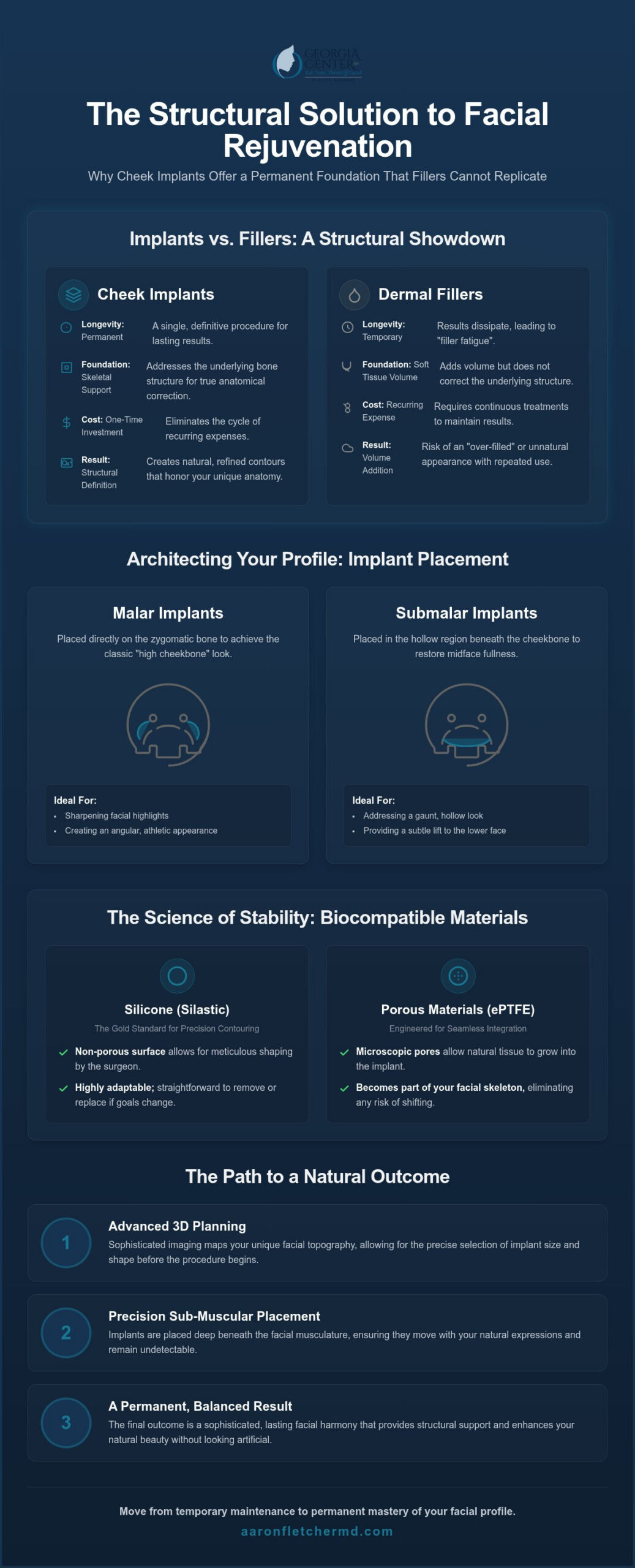
Malar implants are the gold standard for patients seeking the high cheekbone look. They’re placed directly on the zygomatic bone to sharpen the facial highlights and create a more angular, athletic appearance. Conversely, submalar implants address the gaunt look that often accompanies weight loss or natural aging. By filling the hollow area beneath the cheekbone, they provide a subtle lift to the lower face. For mature patients, a combined approach often yields the most balanced result, restoring both the bone-level structure and the soft-tissue volume. This distinction is vital, as The Foundation of Facial Harmony: Understanding Cheek Augmentation notes that implant shape must align with the patient’s existing skeletal contours.
The Aesthetic Philosophy of a Balanced Midface
Achieving a sophisticated result requires moving away from the over-filled look common with excessive injectables. Structural precision ensures that the enhancement remains subtle. Because cheek implants are placed beneath the facial musculature, they don’t interfere with your ability to smile or show emotion. They move with your face, not against it. This placement preserves natural expressions while providing a permanent lift. In many cases, these implants are used to support the results of a facelift or are paired with buccal fat removal to create a more sculpted, refined midface.
Surgical Materials and Customization: Choosing Your Implant
Modern facial plastic surgery has moved beyond generic, one-size-fits-all shapes. Today, cheek implants are selected through a lens of high-level expertise and advanced surgical methodology. We utilize sophisticated 3D imaging during the pre-surgical phase to map your unique facial topography. This allows us to visualize how different sizes and shapes will interact with your skeletal structure before any procedure begins. Biocompatibility is our primary focus. The material must coexist harmoniously with your body to ensure long-term health and stability.
Silicone (Silastic) Implants: The Gold Standard for Contouring
Silicone, often referred to as Silastic, has a long-standing history of safety in facial surgery. Its non-porous nature is a distinct advantage for those seeking precise definition. Because it doesn’t integrate with the surrounding tissue, a surgeon can modify the implant’s shape with extreme accuracy during the procedure. It’s also the most straightforward option to remove or replace if your aesthetic goals change as you age. Many patients find security in this flexibility, knowing their cheek implants provide permanent results that remain adaptable.
Porous Materials and Tissue Integration
Porous materials like ePTFE and porous polyethylene offer a different biological approach. These implants feature microscopic pores that allow your natural tissue to grow into the material. This integration creates a remarkably stable bond. It virtually eliminates the risk of the implant shifting or migrating over time. While this makes them more permanent in their placement, the resulting feel is incredibly natural. The implant essentially becomes a structural extension of your facial skeleton.
Choosing between these materials requires a meticulous evaluation of your anatomy. Understanding The Procedure: Precision, Placement, and Recovery is a vital step in your educational journey. If you’re seeking a comprehensive rejuvenation, these structural enhancements often provide the necessary foundation when paired with a facelift to address more profound volume loss.
Implants vs. Fillers: Addressing Filler Fatigue
Many patients begin their aesthetic journey with temporary injectables, viewing them as a low-commitment entry point to facial rejuvenation. However, a phenomenon known as filler fatigue has become increasingly common among long-term patients. This occurs when the repeated application of soft-tissue fillers leads to a heavy, over-volumized appearance rather than the refined lift originally intended. While cheek implants provide a permanent structural foundation, traditional hyaluronic acid fillers typically have a limited lifespan of 6 to 12 months before the body naturally resorbs them. Patients often turn to cheek augmentation surgery to escape this cycle of maintenance and achieve a result that mimics the density of bone rather than the buoyancy of a gel.
The cost-benefit analysis of this transition is significant. Investing in a one-time surgical procedure often proves more economical over a decade than the cumulative costs of bi-annual injectable maintenance. Beyond the financial aspect, the structural integrity of an implant offers a level of definition that liquid treatments cannot reach. Fillers expand the soft tissue, which can sometimes blur the very features you’re trying to highlight. In contrast, an implant provides a stable anchor that supports the overlying facial architecture from beneath.
Why Fillers Can Sometimes Lead to an Unnatural Appearance
Injectable fillers are excellent for fine lines, but they have limitations when used to create major structural changes. When too much volume is added to the midface, it can result in “pillow face,” where the cheeks look puffy or “doughy” rather than sculpted. This happens because fillers add mass to the skin and fat layers, which can migrate or sag under the weight of gravity over time. They lack the rigidity needed to create sharp bone definition. If you’re seeking the look of high, angular cheekbones, adding more soft-tissue volume often moves you further away from that goal.
Cheek Implants as a Solution for Permanent Structural Loss
Transitioning to a permanent surgical solution allows for the restoration of the “ogee curve,” the elegant S-shaped contour of a youthful face seen from a three-quarter view. This curve requires a specific convexity at the cheekbone that only a solid structure can reliably provide. Cheek implants offer long-term stability without the risk of migration or the need for frequent touch-ups. For many, this procedure is the logical next step after years of temporary fixes. It provides a sense of clarity and resolution, allowing you to enjoy your results without wondering when they’ll begin to fade. For those also concerned with lower facial fullness, this structural support can be beautifully complemented by buccal fat removal to further refine the midface silhouette.
The Procedure: Precision, Placement, and Recovery
Achieving a balanced and symmetrical midface requires more than just clinical skill; it demands a meticulous eye for detail. During the surgical planning phase, we evaluate the precise placement required to enhance your natural bone structure without overwhelming your features. Most patients undergo the procedure under general anesthesia or deep IV sedation to ensure absolute comfort and safety throughout the process. One of the most significant advantages of this modern approach is the use of intra-oral incisions. By accessing the midface through the inside of the upper lip, we can place cheek implants with medical precision while leaving zero external scarring.
Step-by-Step: What Happens During Surgery
The procedure begins by creating a precise pocket just above the malar bone. This pocket is tailored to the exact dimensions of the chosen implant to prevent any shifting. Once the space is prepared, the implant is carefully positioned and secured directly to the underlying bone structure. This fixation is a critical step in ensuring long-term stability and a natural-looking outcome. We then close the incisions using dissolvable sutures, which eliminates the need for future suture removal and minimizes irritation to the delicate oral tissues.
The Recovery Timeline: What to Expect
Recovery is a gradual process that prioritizes healing and comfort as your cheek implants integrate with your natural anatomy. You’ll likely experience the most significant swelling and bruising within the first 48 hours. We recommend keeping your head elevated and using cold compresses to manage these initial symptoms. Because the incisions are located inside the mouth, maintaining meticulous oral hygiene is essential to prevent infection. You’ll need to follow a soft-food diet for approximately one week to avoid disrupting the surgical site. Most patients feel confident returning to social activities within 7 to 10 days, though your final, refined facial contours will continue to settle over the next few months.
If you’re ready to move beyond temporary maintenance and seek a permanent solution for midface volume, learn more about our approach to cheek augmentation surgery and how it can restore your facial harmony.
Achieving Natural Results: A Meticulous Surgical Artistry
The ultimate goal of midface enhancement isn’t to create a face that looks “done,” but to restore a profile that feels inherently balanced and youthful. Dr. Aaron Fletcher, MD approaches every procedure with a philosophy centered on “whispering” results. This focus on refinement over radical change ensures that the transition is subtle enough to go unnoticed by the casual observer while providing a profound sense of rejuvenation to the patient. True success in cheek implants lies in the surgeon’s ability to marry clinical precision with an artistic understanding of facial shadows and highlights.
The Synergy of Midface and Lower Face Contouring
A holistic approach often yields the most sophisticated outcomes. While cheek implants provide the necessary upper-midface projection, they’re frequently integrated with buccal fat removal to address fullness in the lower cheeks. This combination creates a heart-shaped facial silhouette that many patients find highly desirable. By removing excess fat pads while simultaneously adding structural volume above, we can achieve a sculpted, high-definition look that addresses both sagging skin and structural hollowing in a single surgical plan.
For patients experiencing more advanced signs of aging, cheek augmentation serves as a vital support system for the results of a facelift. While a lift repositions sagging soft tissues, it cannot replace the bone-level volume that is lost over decades. Adding an implant provides the framework upon which the lifted skin can rest, ensuring the results look natural rather than stretched. We may also suggest pairing these procedures with a chin augmentation to balance the profile or using fat transfer as a soft-tissue refinement to smooth the transition between the implant and the surrounding anatomy.
Selecting Your Surgeon: The Clinical and Artistic Balance
Choosing a specialist for facial reconstruction requires looking for a unique blend of qualifications. Board certification in both otolaryngology and facial plastic surgery is essential, as it indicates a deep understanding of the complex internal and external structures of the head and neck. This dual expertise allows a surgeon to navigate the midface with a technician’s precision while maintaining a scholar’s focus on aesthetic harmony. When evaluating potential practitioners, it’s important to review before-and-after portfolios specifically for natural-looking outcomes that respect the patient’s original character.
A comprehensive consultation is the foundation of this journey. It’s the time to align your aesthetic goals with a realistic surgical approach. Dr. Aaron Fletcher, MD prioritizes transparency during these discussions, ensuring that every question is answered and that the patient feels secure in the methodical plan created for them. This patient-centered perspective is what moves a procedure from a simple medical event to a life-enhancing transformation.
Defining Your Lasting Facial Profile
Transitioning from the cycle of temporary fillers to the stability of cheek implants is a significant step toward permanent facial harmony. It’s a decision that prioritizes the underlying bone structure rather than just surface volume, helping you achieve a refined look that avoids the risks of over-injection. This structural foundation supports your features for a lifetime, ensuring your aesthetic results remain consistent and natural. By moving beyond maintenance, you’re investing in a definitive solution that respects your unique anatomy.
Choosing a board-certified facial plastic surgeon who possesses expertise in both aesthetic and reconstructive surgery is essential for this journey. Dr. Fletcher brings nearly a decade of surgical experience and a meticulous attention to facial symmetry to every procedure. His philosophy focuses on subtle refinement, providing you with the security that comes from expert care. If you’re ready to explore a permanent path to midface rejuvenation, we invite you to schedule a comprehensive consultation with Dr. Fletcher to discuss your facial rejuvenation goals. We look forward to helping you achieve a look that feels authentically yours.
Frequently Asked Questions
How much do cheek implants cost on average?
The total cost of the procedure depends on several variables including the surgeon’s expertise, the surgical facility fees, and the specific type of implant material used. Because this is a one-time surgical investment, it often proves more cost-effective over a decade than the cumulative expense of bi-annual injectable maintenance. We provide a personalized cost breakdown during your consultation to ensure transparency and help you plan for your long-term aesthetic goals.
Are cheek implants permanent, or do they need to be replaced?
Cheek implants are designed to be a permanent solution for midface contouring. Unlike dermal fillers that dissipate over six to twelve months, these biocompatible prosthetics provide a lasting foundation that doesn’t require regular touch-ups. They are intended to stay in place indefinitely unless you choose to have them removed for aesthetic reasons. This permanency offers a sense of stability and resolution for patients seeking to escape the cycle of temporary treatments.
Can cheek implants be removed if I don’t like the results?
Yes, these implants can be removed or replaced if your aesthetic goals change over time. Silicone options are particularly easy to remove because they don’t integrate with your natural tissue, allowing for a straightforward secondary procedure. While the goal is a permanent enhancement, knowing that the results are reversible provides many patients with peace of mind. We discuss all long-term considerations during your initial planning stages to ensure you feel confident in your decision.
What is the difference between cheek implants and a midface lift?
A midface lift is designed to pull sagging skin and underlying muscle back to a higher position, whereas implants add actual volume to the skeletal structure. If your primary concern is skin laxity, a lift may be appropriate; however, if you lack the underlying bone prominence, implants provide the necessary foundation. Many patients choose to combine these techniques to address both the descent of soft tissue and the loss of structural midface volume simultaneously.
Will I have visible scars after cheek implant surgery?
Most patients won’t have any visible external scarring after the procedure. We typically use intra-oral incisions made inside the upper lip to create the necessary pocket for the cheek implants. This approach allows for medical precision in placement while keeping the surgical site completely hidden from view. By avoiding external cuts, we ensure that your results look natural and your privacy is maintained throughout the healing process.
Are cheek implants safe, and what are the potential risks?
While the procedure is generally safe, potential risks include infection, temporary numbness, or implant shifting. We mitigate these concerns by using sterile, biocompatible materials and securing the implants directly to the malar bone. Choosing a board-certified surgeon with extensive experience in facial anatomy is the most critical factor in minimizing complications. Our methodical approach to surgical planning ensures that every safety protocol is followed to prioritize your health and quality of life.
How do I know if I am a good candidate for cheek augmentation?
You’re likely a good candidate if you’re dissatisfied with midface volume loss or lack natural definition in your cheekbones. Many of our patients seek this procedure to correct facial asymmetry or to replace the recurring need for temporary fillers. Ideal candidates should be in good overall health and have realistic expectations for subtle, sophisticated results. A comprehensive consultation allows us to evaluate your bone structure and determine the best approach for your unique anatomy.
Can I get cheek implants at the same time as a rhinoplasty?
It’s very common to perform cheek augmentation alongside other procedures such as rhinoplasty or a facelift. Combining these surgeries allows you to achieve a more balanced facial profile in a single session while only undergoing one recovery period. Improving the midface structure often provides the necessary architectural support to complement a newly refined nose. We carefully plan these multi-procedure surgeries to ensure all facial features work together in perfect harmony.