
What if the lowest chin augmentation cost isn’t the most useful estimate to compare? Online figures can describe different surgical approaches or leave out fees, making it hard to tell what you’d actually be comparing. It’s reasonable to want a clearer picture before deciding how to move forward.
A personalized estimate reflects more than a headline number. It depends on your anatomy, goals, surgical plan, and the services included. An implant and a procedure that repositions the chin bone involve different planning, so the options and their costs should be considered in the context of your individual assessment.
This article explains the main factors that shape a surgical estimate, the fees it may include, and how to compare options by scope rather than price alone. You’ll also find practical questions to bring to a consultation, including how to connect the proposed approach with your goals. Reviewing the plan and its costs together can help you make an informed decision without choosing based on a number alone.
Key Takeaways
- Chin augmentation cost depends on the surgical plan and related care, so online figures may not be directly comparable.
- Review which professional, facility, anesthesia, and follow-up services an estimate includes.
- A chin implant and sliding genioplasty use different surgical approaches and require individualized planning.
- Compare estimates by confirming they describe the same procedure, then reviewing the services included.
- Use a consultation to discuss how your goals and facial assessment inform the surgical plan and estimate.
What Does Chin Augmentation Cost, and Why Is There No Single Estimate?
Online figures can be difficult to compare when they describe different surgical plans or include different parts of care. One estimate may refer mainly to the surgeon’s fee, while another may include additional services. The chin augmentation cost is best understood as a personalized estimate shaped by the planned procedure and associated care, not as one standard price that applies to every patient.
A general figure can offer a starting point as you learn what may affect an estimate. It can’t predict your own cost without considering your facial anatomy, goals, recommended approach, and the details of the surgical setting. The useful question is not only “How much?” but also “What does this estimate cover?”
What can a chin augmentation estimate include?
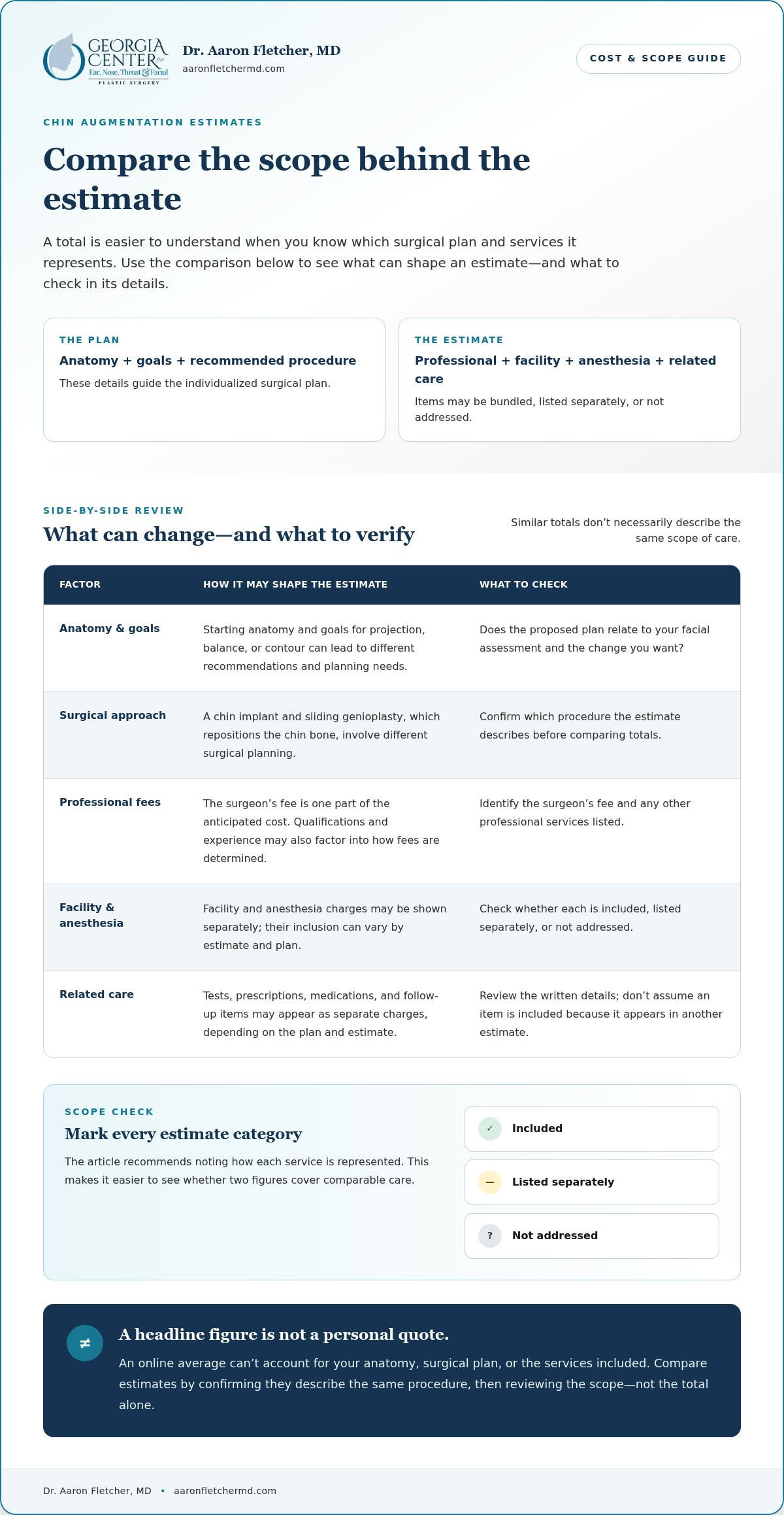
An estimate may list the surgeon’s fee, anesthesia, and surgical-facility charges separately, which helps show how different services contribute to the total. Medications, tests, or follow-up items may also appear as separate charges, depending on the plan and how the estimate is organized. Since inclusions vary by procedure and estimate, two totals may not represent the same scope of care.
As you review an estimate, mark each category as included, listed separately, or not addressed. This gives you a clearer basis for comparison than the total alone. A broad overview of surgical approaches and related concepts is available in Genioplasty (Chin Augmentation), though an individual estimate should relate to a specific treatment plan.
Why two patients may receive different estimates
Patients can have different starting anatomy and different goals for chin projection, balance, or contour. Those details may lead to different recommendations and planning needs. The surgeon’s experience and the surgical setting can also influence professional and facility fees. An estimate is therefore connected to both the proposed procedure and the circumstances in which care is planned.
For example, two people seeking a more balanced profile may not need the same degree or type of change. Their estimates could differ because their anatomy and surgical plans differ, even if they describe their goals in similar terms. That variation doesn’t make one estimate automatically more appropriate. It means the figures need context.
An online average can help orient your research, but it isn’t a personal quote because it can’t account for your anatomy, surgical plan, or the services included. During an individualized facial assessment, Dr. Aaron Fletcher can discuss how your goals relate to the surgical options and address your cost questions. Reviewing the proposed plan alongside the estimate helps you understand what you’re comparing, rather than relying on a headline figure alone.
Which Factors Shape Chin Augmentation Cost?
A surgical estimate is built from several parts of a plan, not just the surgeon’s fee. The chin augmentation cost can reflect the selected approach, professional services, the surgical setting, anesthesia, and related care. Because estimates may organize or bundle these categories differently, compare what each one covers instead of assuming that similar totals describe the same services.
The American Society of Plastic Surgeons outlines common components, including surgeon, anesthesia, and facility fees, in its overview of chin surgery costs. This offers useful context, but your own estimate should connect each item to your individual surgical plan.
The surgical plan and setting
The recommended approach influences the planning involved and which estimate components apply. A plan tailored to your anatomy and goals may differ from another patient’s, even if both are considering chin augmentation. That is why a cost discussion should begin with the proposed procedure, not a price detached from the clinical plan.
Facility and anesthesia fees may be listed separately, but they are not universal inclusions in every estimate. The surgical setting and anesthesia plan are relevant to the services being arranged. During a consultation, Dr. Fletcher can explain which items apply to your plan and how they are represented in the estimate.
Professional fees and related expenses
The surgeon’s fee is one component, not necessarily the full anticipated cost of surgery. It relates to the planned procedure and professional care involved. Qualifications and experience may also be factors in how fees are determined. Dr. Aaron Fletcher is board-certified in otolaryngology and has nearly a decade of surgical experience. An individualized discussion can clarify how the proposed plan relates to the estimate.
Other possible categories include tests, prescriptions, and follow-up care. Whether these appear in the estimate, and how they are itemized, can vary. Don’t assume a category is included simply because it appears in another patient’s estimate. Review the written details and identify which items are included, listed separately, or not addressed.
Compare the surgical plan, professional fees, facility, anesthesia, and related care to understand what each estimate represents. This framework can help you identify differences in scope without treating any category as a standard inclusion.
- Surgical plan: Confirm which procedure the estimate describes.
- Professional fees: Identify the surgeon’s fee and any other professional services listed.
- Setting and anesthesia: Note whether these are separate line items or addressed another way.
- Related care: Look for tests, prescriptions, and follow-up items.
Dr. Fletcher’s approach to chin augmentation starts with an individualized assessment, creating an opportunity to connect your goals, anatomy, and cost questions. You can learn more about chin augmentation with Dr. Fletcher as you consider the procedure and its planning.
Chin Implant or Sliding Genioplasty: How the Surgical Plan Affects Cost
Two estimates for chin augmentation are only meaningfully comparable if they describe a similar surgical approach. A chin implant and sliding genioplasty both address chin shape or projection, but they do so in different ways. That difference affects the surgical plan, so estimates may reflect different services and planning needs. Neither approach is automatically the right choice based on a headline fee.
How implant surgery and genioplasty differ
In chin implant surgery, an implant is placed to enhance chin projection. Sliding genioplasty changes the position of the patient’s own chin bone. It is a bone-repositioning procedure, not another name for implant placement. Each approach has distinct clinical considerations, and an estimate should identify which procedure it covers.
| Approach | Broad purpose | Estimate questions |
|---|---|---|
| Chin implant | Enhance chin projection with an implant | Does the estimate describe implant placement, and which related services are included? |
| Sliding genioplasty | Reposition the chin bone | Does the estimate specifically cover bone repositioning and its associated planning and care? |
The table provides a starting point, not a recommendation. A facial assessment helps determine which options are relevant to your anatomy and goals. For instance, someone seeking greater projection may have different considerations from someone whose desired change involves the position or overall balance of the chin. The surgeon’s clinical judgment guides how those goals translate into a surgical plan.
When comparison matters more than a headline fee
Before comparing totals, check whether both estimates name the same procedure. An implant-based plan and a bone-repositioning plan should not be treated as equivalent simply because both are described as chin surgery. Then compare the scope of each estimate: professional services, facility and anesthesia arrangements, and any related care it addresses. If the procedures or inclusions differ, the totals aren’t a like-for-like comparison.
This is why chin augmentation cost can’t be interpreted apart from the treatment plan. Anatomy, the desired change, and clinical judgment all inform which approach is considered. The estimate follows that plan. It should not determine the plan by itself. A lower headline figure may describe a different procedure or a narrower set of services, rather than the same care at a better value.
During a consultation, Dr. Aaron Fletcher can assess your facial features, discuss your goals, and explain the surgical options relevant to you. Use that conversation to understand what each proposed approach is intended to address and how its estimate is structured. A clear comparison begins with the procedure, then considers the services and details associated with it.
How to Compare Chin Augmentation Estimates Without Focusing Only on Price
A useful comparison starts with the details behind each total. Two estimates can look similar while describing different procedures, or appear far apart because one lists services separately and the other groups them together. A checklist can help you review the scope, note unanswered questions, and make your consultation more specific.
A practical checklist for reviewing an estimate
Review each estimate in the same order. If an item isn’t addressed, record it as a question rather than assuming it is included.
- Confirm the procedure. Check that each estimate describes the same surgical approach and intended plan. An implant procedure and a sliding genioplasty are different operations, so their totals may not be directly comparable.
- Review professional fees. Identify the surgeon’s fee and any other professional services listed. Note whether the estimate presents these as separate line items or groups them together.
- Compare facility and anesthesia details. Look for fees associated with the surgical setting and anesthesia. Record whether each is itemized, included in a broader charge, or not addressed.
- Check follow-up arrangements. See what the estimate says about follow-up care. Don’t assume it covers the same visits or services as another estimate unless the details say so.
- Note exclusions and additional expenses. Write down any stated exclusions, anticipated tests, prescriptions, or other items listed separately. This helps clarify what the total represents.
Questions that clarify the full financial picture
Once you’ve reviewed the documents, bring any unclear points to your consultation. The goal is to understand how the estimate relates to your recommended care and which services it covers, not to evaluate a headline figure on its own.
- How does this estimate relate to the recommended procedure and planned surgical setting?
- Which professional, facility, and anesthesia services are included, and which may be billed separately?
- Are tests, prescriptions, or follow-up care addressed in this estimate, or listed as separate expenses?
- Are there assumptions in the estimate that depend on the final surgical plan?
These questions can also keep the conversation centered on your goals. Chin projection is one part of facial appearance, and an individualized assessment helps connect the proposed surgical approach with the broader topic of chin augmentation and facial balance. Comparing the plan and its included services gives you a more meaningful basis for evaluating chin augmentation cost than looking at totals alone.
For an individualized discussion of your goals, facial assessment, and surgical plan, schedule a chin augmentation consultation with Dr. Fletcher.
What to Expect When Discussing Chin Augmentation Cost With Dr. Fletcher
A consultation puts cost questions in the context of your goals and facial assessment. Rather than beginning with a number alone, the discussion can consider what you hope to change, your facial proportions, and which surgical approach may be relevant. Asking about the estimate is a normal part of making an informed decision. It doesn’t commit you to surgery.
How an individualized discussion brings clarity
Your goals help frame the conversation, while an assessment of facial proportions and relevant health history provides clinical context. Together, these details inform discussion of possible surgical plans. Not every approach will suit every person, and a consultation doesn’t presume that surgery is the right next step. Its purpose is to clarify what may be appropriate for your circumstances.
Once a plan is discussed, ask how it relates to the estimate. For example, ask which professional services, surgical-setting arrangements, and related care are reflected in the document, and what may be addressed separately. This connects the estimate to the proposed care instead of treating it as a stand-alone figure.
Dr. Aaron Fletcher is board-certified in otolaryngology and has nearly a decade of surgical experience. He can discuss the considerations behind a proposed plan without promising a particular result. A measured conversation gives you room to understand options, potential benefits, and relevant considerations before deciding how to proceed.
A considered next step for prospective patients
To make the discussion more useful, bring any estimate you’re reviewing and note what you want clarified. It may help to write down your priorities beforehand, especially if you’re weighing different changes to your chin or profile. Clear questions make it easier to understand how your goals, assessment, and surgical plan relate.
- What does the proposed approach aim to address?
- How does my facial assessment inform the plan?
- Which items are included in the estimate, and which may be separate?
- What benefits and considerations should I understand before making a decision?
These are appropriate questions, not a commitment to proceed. Understanding chin augmentation cost in the context of a personalized plan can help you decide whether the option feels right for you. If you’re considering chin augmentation, a consultation with Dr. Fletcher can help you discuss your goals and receive guidance tailored to your needs.
Take the Next Step With Greater Clarity
Deciding whether to pursue chin augmentation is personal, and the right pace is the one that gives you room to consider your goals and questions. Rather than treating chin augmentation cost as the decision by itself, use the estimate discussion to understand how a proposed plan relates to what matters to you. Take time to reflect on the information, ask for clarification, and decide whether you feel comfortable moving forward.
A consultation with Dr. Aaron Fletcher offers an opportunity to discuss chin augmentation in the context of your individual needs. Bring the questions that would help you feel informed, whether they concern the surgical plan, estimate details, or considerations involved in your decision. The aim is a thoughtful conversation that helps you understand your options, not pressure to proceed.
Explore chin augmentation with Dr. Fletcher and take a considered next step toward a decision that feels right for you.
Frequently Asked Questions
Does health insurance cover chin augmentation?
Coverage depends on your insurance plan and the circumstances of the procedure, so don’t assume chin augmentation will be covered. Before making financial decisions, contact your insurer to ask how your specific plan treats the proposed surgery and what documentation it requires. You can also discuss whether any medical considerations apply during your consultation. This helps separate questions about insurance benefits from the surgical estimate itself.
Can chin augmentation be combined with rhinoplasty?
Chin augmentation may be considered alongside rhinoplasty, but whether combining procedures is appropriate depends on your health, facial assessment, goals, and surgical plan. For example, someone considering changes to both the nose and chin can discuss how each feature relates to their overall profile. A consultation can clarify whether one or both procedures are relevant and what a combined plan would involve, without assuming that every patient is a candidate.
Is chin augmentation permanent?
Chin augmentation can create a lasting change, but no surgical result should be assumed to remain exactly the same forever. The details depend on the approach, healing, and individual changes over time. Natural aging can also affect facial appearance. During your consultation, ask what durability means for the specific plan being considered, whether future monitoring may be relevant, and what circumstances could lead to additional treatment or revision.
What should I ask before agreeing to a chin augmentation estimate?
Before agreeing to an estimate, make sure you understand the procedure it describes and what could change the plan or total. Ask whether the estimate has an expiration date, how unexpected changes are handled, and which expenses may be billed separately. Clarify any payment deadlines or cancellation terms in writing. Understanding these details can help you assess chin augmentation cost in the context of your decision, rather than feeling rushed by a number.
How long is recovery after chin augmentation?
Recovery varies with the surgical approach and individual healing, so your surgeon is best placed to explain the expected course for your plan. Ask what swelling, discomfort, or temporary changes are typical, when follow-up is expected, and which activities may need to be limited. Before surgery, arrange practical support for the early recovery period and keep your post-operative instructions accessible. Contact your care team if you have concerns as you heal.
Can chin augmentation improve facial balance?
Chin augmentation may improve the relationship between the chin and other facial features for some patients, but the effect depends on individual anatomy and goals. A facial assessment considers proportions from more than one angle, including how the chin relates to the jaw and profile. Discuss the specific change you hope to see and ask how the proposed plan addresses it. The aim is an informed recommendation, not a guaranteed aesthetic outcome.