
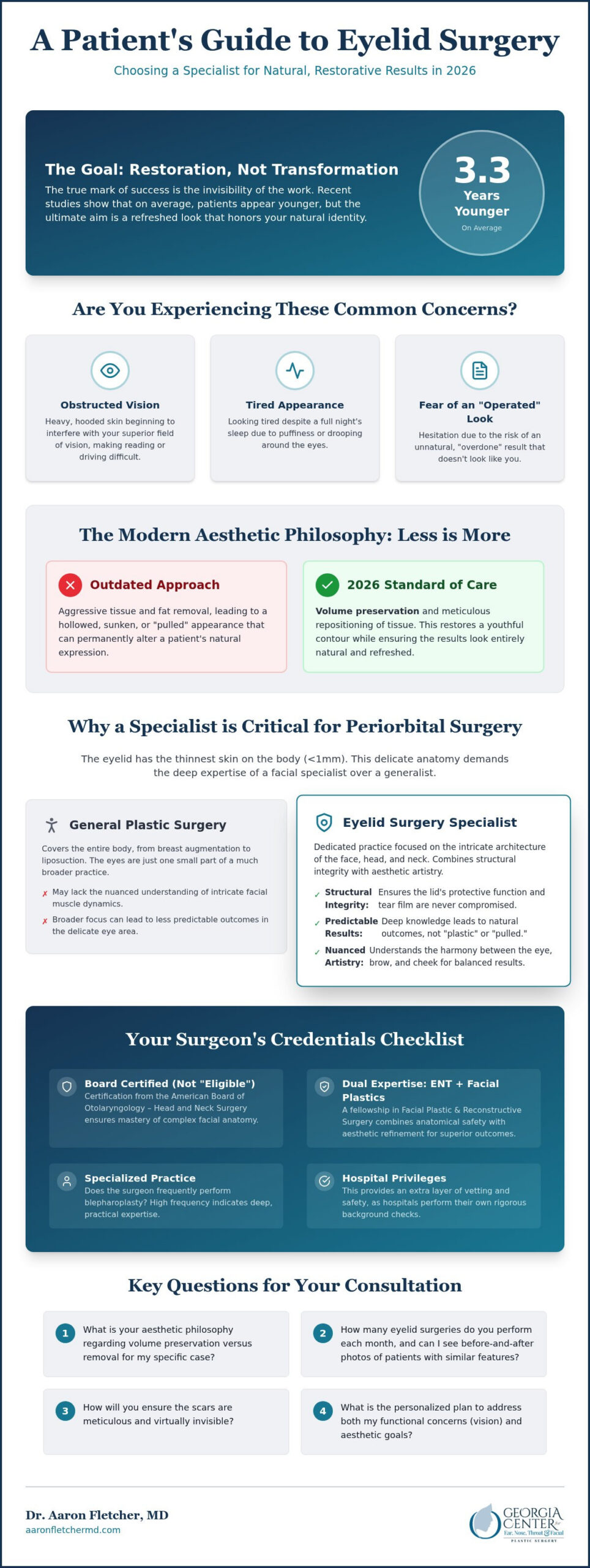
Recent multicenter studies indicate that patients appear an average of 3.3 years younger following blepharoplasty, yet the true mark of success in 2026 isn’t a specific number; it’s the invisibility of the work itself. You’ve likely felt the frustration of looking tired despite a full night’s sleep, or perhaps you’re managing a heavy, hooded gaze that’s beginning to obstruct your field of vision. It’s natural to feel a sense of hesitation when choosing an eyelid surgery surgeon, especially with the fear of an “operated” look or the confusion surrounding various medical credentials.
You deserve a result that feels like a restoration rather than a transformation. In this guide, you’ll learn how to identify a top-tier specialist by evaluating board certifications and the modern shift toward volume preservation over aggressive tissue removal. We’ll explore how the unique clinical synergy of ENT precision and plastic surgery expertise creates a safer, more predictable path to a youthful appearance. By understanding these technical nuances, you can move forward with the quiet confidence that your care is in the hands of a meticulous scholar and a dedicated practitioner.
Key Takeaways
- Discover why the clinical intersection of otolaryngology and facial plastic surgery provides a superior foundation for periorbital rejuvenation.
- Learn to verify essential 2026 credentials, including board certification and specialized fellowship training, to ensure your eyelid surgery surgeon possesses the necessary expertise.
- Identify the “overdone” trap by evaluating a surgeon’s commitment to volume preservation and meticulous, invisible scarring.
- Prepare for your consultation with specific questions regarding surgical frequency and personalized plans for your unique skin type.
- Understand how a meticulous, patient-centered approach honors your individual identity while restoring a youthful, rested appearance.
The Role of a Specialist Eyelid Surgery Surgeon
An eyelid surgery surgeon is a specialist who dedicates their practice to the intricate architecture of the periorbital region. This area is unique because the eyelid consists of the thinnest skin on the human body, often measuring less than one millimeter in thickness. Because of this fragility, even minor adjustments can have profound impacts on both your appearance and your ocular health. A dedicated specialist focuses on correcting upper lid drooping, known as ptosis, and addressing lower lid puffiness caused by fat prolapse. It’s a discipline where clinical precision meets restorative artistry.
Aesthetic vs. Functional Blepharoplasty
While many seek Blepharoplasty to restore a rested and youthful appearance, the procedure often serves a dual purpose. Functional blepharoplasty becomes medically necessary when sagging skin or muscle laxity begins to obstruct your superior field of vision. This can make daily tasks like driving or reading surprisingly difficult. A top-tier eyelid surgery surgeon understands that these needs are rarely separate. By addressing the structural causes of hooded eyes, they can improve your quality of life while simultaneously refining the aesthetic contour of the face. This holistic approach ensures you don’t just look better, but you see the world more clearly as well.
Why General Plastic Surgery May Not Be Enough
The periorbital region is a complex landscape of vital ocular structures, delicate nerves, and dynamic muscles. Choosing a specialist over a generalist is often a matter of safety and long-term satisfaction. General plastic surgery covers the entire body, but the eyes require an intimate knowledge of facial muscle dynamics that only a facial specialist can provide. In 2026, the standard of care has shifted toward preservation rather than removal.
- Structural Integrity: Specialist training ensures the lid’s protective function and tear film distribution are never compromised.
- Predictable Results: Deep knowledge of facial anatomy leads to outcomes that look natural rather than “pulled” or “plastic.”
- Nuanced Artistry: Understanding how the eye interacts with the brow and cheek is essential for a balanced, harmonious result.
Subtle changes in the position of the orbicularis oculi muscle can mean the difference between a refreshed look and a permanent change in your natural expression. You aren’t just looking for a technician; you’re seeking a scholar who understands the biological and aesthetic weight of every stitch. This specialized focus is what allows for the “invisible” results that patients prioritize today.
Credentials to Verify: Board Certification in 2026
Selecting an eyelid surgery surgeon requires a methodical review of their professional standing. In 2026, the distinction between a practitioner who performs these procedures and a board-certified specialist is sharper than ever. When you begin your search, prioritize verification of credentials from the American Board of Otolaryngology – Head and Neck Surgery. This certification ensures the surgeon has mastered the complex anatomy of the head and neck, providing a foundation of safety for delicate periorbital work.
It’s vital to distinguish between “board-eligible” and “board-certified.” A board-eligible surgeon has completed their residency but hasn’t yet passed the rigorous oral and written examinations required for full certification. By contrast, a board-certified specialist has demonstrated a peer-reviewed level of competency and commitment to the field. You should also confirm that your surgeon holds hospital privileges for blepharoplasty. Hospitals perform their own background checks and vetting, offering an additional layer of security that independent surgical centers might lack. Maintaining these standards in 2026 involves ongoing continuing medical education to stay abreast of the latest preservation-based techniques.
The Value of Dual Certification
Expertise in Otolaryngology (ENT) provides a unique advantage in eyelid surgery. This structural knowledge informs safer procedures by accounting for the functional health of the eye and surrounding sinuses. When a surgeon combines this with a fellowship in Facial Plastic and Reconstructive Surgery, they achieve a synergy between structural integrity and aesthetic refinement. Dr. Aaron Fletcher, MD exemplifies this dual expertise, functioning as both a scholar of anatomy and a meticulous technician. This comprehensive background allows for a more nuanced approach to choosing a board-certified plastic surgeon who understands the intricacies of the facial framework.
Researching Surgical Society Memberships
Professional affiliations often signal a surgeon’s standing among their peers. Membership in the American Academy of Facial Plastic and Reconstructive Surgery (AAFPRS) is widely considered a gold standard. These organizations require members to adhere to strict ethical codes and participate in scholarly activity, such as peer-reviewed research or teaching. To deepen your understanding of how these credentials translate into surgical outcomes, you can consult Revitalizing Your Eyes: The Ultimate Guide to Blepharoplasty for more detailed insights. Engaging with a surgeon who is an industry leader ensures your care is guided by the most sophisticated and transparent practices available today. If you have questions about specific qualifications, a personalized consultation can provide the clarity you need to move forward with confidence.
Evaluating Aesthetic Philosophy and Natural Results
Technical proficiency is the baseline for any eyelid surgery surgeon, but aesthetic philosophy is what determines whether you’ll look like a younger version of yourself or like someone who has clearly “had work done.” In 2026, the industry has moved away from the aggressive tissue removal common in previous decades. Modern excellence focuses on volume preservation. The “Overdone Trap” occurs when a surgeon over-resects skin or fat, leading to a hollowed, skeletal appearance or a perpetually surprised expression. A sophisticated approach ensures the eyes complement the brow and midface, maintaining the delicate balance of your natural facial proportions.
Spotting Subtle Perfection in Portfolios
When reviewing a surgeon’s before-and-after gallery, look beyond the initial “wow” factor. Examine the symmetry of the eyelid crease and the positioning of the lash line. In high-quality results, scarring should be virtually invisible, tucked neatly into the natural folds of the skin. Pay close attention to the transition between the lower lid and the cheek, known as the tear trough. If the transition is smooth and lacks a harsh “step-off” appearance, the surgeon has likely mastered the art of fat repositioning. For many patients, combining facelifts with fat transfer can further enhance these results by restoring the midface volume that naturally supports the lower eyelids.
- Consistency: Do the results look similar across different ages and ethnicities?
- Individualization: Does every patient have the same “look,” or do the results honor their original identity?
- Lid Position: Is the lower lid resting naturally against the eye, or is there visible pulling?
The Importance of a Patient-Centered Consultation
A meticulous surgeon treats the consultation as a scholarly evaluation rather than a sales pitch. They will carefully assess your unique bone structure, skin elasticity, and the current position of your brow. This transparency is vital; a practitioner should be honest about what surgery can and cannot achieve for your specific anatomy. This level of detail is a key recommendation by the American Society of Plastic Surgeons when choosing a specialist.
You should look for a sense of “quiet confidence.” An expert doesn’t need to use aggressive marketing or hyperbolic claims to prove their worth. Instead, they provide clear, methodical answers to your questions and present a surgical plan tailored specifically to you. This individualized approach ensures that the restorative work feels authentic to your quality of life and personal history.
The Consultation: Questions for Your Eyelid Surgeon
The consultation represents a pivotal moment in your surgical journey. It’s the opportunity to move beyond digital research and engage with your potential eyelid surgery surgeon in a transparent, educational dialogue. A meticulous specialist welcomes these inquiries, as they reflect your commitment to a safe and natural outcome. During your meeting, your focus should be on the surgeon’s specific methodology and their ability to tailor the procedure to your unique facial anatomy.
Consider asking these specific questions to gauge their level of expertise:
- How many blepharoplasty procedures do you perform annually? High volume often correlates with refined technique and a deeper understanding of anatomical variations.
- What is your specific plan to minimize visible scarring for my skin type? An expert should explain how they utilize natural eyelid folds to conceal incisions effectively.
- Do you perform the procedure under local anesthesia or general sedation? Understanding the pharmacological approach helps you prepare for the surgical day with confidence.
- What are the most common risks you see, and how do you mitigate them? Transparency about potential complications like dry eye indicates a responsible and experienced practitioner.
- Can you explain the functional impact this will have on my eye health? A specialist can provide insights into how the procedure supports ocular protection and vision.
Understanding the 2026 Recovery Framework
In 2026, recovery protocols prioritize rapid healing through methodical post-operative care. Within the first 48 hours, you can expect to manage mild swelling and bruising with head elevation and cold compresses. Most patients find they can return to social activities within seven to ten days, though strenuous exercise is typically deferred for three weeks. A meticulous eyelid surgery surgeon will emphasize that protecting your investment requires a long-term commitment to sun protection and advanced skincare to maintain the integrity of the delicate periorbital skin.
Financial Transparency and Investment
A sophisticated patient understands that surgical fees reflect a surgeon’s scholarship, experience, and the safety of the clinical environment. While you may research the eye lifting surgery price, it’s essential to view this as a restorative investment rather than a commodity. Understanding the facelift cost can also provide a helpful benchmark for the level of investment required for high-level facial rejuvenation. Choosing a specialist based on value rather than “bargain” options ensures your safety and the subtlety of your results. If you are ready to begin this meticulous process, schedule your consultation with Dr. Fletcher to receive a personalized evaluation.
Why Dr. Aaron Fletcher is the Choice for Meticulous Eyelid Care
Dr. Aaron Fletcher brings a unique perspective to periorbital surgery as a board-certified otolaryngologist and facial plastic surgeon. In 2026, the demand for restorative work that preserves a patient’s identity has never been higher. Choosing an eyelid surgery surgeon with this dual background ensures your procedure is grounded in both anatomical scholarship and aesthetic refinement. His practice is built on a detail-oriented philosophy where the goal isn’t just to remove skin, but to restore the vibrant, rested look you remember without altering the essence of your face.
The Intersection of ENT and Facial Plastic Artistry
Many practitioners view blepharoplasty as a purely surface-level procedure. However, the eyelids serve a critical functional role in ocular health and tear film distribution. Dr. Fletcher’s training in otolaryngology provides a structural precision that general plastic surgeons may lack. This expertise allows him to address complex issues like ptosis or functional vision obstruction with a level of accuracy that prioritizes your quality of life. When structural integrity is the foundation, the resulting aesthetic outcomes are not only more natural but also significantly more durable. This dual-specialty approach addresses a common gap in care by ensuring the health of the eye is never sacrificed for the sake of appearance.
This scholarly approach extends to every aspect of the patient journey. You won’t find aggressive marketing or hyperbolic claims here. Instead, you’ll encounter a clinical environment defined by quiet confidence and empathetic reassurance. Dr. Fletcher functions as a caring guide, ensuring you understand every nuance of your surgical plan. This transparency helps mitigate the anxiety often associated with the recovery process, providing a steady, methodical path toward your desired outcome. It’s a commitment to modern excellence that views the patient as a whole person, not just a surgical candidate.
Taking the Next Step in Your Rejuvenation Journey
The decision to undergo facial surgery is deeply personal and deserves a comprehensive evaluation. During your consultation, your eyelid surgery surgeon will analyze your facial aesthetics with a meticulous eye, considering skin elasticity, bone structure, and muscle dynamics. This thoroughness ensures that your results are subtle and sophisticated, never appearing “operated” or unnatural. It’s about achieving a sense of harmony that honors your personal history while refreshing your gaze.
If you’re ready to experience a rejuvenation process rooted in clinical authority and modern excellence, the next step is a one-on-one discussion of your goals. Schedule your consultation with Dr. Aaron Fletcher today. By choosing a specialist who values the holistic well-being of his patients, you’re investing in a future of confidence and clarity.
Achieving Lasting Clarity and Confidence in 2026
Your journey toward a refreshed and youthful gaze begins with a single, informed decision. Selecting an eyelid surgery surgeon who balances structural precision with aesthetic artistry is the most critical step you’ll take. By prioritizing board certification and a philosophy of volume preservation, you ensure your results are both safe and restorative. You don’t have to choose between looking younger and looking like yourself; the right specialist makes both possible.
Dr. Aaron Fletcher is a board-certified otolaryngologist and fellowship-trained facial plastic surgeon who is deeply committed to achieving natural-looking aesthetic outcomes. His methodical approach prioritizes your quality of life, providing a transparent and scholarly experience from the initial evaluation through your final resolution. If you’re ready to restore your field of vision and your confidence, it’s time to take the next step with a practitioner who values meticulous care above all else.
Consult with a Board-Certified Eyelid Specialist today to explore a personalized plan tailored to your unique anatomy. You deserve a restorative experience that feels as natural as it looks.
Frequently Asked Questions
Is eyelid surgery performed by an ophthalmologist or a plastic surgeon?
Eyelid surgery is performed by various specialists, including ophthalmologists, general plastic surgeons, and facial plastic surgeons. However, a board-certified otolaryngologist who is also fellowship-trained in facial plastic surgery offers a distinct advantage. This combination ensures the surgeon understands the structural health of the head and neck while possessing the artistic skill required for periorbital rejuvenation. Choosing an eyelid surgery surgeon with this dual expertise prioritizes both your vision and your aesthetic outcome.
How do I know if my eyelid surgeon is board-certified?
You can verify a surgeon’s board certification by visiting the official websites of the American Board of Medical Specialties or specific boards like the American Board of Otolaryngology. It’s essential to confirm they are “board-certified” rather than “board-eligible,” as certification requires passing rigorous peer-reviewed examinations. A transparent practitioner will prominently display these credentials. Always cross-reference this information with hospital privileges to ensure a high standard of clinical safety and professional standing.
What is the difference between an oculoplastic surgeon and a facial plastic surgeon?
An oculoplastic surgeon is an ophthalmologist who specializes in the eyelids and the orbit, often focusing on reconstructive or tear duct issues. A facial plastic surgeon, particularly one with an ENT background, focuses on the aesthetic and structural harmony of the entire face. This specialist understands how the eyelids interact with the brow and midface. This broader perspective is vital for patients seeking a balanced, natural-looking result that honors their unique facial identity.
Will I look like a different person after eyelid surgery?
You should look like a rested, more youthful version of yourself rather than a different person. Modern surgical philosophy in 2026 emphasizes volume preservation and subtle adjustments over aggressive skin removal. A meticulous eyelid surgery surgeon focuses on restorative techniques that avoid the “pulled” or “plastic” look. The goal is to address signs of aging or functional obstruction while maintaining the characteristic features that make your face uniquely yours.
How long do the results of a professional blepharoplasty last?
While the aging process continues, the results of a professional blepharoplasty are long-lasting, often spanning ten to fifteen years. Lower eyelid surgery results are frequently considered permanent, as the fat pads removed or repositioned rarely return. Upper eyelid results may eventually be affected by further skin laxity or brow descent. Maintaining a healthy lifestyle and utilizing advanced skincare can help protect your surgical investment and extend the longevity of your refreshed appearance.
Can eyelid surgery be combined with other facial procedures like a brow lift?
Eyelid surgery is frequently combined with other procedures such as a brow lift or facelift to achieve a comprehensive rejuvenation. Addressing the eyelids in isolation may not resolve heaviness caused by a descending brow line. A specialist will evaluate your entire facial structure to determine if a multi-layered approach is necessary for aesthetic harmony. Combining these procedures can also streamline the recovery process, allowing you to achieve your desired outcome in a single surgical event.
What is the most important factor in choosing an eyelid surgery surgeon?
The most important factor is the synergy between the surgeon’s board certification and their aesthetic philosophy. You need a practitioner who possesses the technical scholarship of an industry leader and a commitment to subtle, restorative outcomes. Evaluate their portfolio for consistency and “invisible” results. Ultimately, your comfort level during the consultation and the surgeon’s ability to provide clear, methodical answers to your questions should guide your final selection for periorbital care.