
Camouflaging jowls with dermal fillers often creates a heavy, widened lower face rather than the sharp, youthful jawline you actually desire. While non-surgical options offer temporary camouflage, they cannot address the fundamental anatomical shift where fat and muscle have descended past the mandibular border. You’ve likely noticed that “disappearing neck” or the way downturned mouth corners make you look perpetually tired, even when you’re well-rested. It’s frustrating to feel like your reflection no longer reflects your internal vitality. A specialized facelift for jowls is the definitive way to achieve a clean, defined result that looks entirely natural.
This guide explores how modern surgical techniques move beyond simple skin tightening to achieve true structural restoration. By leveraging an “inside-out” understanding of facial anatomy, we can precisely target the ligaments and deep tissue layers responsible for lower face heaviness. You’ll discover how the latest surgical approaches in 2026 release these tethers to restore a crisp mandibular border. We will walk through the methodical approach to long-lasting rejuvenation, ensuring you have the clarity needed to reclaim a defined and confident profile. This transition from temporary fixes to definitive surgical excellence provides the security of knowing your results will stand the test of time.
Key Takeaways
- Learn how the weakening of the mandibular septum leads to tissue descent and why true restoration requires addressing these deep structural anchors.
- Discover why a specialized facelift for jowls, particularly the Deep Plane technique, offers superior results compared to traditional methods by releasing key facial ligaments.
- Identify the limitations of non-surgical options like dermal fillers, which can often lead to a heavy or “bulky” appearance in the lower face.
- Prepare for your surgical journey with a clear understanding of the 2026 recovery benchmarks, including what to expect during the first seven days.
- Explore the clinical advantages of choosing a double board-certified expert who combines ENT precision with advanced facial plastic surgery techniques.
The Anatomy of Jowls: Why Your Jawline Changes with Age
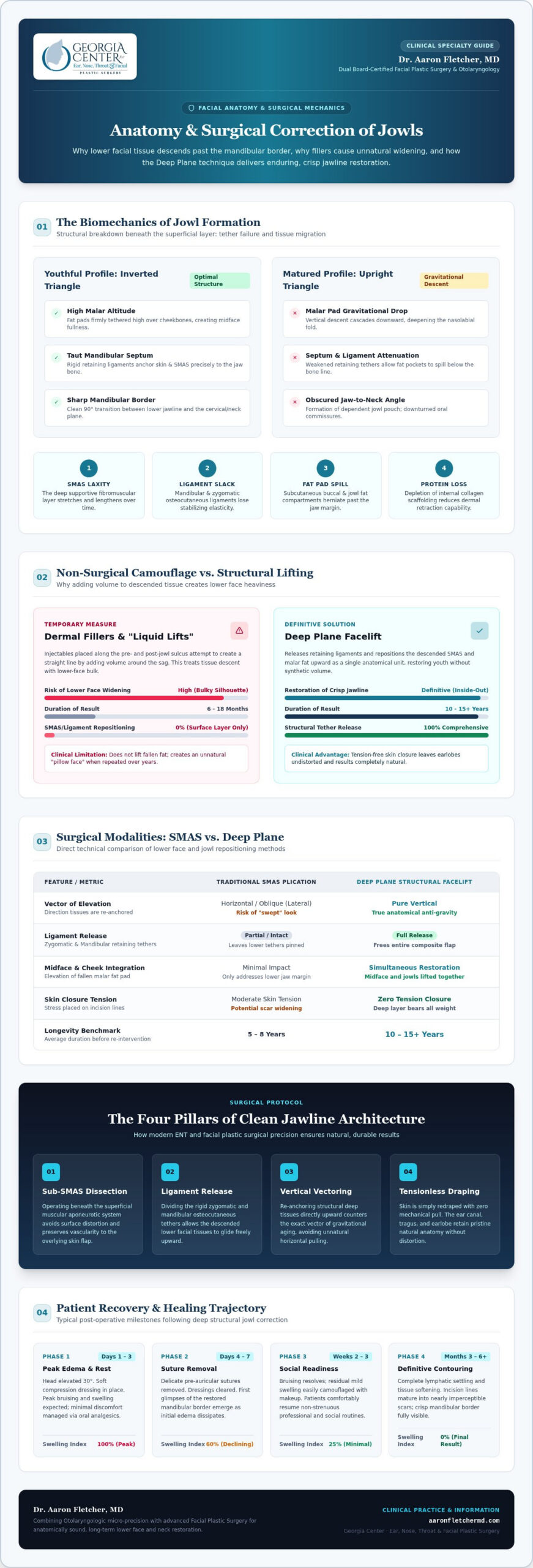
Jowls represent a specific anatomical change where facial fat and skin descend below the mandibular border, disrupting the once-sharp line of your jaw. This transition often creates a heavy appearance in the lower face, making you look tired or sad. To understand why this happens, we must look beneath the surface at the structural anchors of the face. The mandibular septum acts as a vital tether, holding tissues in place against the force of gravity. As we age, this anchor weakens, and the overlying fat pads begin to spill over the jawline, creating the visible bulge known as a jowl.
This process is compounded by the natural depletion of collagen and elastin. These proteins provide the internal scaffolding that keeps skin resilient. When they diminish, the face undergoes a triangular shift. In youth, volume is concentrated in the upper and midface, creating a heart-shaped or inverted triangle profile. Over time, this volume migrates downward. The face becomes bottom-heavy, and the once-defined mandibular border becomes obscured by redundant tissue. For many, a facelift for jowls is the only way to effectively reverse this structural migration and restore the face’s natural architecture.
The Descent of the Malar Fat Pad
When considering a facelift for jowls, it’s essential to recognize that true lower face rejuvenation requires addressing the midface. The malar fat pad, located in the cheek area, is subject to vertical descent rather than just horizontal sagging. As this pad slides downward, it adds weight to the lower face and deepens the nasolabial folds. Focusing solely on the jawline misses the root cause of the problem. Effective rhytidectomy techniques prioritize repositioning these deep fat pads to their original, higher altitude. This holistic approach ensures the jawline isn’t just pulled tight, but rather structurally restored to a youthful position.
Why Topical Treatments Fail to Correct Jowls
It’s vital to distinguish between skin quality and skin position. High-end creams and serums can improve texture, hydration, and fine lines on the surface. However, they’re physically incapable of penetrating the Superficial Musculoaponeurotic System (SMAS) layer. This deep fibrous network is what actually supports the face’s weight. Because jowling is a structural failure of these deep layers, topical interventions cannot lift the descended tissue. While medical-grade skincare is a valuable component of a holistic well-being plan, surgical intervention remains the definitive solution for restoring a sharp, clean jawline that reflects your internal vitality.
Surgical Solutions: Comparing Facelift Techniques for Jowls
Choosing a facelift for jowls involves a critical decision between traditional methods and modern structural restoration. The SMAS (Superficial Musculoaponeurotic System) facelift has long been the industry standard, focusing on tightening the fibrous layer beneath the skin. While effective for moderate aging, it often falls short for those with significant tissue descent. For a more comprehensive result, the Deep Plane technique has emerged as the definitive choice in 2026. This approach utilizes a vertical vector, lifting tissues upward rather than pulling them horizontally toward the ears. This distinction is vital for avoiding the “windblown” or “pulled” appearance that many patients fear, ensuring the results look natural and refreshed.
Surgical success also depends on tension-free skin closure. When the deep muscle and fat layers are properly repositioned, the skin can be draped without any strain. This technique is essential for creating nearly invisible scars and maintaining the integrity of the earlobe shape. For those beginning their research, a Mayo Clinic face-lift overview provides a helpful foundation for understanding these surgical preparations and realistic outcomes. By focusing on the underlying architecture rather than just the surface, surgeons can achieve a level of definition that was previously unattainable.
The Deep Plane Advantage for Jawline Definition
The primary advantage of the Deep Plane facelift for jowls lies in the release of key facial ligaments, such as the mandibular and zygomatic ligaments. By dividing these tethers, the surgeon can move the muscle and fat as a single, cohesive unit. This structural restoration results in a much sharper jawline and more durable outcomes. Research indicates that Deep Plane results typically last 10 to 15 years, significantly outperforming the 8 to 10 year lifespan of a standard SMAS plication. This longevity makes the procedure a worthwhile investment for those seeking a permanent solution to lower face heaviness.
The Role of the Neck and Platysmaplasty
A defined jawline is rarely achieved in isolation; the neck plays a supporting role in the overall architecture of the face. Most successful jowl corrections involve a platysmaplasty to address the underlying neck muscles. Techniques like the “corset platysmaplasty” tighten the platysma bands, eliminating the “turkey gobbler” effect and restoring a crisp 90 degree angle between the jaw and the neck. This comprehensive approach ensures that the rejuvenated jawline transitions seamlessly into a smooth, contoured neck. Evaluating these intricate anatomical layers requires a meticulous eye, and scheduling a consultation with Dr. Fletcher ensures your surgical plan is tailored to your unique facial structure.
Facelift vs. Non-Surgical Options for Jowl Contouring
You might initially seek non-surgical remedies to avoid downtime, yet these interventions often reach a point of diminishing returns. Dermal fillers, frequently marketed as “liquid lifts,” can inadvertently exacerbate the “heavy” look of your lower face. When volume is added to an area already burdened by tissue descent, the result is often a widened, unnatural appearance known as over-filled syndrome. Energy-based treatments like Ultherapy offer modest tightening by stimulating collagen, but they can’t reposition deep muscle layers or remove redundant skin. According to the American Society of Plastic Surgeons, surgical intervention remains the most effective method for addressing the structural changes that define prominent jowling.
While non-surgical cycles require you to repeat investments every 6 to 18 months, a definitive facelift for jowls provides structural correction that lasts a decade or longer. This makes the cost-to-longevity ratio of surgery significantly more favorable if you have moderate to advanced laxity. Thread lifts, while popular for their perceived ease, often yield fleeting results that last under a year, leading to high rates of re-intervention and frustration for patients seeking a permanent change.
When Fillers Make Jowls Look Worse
Injecting fillers along the pre-jowl sulcus aims to camouflage the dip between your chin and the jowl, but this often masks the problem rather than solving it. Adding more material to a sagging jawline only increases the gravitational pull on your skin; this eventually leads to a loss of the sharp mandibular border you’re looking for. True rejuvenation requires the removal of excess tissue and the vertical repositioning of fat pads. Structural integrity is the ultimate goal of surgical intervention.
The ‘Mini-Facelift’ for Early Jowling
If you’re in your late 30s to early 50s and experiencing the first signs of tissue descent, a mini-facelift serves as a precise middle ground. This procedure uses shorter incisions, typically hidden around the ear, and focuses specifically on the lower third of your face. Recovery is notably faster than a full deep plane lift; most patients return to public settings within 7 to 10 days. It’s a highly effective facelift for jowls in its early stages, though you should understand that a mini-lift primarily refines the jawline and doesn’t address significant neck laxity or platysmal banding.
The Patient Journey: Recovery and Long-Term Expectations
Understanding the recovery process is essential for maintaining a sense of security and confidence after your procedure. The immediate post-operative phase, spanning days one through seven, focuses on initial healing and tissue stabilization. During the first 72 hours, you’ll experience peak edema and bruising, which is a natural response to the structural restoration of the lower face. Dressings are typically removed within the first 48 hours; by the end of the first week, sutures are carefully taken out. This methodical progression ensures that the incisions heal with the subtlety expected from a high-level surgical intervention.
Most patients feel comfortable returning to social and professional activities within 10 to 14 days. By this point, residual bruising can often be camouflaged with mineral makeup, and the initial sharp contour of the jawline begins to emerge. You should remember that a facelift for jowls involves deep tissue repositioning; the final “settled” result usually reveals itself between three and six months post-surgery. This window allows for the complete resolution of micro-edema and the full maturation of the internal support structures. In 2026, our recovery protocols prioritize patient comfort and a transparent timeline to ensure you feel supported at every step.
Managing Your Recovery for Optimal Results
The use of a light compression garment is a critical component during the first week. This garment provides gentle support to the newly defined mandibular border, helping to minimize swelling and ensure the tissues adhere correctly to their new positions. Additionally, protecting your incisions from sun exposure for the first year is vital. UV rays can cause permanent hyperpigmentation of maturing scars, compromising the invisible result we strive to achieve. For a more detailed breakdown of what to expect, you can explore our guide on Understanding the Facelift Recovery Timeline.
How Long Will Your New Jawline Last?
While a facelift for jowls significantly turns back the clock, it doesn’t stop it. You’ll continue to age, but you’ll do so from a much younger starting point. For most patients, the structural results of a deep plane lift last between 10 and 15 years. Your longevity depends on several factors, including your genetic skin elasticity, sun protection habits, and overall lifestyle. Maintaining a clinical skincare regimen and avoiding nicotine are the best ways to protect your surgical investment. If you’re ready to discuss a personalized plan for your rejuvenation, reach out to Dr. Fletcher’s team to begin your consultation journey.
Expert Jowl Correction with Dr. Aaron Fletcher
Dr. Aaron Fletcher provides a unique “inside-out” understanding of facial structure that is rare even among specialized practitioners. As a double board-certified specialist in Otolaryngology and Facial Plastic Surgery, he approaches every facelift for jowls with the precision of a head and neck expert. This dual training means your procedure isn’t just about redraping skin; it’s about navigating the complex network of nerves, muscles, and ligaments that define the lower face. By prioritizing safety and modern surgical excellence, Dr. Fletcher ensures that every intervention is grounded in a deep knowledge of anatomical architecture.
We believe that the patient journey should be an educational experience. Dr. Fletcher acts as a scholarly guide, taking the time to explain the physiological reasons behind tissue descent and the methodical steps required for restoration. Our practice’s commitment to natural, harmonious results means we never aim for a “surgical” look. Instead, we focus on outcomes that respect your individual heritage and restore the youthful vitality you remember. This patient-centered perspective prioritizes your quality of life, ensuring you feel seen, heard, and confident in your choice.
The Meticulous Approach to Facial Rejuvenation
Successful correction of the jawline requires more than just focusing on the jowl itself. Dr. Fletcher evaluates the midface, jaw, and neck as a single, interconnected complex. If the midface has lost volume or the neck muscles have loosened, treating the jawline in isolation won’t provide the seamless result you deserve. This personalized planning process identifies which specific layers require structural restoration to achieve a crisp mandibular border. For a deeper look at these advanced techniques, you can consult The Definitive Guide to Modern Facelift Surgery.
Schedule Your Consultation for a Defined Profile
During your physical evaluation, Dr. Fletcher will meticulously assess the mandibular border and the degree of tissue laxity present. You’ll discuss your aesthetic goals and review how a tailored facelift for jowls can address your specific concerns. Preparing for your consultation is simple: come with your questions and a clear understanding of the features you wish to refine. We provide a stable, informative environment where transparency is the standard. If you’re ready to reclaim a sharp, youthful profile, Contact Dr. Aaron Fletcher to discuss your facelift options and begin your journey toward lasting rejuvenation.
Reclaiming Your Profile with Structural Precision
Restoring a sharp, clean jawline is about more than aesthetics; it’s about aligning your outward appearance with your internal sense of vitality. We’ve explored how effective correction requires moving beyond surface-level treatments to address the deep structural anchors of the face. By choosing a sophisticated facelift for jowls, you’re opting for a methodical approach that repositions descended tissue and fat pads to their natural altitudes. This technique avoids the heavy, over-filled look of temporary injectables and provides a foundation for results that stand the test of time.
Dr. Aaron Fletcher’s double board-certified expertise ensures that your surgical journey is guided by a meticulous, “inside-out” understanding of facial anatomy. Our practice remains dedicated to providing patient-centered care that prioritizes natural-looking structural results and your holistic well-being. You deserve a profile that feels authentic and reflects your confidence. When you’re ready to move past temporary camouflage and seek a definitive solution, we’re here to provide the scholarly guidance and modern excellence you expect.
Request a Consultation with Dr. Fletcher to Restore Your Jawline and take the first step toward a more defined future.
Frequently Asked Questions
Does a facelift completely get rid of jowls?
A structural facelift is the most definitive method for eliminating jowls by repositioning descended tissues to their original altitude. Unlike topical treatments that only affect the surface, a surgical lift addresses the underlying muscle and fat layers. By releasing the mandibular ligaments and vertically elevating the malar fat pads, the surgeon restores a crisp, uninterrupted mandibular border. This anatomical correction provides a level of definition that non-surgical options simply cannot achieve, though many patients find that optimizing dental structure also plays a key role; you can learn more about Implantološki centar Smile to see how these treatments work together.
The total investment for a facelift for jowls depends on several variables, including the specific surgical technique, the complexity of your anatomy, and the necessary facility fees. In 2026, pricing reflects the level of specialized expertise required for deep structural restoration rather than simple skin tightening. Because every patient requires a personalized plan, costs are determined during a physical evaluation where we assess the degree of tissue descent and the necessary surgical approach.
Can I fix jowls without surgery?
Non-surgical options can provide temporary camouflage for early jowling, but they cannot surgically reposition descended tissue. Dermal fillers are often used to fill the pre-jowl sulcus, though this can lead to a bulky lower face if overused. Energy-based treatments offer modest skin tightening but don’t address the structural ligament failure that causes jowls. For a sharp, long-lasting jawline, surgical intervention remains the gold standard in clinical practice for achieving definitive results.
What is the best age to get a facelift for jowls?
There isn’t a single perfect age, as the decision for a facelift for jowls depends more on your individual anatomy and the degree of tissue laxity. Most patients seek this procedure between their late 40s and early 60s when the mandibular border begins to lose its definition. However, some individuals in their late 30s may benefit from a mini-facelift to address early signs of descent before they become more pronounced and difficult to correct.
How long do the results of a jowl lift last?
The longevity of your results depends heavily on the surgical technique employed and your underlying skin quality. Outcomes from a deep plane facelift typically last between 10 and 15 years due to the thorough release and repositioning of deep facial ligaments. Traditional techniques may provide slightly shorter durations of correction. While you’ll continue to age naturally, you’ll always look significantly younger than you would have without the structural restoration of the jawline.
Will a facelift for jowls leave visible scars?
Modern surgical techniques prioritize discreet incision placement to ensure that scarring is virtually invisible once fully matured. Incisions are typically hidden within the natural contours of the ear and along the hairline. By utilizing tension-free closure methods, the skin drapes naturally without pulling, which prevents the widening of scars. Following post-operative care instructions, such as strict sun protection, is essential for optimal scar maturation and the long-term subtlety of your results.
Is a neck lift better than a facelift for jowls?
These procedures target different anatomical regions, though they’re frequently performed together for a harmonious result. A facelift focuses on the lower two-thirds of the face, specifically addressing the jowls and midface descent. A neck lift targets platysmal banding and laxity below the jawline. For most patients seeking a sharp jawline, a combined approach ensures the rejuvenated lower face transitions seamlessly into a smooth, contoured neck with a defined cervicomental angle.
What is the recovery time for a lower facelift?
Most patients are ready for social and professional activities within 10 to 14 days after a lower facelift. While initial bruising and swelling peak within the first 72 hours, these symptoms significantly subside by the second week. You can expect the final, refined results to emerge between three and six months as the deep tissues fully settle into their new positions. Adhering to recovery protocols helps ensure the most defined and stable outcome.