
What if the secret to enduring facial rejuvenation has almost nothing to do with tightening your surface skin? When contemplating a restorative procedure, the primary question on your mind is almost certainly: how long do facelift results last? It’s entirely natural to feel overwhelmed by contradictory timelines online, or to worry that your surgical investment might fade prematurely after you’ve committed to significant healing time. You shouldn’t have to wonder whether your outcome will appear strained or fail to endure.
A successful rhytidectomy doesn’t freeze the clock; rather, it methodically resets your chronological baseline by releasing and elevating deep structural anatomy without artificial tension. In this comprehensive guide, you’ll discover the anatomical, surgical, and lifestyle factors that determine the true lifespan of your facelift results. We’ll explore clinical longevity benchmarks across surgical techniques, examine how structural harmony protects your investment, and provide actionable protocols to preserve balanced, natural results for a decade or more.
Key Takeaways
- Understand the clinical benchmarks governing how long do facelift results last, including why structural repositioning typically endures for 7 to 10 years or longer.
- Discover why targeting deep facial architecture rather than relying on surface skin tension prevents a strained appearance and extends procedural longevity.
- Identify the biological and environmental factors, from baseline bone density to daily ultraviolet exposure, that dictate ongoing tissue health after surgery.
- Learn proactive postoperative preservation strategies designed to safeguard your newly restored facial contours over the following decade.
- Recognize the vital credentialing and anatomical expertise required of a dedicated facial specialist to ensure balanced, natural rejuvenation.
The Realistic Lifespan: How Long Do Facelift Results Truly Last?
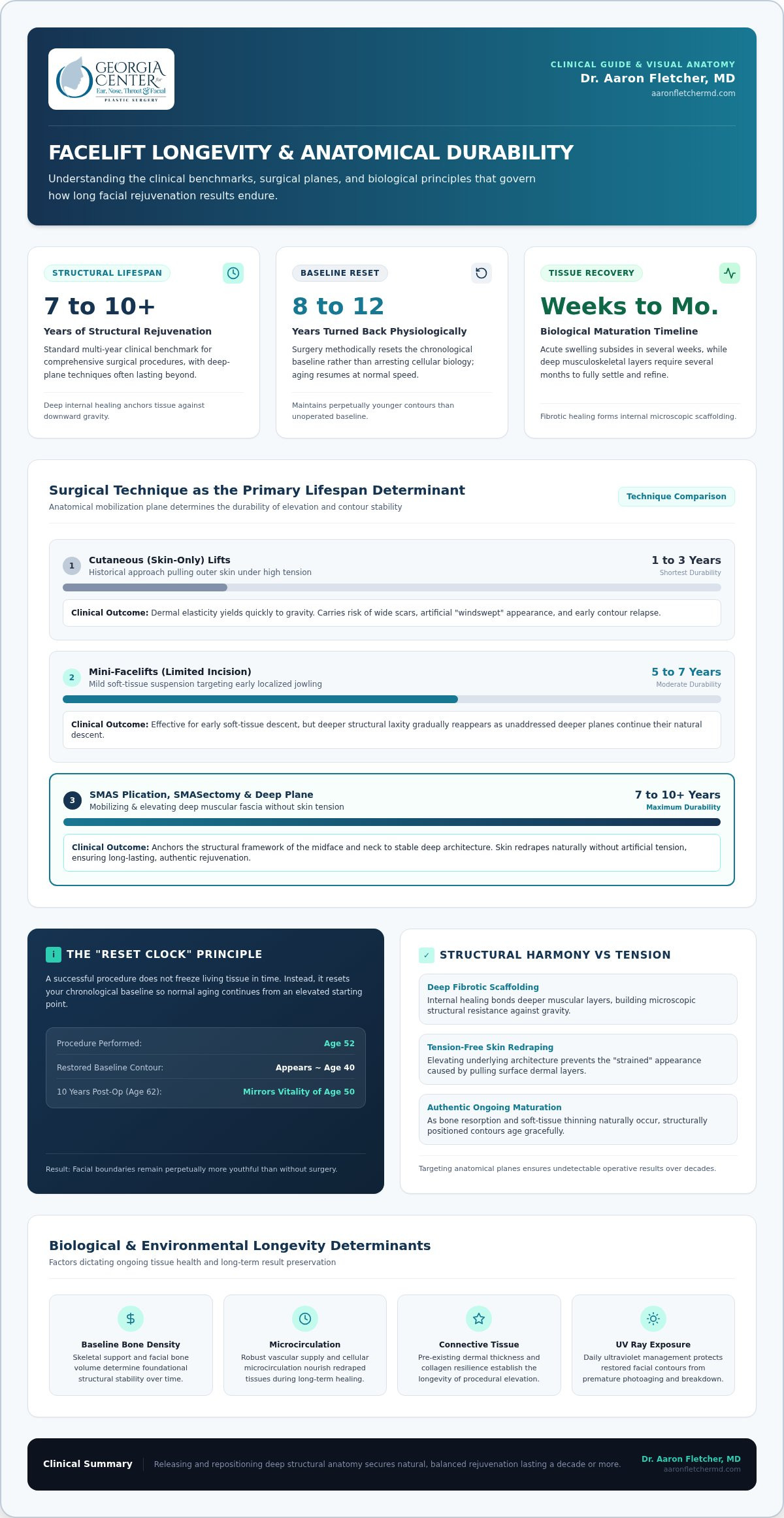
When patients inquire about surgical longevity, they often seek a definitive expiration date. In clinical practice, most comprehensive facial procedures provide enduring structural rejuvenation lasting between 7 and 10 years, with advanced deep-plane interventions frequently extending beyond that benchmark. Rather than an abrupt reversal, surgical outcomes evolve gradually alongside your body’s natural maturation. While acute postoperative swelling subsides within several weeks, the deeper musculoskeletal framework requires several months to fully settle, heal, and reveal its definitive refined contour.
A surgical procedure does not arrest cellular biology. Instead, precise intervention turns back the physiological clock by roughly eight to twelve years. From that newly restored baseline, normal chronological aging resumes at its customary pace. A patient who undergoes comprehensive structural elevation will perpetually look younger and more refreshed than if they had avoided surgery entirely.
The 7-to-10-Year Clinical Benchmark Explained
The standard multi-year timeline reflects the biological durability of underlying structural repositioning. Modern surgical rhytidectomy techniques mobilize and secure the deeper muscular and fascial support networks rather than merely stretching superficial skin. During the initial recovery, internal fibrotic healing creates durable microscopic scaffolding across these deeper anatomical planes. This natural internal reinforcement holds underlying tissue securely against downward gravitational forces far longer than surface-level intervention ever could.
Key clinical realities regarding procedural durability include:
- Structural Stability: Internal healing bonds deeper muscular layers, resisting tissue descent for roughly a decade.
- Biological Durability: Pre-existing cellular health, systemic microcirculation, and baseline connective tissue density establish the foundation for how long do facelift results last.
- Baseline Preservation: Even as chronological aging continues ten or fifteen years post-procedure, structural facial boundaries remain visibly superior to their unoperated counterpart.
The ‘Reset Clock’ Principle Versus Halting the Aging Process
True surgical rejuvenation rests on the concept of resetting your anatomical baseline rather than attempting to freeze living tissue. If you undergo surgery at age fifty-two and restore your jawline and midface to the appearance you maintained at forty, your face will naturally progress forward from that refreshed state. When you reach age sixty-two, your facial contours will mirror the vitality of a typical fifty-year-old, preserving structural harmony indefinitely.
Evaluating how long do facelift results last requires looking past the idea of surgical permanence. Bone resorption, gradual fat atrophy, and soft tissue thinning occur naturally over time. By repositioning underlying structural elements rather than exerting tension on the skin, your surgeon ensures that ongoing aging looks graceful, authentic, and completely undetectable as previous operative work.
Surgical Technique as the Primary Determinant of Facelift Longevity
How long do facelift results last depends predominantly on the exact anatomical plane your surgeon mobilizes. Superficial cutaneous procedures, which rely merely on pulling the outer skin tight, fail rapidly because dermal elasticity yields to gravity within one to three years. In contrast, operating beneath the superficial musculoaponeurotic system (SMAS) anchors the structural framework of the midface and neck to stable deep architecture, creating an enduring foundation that permits skin to redrape without artificial tension.
Deep Plane and SMAS Procedures Versus Cutaneous Lifts
Modern aesthetic facial surgery contrasts sharply across structural tiers:
- Cutaneous (Skin-Only) Lifts: Historical approaches pulled skin under high tension, leading to wide scars, a “windswept” appearance, and relapse within 1 to 3 years.
- Mini-Facelifts: Limited-incision procedures provide mild soft-tissue suspension for early jowling, generally lasting 5 to 7 years before deeper laxity reappears.
- SMAS Plication / SMASectomy: Folding or removing portions of the muscular fascia suspends tissue for 7 to 10 years, though unreleased deep retaining ligaments can eventually pull against the repair.
- Deep Plane Facelift: By systematically releasing true osteocutaneous retaining ligaments (zygomatic, masseteric, and mandibular), this technique mobilizes the muscle and deep fat pads as one cohesive unit. As detailed in the Mayo Clinic’s overview of facelift results and limitations, structural mobilization provides the most authentic outcome, often enduring 10 to 15 years.
Releasing those retaining tether points allows tissue to glide upward into its original youthful vector without tension, producing exceptionally durable contours along the jawline and midface.
Synergistic Procedures That Reinforce Overall Facial Longevity
Aging rarely isolates itself to the lower jawline and neck. A lower-face elevation that leaves heavy periorbital tissue unaddressed can create visual disharmony, making the entire face appear as though it is aging unevenly. Pairing your lift with a targeted blepharoplasty resolves redundant upper lid skin and lower lid pseudoherniation, ensuring upper and lower facial zones age at the exact same pace.
Similarly, volume loss compounds structural descent. Deep plane elevation repositions fallen fat pads, but natural age-related fat atrophy can leave facial hollows behind. Introducing autologous fat grafting restores youthful midface convexities alongside your lift. For individuals presenting with persistent lower facial fullness, precise buccal fat removal can further sculpt the submalar hollow, refining your profile permanently. If you want to understand how comprehensive structural harmony directly influences how long do facelift results last, exploring a tailored surgical consultation with Dr. Aaron Fletcher can clarify your ideal anatomical roadmap.
Biological and Lifestyle Factors That Influence How Your Face Ages Post-Surgery
Surgical intervention restores structural architecture, but your day-to-day biology governs how that repositioned framework matures over time. Once healing completes, intrinsic physiological processes and external environmental stressors dictate cellular turnover. Understanding these dynamic influences clarifies how long do facelift results last in real-world conditions, shifting the conversation from a static surgical guarantee to active biological preservation.
Intrinsic Biological Drivers: Genetics, Bone Loss, and Collagen
Your genetic profile establishes baseline dermis thickness, inherent tissue elasticity, and the rate at which you synthesize new extracellular matrix proteins. While surgery repositions descending muscles, it cannot alter underlying craniofacial skeletal remodeling. Over successive decades, gradual bone resorption across the pyriform aperture, orbital rims, and mandible reduces the rigid scaffolding beneath your soft tissues.
Intrinsic mechanisms governing long-term tissue maintenance include:
- Dermal Fibroblast Vitality: Hereditary collagen synthesis rates dictate how firmly overlying skin drapes across newly elevated muscle layers.
- Craniofacial Skeletal Resorption: Bone remodeling around the lower jawline reduces anterior projection, subtly shifting the foundation beneath soft tissues.
- Connective Tissue Quality: Baseline elastin content determines whether skin contracts cleanly over your repositioned facial contours or experiences gradual cutaneous thinning.
Extrinsic Accelerators: Photodamage, Nicotine, and Weight Instability
Extrinsic variables can degrade even the most meticulous surgical outcome prematurely. Chronic ultraviolet radiation triggers matrix metalloproteinases, enzymes that cleave healthy collagen and cross-link elastin fibers into disordered masses. According to the American Society of Plastic Surgeons on facelift longevity, lifelong sun protection and healthy habits directly safeguard surgical outcomes against accelerated cutaneous wrinkling and thinning.
Vascular health plays an equally decisive role. Nicotine from cigarettes or vaping induces immediate peripheral microvascular vasoconstriction, depriving redraped cutaneous flaps of vital oxygen and accelerating structural matrix degradation. Similarly, rapid systemic weight cycling of 15 to 20 pounds stretches the facial skin envelope and exhausts underlying fat compartments. Rapid loss empties midface volume, while substantial gain stresses deep suture suspensions. Maintaining a stable, balanced baseline protects structural balance, directly extending how long do facelift results last over the subsequent decade.
Preserving and Maximizing Your Facelift Investment Over Time
Securing an exceptional surgical outcome represents the first phase of facial restoration; actively protecting that newly contoured anatomy ensures its lasting power. While structural repositioning handles muscular descent, post-procedure diligence directly governs skin texture and tissue adhesion. Establishing a methodical preservation protocol maximizes your return on recovery and decisively extends how long do facelift results last.
Postoperative Healing and Immediate Structural Protection
The initial twelve weeks following surgery represent a critical window for internal wound remodeling. Newly transposed tissue planes rely on microscopic fibrin bridges before dense collagen matrices establish permanent mechanical strength. Strenuous exertion, heavy lifting, or premature aerobic activity spikes systemic arterial pressure, risking shear stress along delicate internal suspension lines.
Essential immediate post-surgical safeguards include:
- Consistent Elevation: Maintaining continuous 30-degree head elevation during sleep mitigates dependent micro-edema, avoiding unnecessary hydrostatic pressure on healing tissue margins.
- Mechanical Rest: Avoiding forceful neck rotation and high-impact movement prevents disruptive tension across deep-plane anchoring points.
- Controlled Lymphatic Recovery: Supporting gentle fluid clearance accelerates tissue apposition, ensuring that redraped cutaneous layers adhere smoothly to underlying muscle.
Long-Term Dermal Regimens and Non-Surgical Maintenance
A comprehensive lift restores foundational contours, but it doesn’t halt the surface-level thinning of the epidermis. Protecting superficial skin quality prevents fine texture changes from dulling your refined jawline and midface. Daily broad-spectrum mineral photoprotection shields newly healed incisions and stops ultraviolet radiation from degrading your collagen reserves. Topical retinoids accelerate cellular turnover, while stable vitamin C and biomimetic peptides support robust dermal thickness.
Non-invasive skin maintenance complements surgical rejuvenation by targeting skin elasticity from the outside in. Periodic fractionated laser treatments or targeted radiofrequency microneedling stimulate ongoing neocollagenesis within the upper dermis without disturbing deep surgical planes. Keeping the cutaneous envelope plump and hydrated ensures that superficial crinkling never distracts from crisp underlying muscular vectors. To build a customized long-term plan tailored to your specific anatomical goals, schedule a consultation with Dr. Aaron Fletcher to discuss structural facial restoration.
Taking ownership of your postoperative routine ultimately dictates how long do facelift results last. When meticulous surgical craftsmanship pairs with disciplined daily photoprotection and medical-grade skin therapy, your facial contours can easily remain sharp, balanced, and youthful for a decade or more.
Selecting a Board-Certified Specialist for Enduring Facial Rejuvenation
Surgical expertise remains the single most critical factor in aesthetic durability. While biological health and diligent skincare preserve your outcome, the architectural craftsmanship executed in the operating room sets the boundaries of what is possible. Determining how long do facelift results last comes down to who holds the scalpel, how thoroughly they understand head and neck anatomy, and whether their surgical philosophy emphasizes enduring structural repositioning over superficial cutaneous tension.
Anatomical Precision and Deep Structural Vector Alignment
Every face presents unique bony margins, ligamentous attachments, and muscular dynamics. Applying a rigid, standardized surgical template across diverse patient profiles inevitably compromises longevity. Vertical repositioning vectors resist downward gravitational forces far better than oblique or lateral pulling, which flattens natural midface contours and distorts the mouth.
Dual training in otolaryngology and facial plastic surgery provides an unmatched foundation for this work. An otolaryngologic background equips a surgeon with an instinctive mastery of facial nerve pathways, parotid fascia, and subplatysmal corridors. This anatomical fluency allows your surgeon to navigate deep tissue planes confidently, releasing true retaining ligaments to anchor structural tissues to deep bony landmarks without risking superficial nerve trauma.
Evaluating Surgeon Credentials and Long-Term Patient Proof
When vetting prospective surgeons, prioritize credentials that reflect dedicated, specialized mastery of facial biomechanics:
- Dedicated Certification: Seek a board-certified specialist who focuses exclusively on head and neck aesthetic surgery rather than a generalist performing whole-body cosmetic work.
- Multi-Year Photographic Documentation: Scrutinize patient galleries that feature results at two, five, or ten years post-operation, rather than relying strictly on early three-month photographs that still conceal descent behind residual healing fullness.
- Customized Structural Harmonization: Look for a practitioner who tailors deep anatomical repositioning to your individual bone structure, preventing the unnatural, operated look while maximizing mechanical longevity.
Navigating these qualifications ensures your surgeon views facial rejuvenation as an enduring, evolving patient partnership. Reviewing our resource on finding a specialist helps you ask the right technical questions during consultations. Selecting a dual-trained, board-certified expert who understands the complex mechanics of facial anatomy guarantees that your procedure answers how long do facelift results last with lasting structural confidence.
Restoring Your Facial Foundation for the Next Decade
Achieving authentic, enduring rejuvenation isn’t about pulling skin tight; it’s about methodically resetting your underlying anatomy. As you consider your aesthetic goals, understanding how long do facelift results last empowers you to make informed decisions grounded in biological reality. By releasing true facial retaining ligaments and suspending deep muscular architecture, advanced surgical approaches provide a refreshed, natural baseline that withstands gravity for a decade or more.
Long-term success ultimately depends on partnering with a dedicated specialist who views your care as an ongoing clinical relationship. With dual board-certified expertise focused exclusively on otolaryngology and facial plastic surgery, Dr. Aaron Fletcher combines deep structural precision with personalized artistic harmony to ensure your results look vibrant from every angle. Schedule a consultation with Dr. Aaron Fletcher today to design a tailored surgical plan that honors your individual anatomy and protects your aesthetic investment for years to come.
Frequently Asked Questions
How long do facelift results realistically last on average?
Most patients enjoy visible, natural rejuvenation for 7 to 10 years, with advanced deep-plane repositioning often lasting 10 to 15 years. Longevity depends on releasing deep retaining ligaments rather than relying on skin tension alone. Because underlying tissues heal into their new positions, your facial contours will perpetually remain more youthful than if you had never undergone surgery.
Will a facelift prevent me from looking older in the future?
No surgical procedure stops biological cellular maturation entirely. Instead, a rhytidectomy sets your aesthetic clock back by roughly a decade. Your body continues its normal aging trajectory from that refreshed baseline. Ongoing volume loss and bone remodeling occur gradually, but your structural jawline and midface contours retain their enhanced positioning indefinitely.
What is the difference in longevity between a mini facelift and a full facelift?
A mini facelift typically lasts 5 to 7 years because it relies on limited incisions to suspend superficial soft tissues. A comprehensive full or deep-plane rhytidectomy addresses the entire muscular system and releases osteocutaneous ligaments, delivering 10 or more years of correction. When evaluating how long do facelift results last, deeper anatomical mobilization consistently provides superior longevity.
Can lifestyle habits shorten the lifespan of my facelift results?
Unprotected sun exposure, significant weight fluctuations, and nicotine consumption will rapidly degrade surgical outcomes. Ultraviolet light triggers enzymatic breakdown of collagen, while smoking constricts microvascular capillary beds essential for tissue nourishment. Similarly, cyclic weight changes of 15 to 20 pounds stretch redraped facial skin, accelerating tissue laxity and compromising structural contour definition.
Is it possible to have a second facelift years later if aging continues?
Secondary revision procedures are common and safe when performed by an experienced specialist. Patients often consider a targeted touch-up 10 to 15 years after their primary surgery to address progressive physiological laxity. A prior deep structural lift often simplifies secondary procedures because deeper retaining landmarks have already been properly aligned without skin distortion.
Does combining a facelift with eyelid surgery or fat grafting make results last longer?
Combining procedures creates comprehensive facial balance that ages synchronously. While a blepharoplasty does not technically lengthen the lifespan of lower-face muscular repositioning, restoring the periorbital area prevents untreated upper-face laxity from drawing attention away from your refreshed jawline. Structural fat grafting replenishes biological volume atrophy, supporting overall structural longevity far better than tissue lifting alone.
How can I maintain my surgical results without undergoing additional invasive procedures?
Sustaining your outcome requires disciplined dermal photoprotection and medical-grade topical regimens. Broad-spectrum daily sunscreen prevents ultraviolet elastin degradation, while topical retinoids and antioxidants stimulate ongoing extracellular matrix turnover. Incorporating non-ablative resurfacing treatments preserves epidermal thickness, ensuring your skin quality complements your sculpted underlying contours and extending how long do facelift results last.