
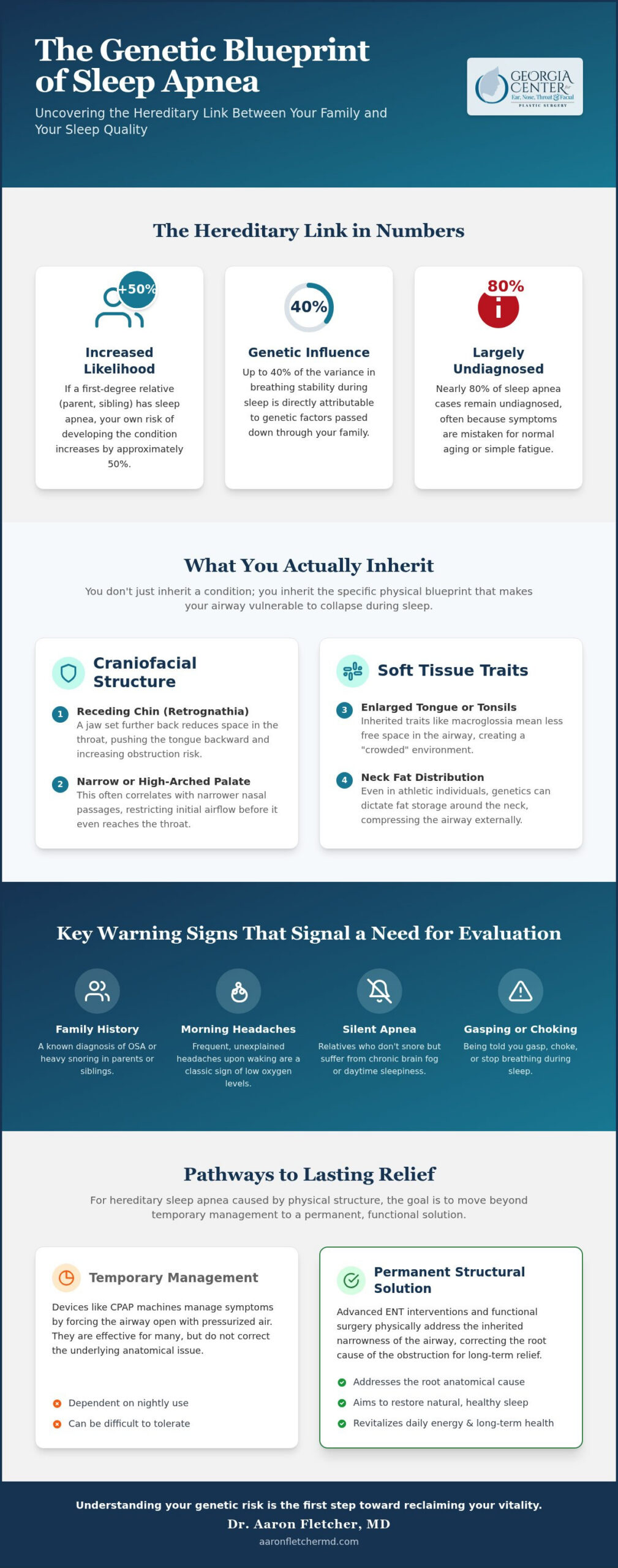
What if the persistent exhaustion you feel every morning isn’t a result of your sleep habits, but rather a blueprint written into your DNA? While many people assume that snoring and gasping are strictly tied to lifestyle choices, the reality is that sleep apnea is hereditary in a significant number of cases. If you have a first-degree relative with this condition, research indicates you face an approximately 50% increased likelihood of developing it yourself. This isn’t just about bad luck; it’s about the physical architecture of your airway, from the shape of your soft palate to the position of your jaw, which you likely share with your family.
It’s understandable to feel a sense of anxiety when faced with the prospect of life-long CPAP dependency, especially if you’re unsure whether your issues are anatomical or weight-related. You deserve clarity on why your breathing is obstructed. In the following sections, you’ll discover the specific inherited traits that influence your sleep quality and learn about the advanced ENT interventions that provide long-term relief. We’ll explore how modern surgical expertise can move you beyond temporary fixes toward permanent, functional solutions that prioritize your long-term well-being and restore your vitality.
Key Takeaways
- Understand how your inherited facial structure and airway anatomy create a physical predisposition for obstruction during sleep.
- Recognize that while lifestyle choices matter, research confirms sleep apnea is hereditary, with genetics accounting for up to 40% of the variance in breathing stability.
- Learn to identify subtle symptoms like morning headaches and brain fog that, when combined with family history, signal the need for a professional ENT evaluation.
- Discover how advanced surgical interventions can address structural narrowness, providing a permanent alternative for those who find CPAP machines difficult to tolerate.
- Gain clarity on how optimizing your upper airway through functional surgery can revitalize your daily energy and long-term health.
The Genetic Link: Is Sleep Apnea Truly Hereditary?
Obstructive Sleep Apnea (OSA) is a pervasive condition characterized by the repetitive collapse of the upper airway during sleep. This structural failure leads to fragmented rest and decreased oxygen saturation, affecting an estimated 80.6 million adults in the United States alone. While lifestyle factors like weight are frequently discussed, clinical evidence reveals that sleep apnea is hereditary for a significant portion of the population. Understanding this link requires looking beyond the symptoms to the underlying biological drivers that you share with your parents and siblings.
Differentiating between inheriting the condition itself and inheriting predisposing traits is crucial. You aren’t necessarily born with apnea; rather, you inherit the craniofacial morphology and neurological patterns that make the condition likely to develop. Sleep apnea often remains undiagnosed in nearly 80% of cases because patients assume their struggles are merely a personal failing or a consequence of aging, rather than a physical legacy. Research suggests that between 25% and 40% of your risk is tied directly to these genetic factors, making family history one of the most reliable predictors for the disorder.
Understanding the Genetic Predisposition
Your genetic makeup influences more than just bone structure. It also dictates your ventilatory control, which is the internal mechanism your brain uses to regulate breathing during rest. Some individuals possess a lower arousal threshold, meaning they wake up far more easily when their airway narrows, leading to severe sleep fragmentation. Research indicates that approximately 40% of the variance in the Apnea-Hypopnea Index is directly attributable to genetic factors.
The Family Connection: Snoring and Apnea
A family history of heavy snoring is often the first clinical red flag. If a first-degree relative has been diagnosed with OSA, your own likelihood of developing the condition increases by approximately 50%. This risk remains high even if you maintain a healthy weight, as the issue often stems from a naturally narrow upper airway or a recessed jawline. It’s also vital to watch for silent apnea in relatives who don’t snore but suffer from chronic brain fog or morning headaches. Early screening for those with a strong family history is a proactive step toward revitalizing your quality of life before the long-term effects of sleep deprivation take hold.
What You Actually Inherit: Anatomy, Airway, and Facial Structure
When we discuss how sleep apnea is hereditary, we’re really describing the inheritance of an anatomical blueprint. Your parents don’t just pass down eye color or height; they pass down the specific dimensions of your jaw, the height of your palate, and the width of your nasal passages. These structural features determine the volume of your airway, which is the primary factor in whether that tissue will collapse under the negative pressure of inhalation during sleep. If your family shares a specific facial “type,” you likely share the same breathing vulnerabilities, and families in Southern Nevada can check out Mountain West Dental Specialists for orthodontic evaluations that focus on these inherited structural traits.
Certain skeletal traits, such as retrognathia (a receding chin), significantly reduce the space available for the tongue. When the lower jaw is set further back, the tongue naturally occupies a larger portion of the throat, increasing the likelihood of nocturnal obstruction. Additionally, a high-arched or narrow hard palate often correlates with narrow nasal passages, which restricts the “intake” of air before it even reaches the throat. According to the NHLBI, Family history and genetics play a pivotal role in determining these skull and facial proportions, making some individuals physically predisposed to OSA regardless of their lifestyle choices or body weight.
Soft Tissue Inheritance
It isn’t just bone structure that follows a familial pattern; soft tissue characteristics also run in the family. Features like macroglossia (an enlarged tongue), the length of the soft palate, and even the size of your tonsils are heavily influenced by your DNA. While obesity is a common risk factor, the specific distribution of fat in the neck area is frequently a genetic trait. This explains why some athletic individuals still struggle with severe symptoms; their “container” is simply too crowded by inherited soft tissue. Understanding that sleep apnea is hereditary allows patients to stop blaming their habits and start looking at their physical structure as the root cause.
Board-certified specialists who bridge the gap between ENT surgery and facial plastics are uniquely qualified to visualize these obstructions. They don’t just see a snoring patient; they see a specific configuration of the nasal valve, septum, and tongue base that requires a meticulous, detail-oriented approach to correction. If you’ve noticed similar breathing patterns or facial features in your relatives, a comprehensive sleep apnea treatment evaluation can help identify these structural root causes and provide a path toward revitalized sleep.
Genetics vs. Lifestyle: Identifying Your Primary Sleep Apnea Triggers
The debate between nature and nurture is particularly relevant when discussing obstructive sleep apnea. While many sources emphasize lifestyle choices as the sole cause, clinical data suggests a strong genetic and hereditary component that often dictates the baseline stability of your airway. If you’ve inherited a narrow facial structure, lifestyle factors like a high BMI or alcohol consumption don’t necessarily create the problem. Instead, they exacerbate an existing physical vulnerability. Acknowledging that sleep apnea is hereditary helps explain why some individuals experience severe symptoms despite maintaining a healthy weight and active lifestyle.
This leads to the “thin apnea” phenomenon. In these cases, a patient’s body mass index is within a normal range, yet they suffer from significant nocturnal obstructions. The root cause is anatomical crowding, where the tongue or soft palate is too large for the inherited dimensions of the oral cavity. As you age, the natural loss of muscle tone and tissue elasticity further compromises these narrow passages. This biological progression often turns a mild genetic predisposition into a chronic health concern that requires professional intervention.
Environmental Factors That Amplify Risk
Environmental triggers often act as catalysts for your genetic risk. For instance, sleeping in the supine position allows gravity to pull inherited soft tissue toward the back of the throat, increasing the frequency of apneas. Chronic inflammation from seasonal or environmental sensitivities can also restrict airflow through the nose. If you struggle with persistent nasal congestion, exploring Allergy Testing and Treatment: A Long-Term Approach can be a vital step in reducing the total load on your airway and improving your overall sleep quality.
Distinguishing Your Primary Cause
Determining whether your apnea is primarily structural or lifestyle-based requires a nuanced clinical perspective. A comprehensive ENT evaluation uses diagnostic mapping to identify exactly where the collapse occurs within the upper airway. One-size-fits-all treatments often fail because they don’t account for the unique anatomical blueprint you’ve inherited. By identifying your specific triggers, we can move beyond generic advice and toward a precision-based treatment plan that addresses the physical reality of your airway. This methodical approach ensures that the solution is tailored to your anatomy rather than a broad statistical average.
Diagnostic Pathways: When Family History Signals a Need for Action
If you’ve observed a pattern of disruptive snoring or persistent daytime fatigue in your parents or siblings, it’s vital to recognize that sleep apnea is hereditary. This family link serves as more than just a piece of trivia; it provides a clinical roadmap for your own diagnostic journey. Documenting these family patterns gives your provider essential context, allowing them to look past generic symptoms and focus on the structural vulnerabilities you may have inherited. Recognizing the signs early, such as morning headaches or a pervasive sense of “brain fog” that caffeine cannot clear, is the first step toward reclaiming your quality of life.
The Role of the Sleep Study
A formal sleep study, or polysomnography, remains the gold standard for confirming a diagnosis. This test measures your Apnea-Hypopnea Index (AHI), which quantifies the number of times your breathing pauses or becomes shallow each hour. While an in-lab study provides the most comprehensive data, many patients now qualify for a Home Sleep Apnea Test (HSAT). These portable devices are particularly useful for confirming the severity of hereditary obstruction in a comfortable environment. The resulting data is crucial, but it only tells part of the story; it confirms that a blockage is happening, but it doesn’t always explain why it’s occurring in your specific airway.
Consulting an ENT Specialist
While sleep data is indispensable, a board-certified otolaryngologist is essential for diagnosing the structural root of the problem. A physical airway exam goes beyond the numbers to visualize exactly where the collapse occurs. Using a specialized tool called a nasal endoscope, a specialist can examine the nasal passages, the base of the tongue, and the soft palate in real-time. This level of detail is necessary because sleep apnea is hereditary in ways that often manifest as subtle anatomical crowding rather than obvious lifestyle triggers.
Transitioning from a general diagnosis to a personalized treatment plan requires this meticulous, detail-oriented approach. By mapping your specific anatomy, we can determine if your obstruction is located in the nose, the throat, or a combination of both. This clarity ensures that you aren’t funneled into a one-size-fits-all solution that fails to address your inherited traits. If you are ready to move beyond temporary fixes and understand the physical reality of your breathing, schedule a comprehensive sleep apnea treatment evaluation to begin your journey toward revitalized health.
Beyond CPAP: Surgical and Functional Interventions for Hereditary OSA
Continuous Positive Airway Pressure (CPAP) machines are frequently prescribed as a universal first line of defense, yet they often fail to address the underlying anatomical constraints that occur when sleep apnea is hereditary. For many patients, the high pressure required to bypass a narrow or obstructed airway makes the machine intolerable, leading to frustration and poor compliance. Rather than struggling with a device that only masks the symptoms, patients can explore functional interventions that optimize the airway’s physical structure. These surgical options aim to resolve the root cause of the obstruction, offering a path toward revitalized health without a lifelong dependency on external machinery.
Addressing Nasal Obstruction
Effective breathing begins with the nose. If the “intake” is restricted by a deviated septum or enlarged turbinates, any downstream treatment will be significantly less effective. Procedures like septoplasty and turbinate reduction create a clearer path for airflow, which often lowers the pressure settings needed for secondary treatments. In cases where chronic inflammation is present, Sinus Surgery can significantly complement sleep apnea treatment by restoring proper drainage and reducing persistent congestion. For those seeking less invasive options, Balloon Sinuplasty offers a meticulous way to improve airway health with minimal downtime, ensuring the upper respiratory tract is fully optimized for nocturnal breathing.
Comprehensive Airway Reconstruction
Because inherited traits often affect multiple points in the airway, a “multilevel” approach is frequently the most successful strategy for long-term relief. This might involve soft tissue procedures like uvulopalatopharyngoplasty (UPPP) to trim an elongated soft palate or tongue base reduction to clear space in the throat. For patients with significant jaw misalignment, skeletal surgery can reposition the framework of the face to provide a permanent expansion of the breathing passage. Each surgical plan is customized to the specific collapse points identified during your clinical evaluation, ensuring the intervention matches your unique anatomy.
Restoring your quality of life through permanent structural optimization requires a meticulous, detail-oriented philosophy that addresses the physical blueprint you’ve inherited. By correcting these anatomical bottlenecks, we can provide a sense of security and stability that CPAP alone cannot offer. If you are ready to explore a permanent solution for your rest and vitality, Schedule a consultation with Dr. Aaron Fletcher, MD to discuss your surgical options and begin your journey toward lasting relief.
Reclaiming Your Vitality Through Anatomical Clarity
Recognizing that sleep apnea is hereditary represents a significant step toward finding a resolution that lasts. It shifts the focus from perceived lifestyle failings to the physical reality of your inherited anatomy. Whether your challenges stem from a narrow nasal passage or a recessed jawline, understanding these structural root causes allows for a more precise and effective treatment strategy. You don’t have to settle for the nightly frustration of temporary fixes when permanent, functional solutions are available.
By choosing a path centered on structural optimization, you can move toward a future defined by restorative rest rather than chronic exhaustion. Dr. Aaron Fletcher, MD, a Board-Certified Otolaryngologist with deep expertise in functional airway surgery, offers the compassionate, patient-centered care required to address these complex genetic traits. His detail-oriented approach ensures that every intervention is tailored to your unique anatomical blueprint, providing the security and clarity you deserve. Consult with Board-Certified ENT Specialist Dr. Aaron Fletcher, MD today to begin your journey toward breathing freely and living fully.
Frequently Asked Questions
Is sleep apnea 100% hereditary?
Sleep apnea is not 100% hereditary; instead, it’s a multifactorial condition driven by both genetics and environmental factors. While research indicates that about 40% of the variance in the Apnea-Hypopnea Index is due to genetic factors, your daily habits still play a significant role. You inherit the physiological blueprint, such as your airway size and bone structure, but lifestyle choices can either mitigate or worsen that biological predisposition. For individuals whose condition is exacerbated by weight, find out more about bariatric surgical options that can help restore healthy breathing patterns.
You can certainly develop obstructive sleep apnea without being overweight, as the condition is often rooted in your physical anatomy. This phenomenon, sometimes called “thin apnea,” frequently occurs because sleep apnea is hereditary and involves inheriting a narrow upper airway or a small lower jaw. In these cases, the obstruction isn’t caused by excess tissue weight but by a skeletal structure that doesn’t provide enough space for the tongue and soft palate.
If my father has sleep apnea, what are the chances I will have it too?
Having a father with obstructive sleep apnea increases your personal risk of developing the condition by approximately 50%. This statistical jump occurs because you are likely to share similar craniofacial features, such as a high-arched palate or a specific jaw alignment. While these inherited traits don’t guarantee a diagnosis, they serve as a vital clinical indicator that you should monitor your sleep quality and energy levels more closely than the general population.
Does hereditary sleep apnea require different treatment than lifestyle-induced apnea?
Treatment plans for hereditary sleep apnea often prioritize structural interventions because the root cause is anatomical rather than metabolic. While lifestyle-induced cases might resolve with weight management or positional changes, inherited obstructions frequently require a more meticulous surgical approach to widen the airway. This distinction is why a board-certified otolaryngologist focuses on mapping your specific collapse points to ensure your treatment addresses the physical reality of your inherited traits.
Can surgery permanently cure hereditary sleep apnea?
Surgical intervention can provide a permanent functional solution by optimizing the physical dimensions of your airway. By correcting inherited structural bottlenecks, such as a deviated septum or a crowded throat, surgery aims to restore stable breathing during rest. While “cure” is a strong term in medicine, many patients achieve long-term relief and a significantly higher quality of life, often eliminating the need for a CPAP machine entirely through precise anatomical reconstruction.
Are children of sleep apnea patients at risk even if they do not snore?
Adult children of sleep apnea patients are at risk even in the absence of loud snoring, as “silent” apnea can still cause significant health issues. Inherited traits might manifest as a narrow airway that doesn’t vibrate loudly but still collapses enough to fragment sleep. If you experience chronic morning headaches, brain fog, or persistent daytime exhaustion, these symptoms are often more telling than the presence or absence of snoring in those with a family history.
What is the most common inherited trait that leads to sleep apnea?
The most common inherited trait leading to sleep apnea is craniofacial morphology, specifically the size and shape of the jaw and upper airway. Traits like a recessed chin, also known as retrognathia, or a naturally narrow throat create a crowded environment where tissue is more likely to obstruct breathing. These skeletal proportions are passed down through generations, making the physical “container” for your airway the primary driver of hereditary risk.
Is a sleep study necessary if I already know it runs in my family?
A sleep study is absolutely necessary even if you have a strong family history, as it quantifies the severity of your specific condition. Knowing that sleep apnea is hereditary helps your provider understand your risk, but the study provides the data needed to determine your Apnea-Hypopnea Index (AHI). This information is essential for customizing a treatment plan, as it distinguishes between mild, moderate, and severe obstruction, guiding the selection of the most effective surgical or functional intervention.