
The secret to truly natural looking facelift results has almost nothing to do with pulling skin tight. If you have ever felt hesitant after seeing the over-tightened, windblown expressions that often dominate the public eye, your apprehension is entirely justified. You want to restore a crisp jawline and smooth neck contours, yet the thought of losing your unique identity feels daunting. Between conflicting terminology like deep plane releases versus SMAS procedures and heavily filtered online portfolios, finding clear, trustworthy medical guidance can feel overwhelming.
Modern facial rejuvenation has evolved far beyond the superficial tensioning of previous decades. Today, genuine artistry lies in vertically repositioning the deep structural tissues beneath the skin, allowing the surface to drape softly without distortion. In this guide, you’ll discover how advanced anatomical techniques recreate youthful balance while preserving your natural character. We’ll demystify surgical approaches, help you evaluate genuine outcomes with confidence, and outline the precise questions to ask during a surgical consultation to ensure your rejuvenation remains entirely undetectable.
Key Takeaways
- True natural looking facelift results depend on vertically repositioning deep structural retaining ligaments and muscle rather than pulling surface skin.
- Understanding the layered anatomy of facial aging helps you see why superficial skin tightening cannot correct structural descent or volume changes.
- Comparing surgical methods like deep plane procedures, SMAS techniques, and mini-facelifts reveals which approach best matches your unique anatomical needs.
- Harmonizing a lower-face lift with complementary procedures such as platysmaplasty, blepharoplasty, or chin augmentation prevents disjointed surgical outcomes.
- Learning how to evaluate unedited patient galleries and ask incisive consultation questions ensures you choose a dedicated facial specialist with proven artistic judgment.
What Defines Natural Looking Facelift Results in Modern Aesthetic Surgery?
Achieving natural looking facelift results requires a complete departure from the historical philosophy of cutaneous traction. In modern facial aesthetic surgery, an authentic outcome is defined by structural restoration rather than superficial tightening. Patients should look thoroughly rested, vibrant, and recognizable; they shouldn’t appear operated on or fundamentally altered. Dynamic expression serves as the true clinical litmus test. When an individual speaks, laughs, or rests, facial mobility must remain fluid and organic, devoid of the frozen stiffness common in older interventions. Historically classified under the broad surgical umbrella of Rhytidectomy (facelift) procedures, contemporary surgery prioritizes deeper anatomical repositioning so that surface tissues retain their natural softness.
The Hallmarks of an Undetectable Surgical Transformation
An imperceptible outcome reveals itself through subtle anatomical markers that preserve personal identity rather than masking it:
- Preserved Periauricular Architecture: The tragus retains its natural cartilaginous projection, the preauricular sulcus stays distinct, and the earlobe sits freely without downward elongation.
- Unshifted Hairlines: Temporal hair tufts, sideburns, and the posterior hairline retain their original positions, preventing the unnatural gaps caused by indiscriminate excision.
- Tension-Free Healing: Fine incision lines heal flush with adjacent skin contours because deep structures, rather than the skin layer, support the suspended weight.
- Harmonious Mandibular Contours: The jawline emerges sharp and continuous, avoiding unnatural hollows beneath the chin or exaggerated midface bulges.
Why Traditional “Skin-Only” Facelifts Created an Artificial Appearance
The infamous windblown distortion associated with vintage procedures stemmed directly from pulling only the superficial skin envelope laterally toward the ears. Human skin is viscoelastic; it lacks the mechanical strength to suspend descending fat compartments and sagging muscle over time. When historical techniques placed tension strictly on the epidermis, the midface flattened horizontally, the oral commissures widened unnaturally, and the skin thinned under perpetual strain. This excessive surface tension inevitably led to widened scars, distorted hair patterns, and the classic pixie ear deformity, wherein the earlobe is dragged downward into the incision line. Modern structural techniques bypass these vulnerabilities entirely by unloading all tension from the skin envelope.
The Anatomy of Aging: How Advanced Techniques Restore Authentic Contours
Facial aging is fundamentally a three-dimensional structural shift, not merely a loss of surface elasticity. Over time, deep retaining ligaments attenuate, muscular framework descends, and skeletal volume diminishes. When these supporting anchors loosen, the overlying midface fat compartments fall downward toward the jawline, forming pronounced nasolabial folds and prominent jowls. Simply redraping the skin cannot reverse this underlying ptosis. Delivering lasting, natural looking facelift results requires navigating beneath the skin to address the muscular and fibrous scaffolding directly.
Understanding the SMAS and Deep Plane Structural Layers
The superficial musculoaponeurotic system (SMAS) serves as the primary structural foundation of the face. In deep plane surgery, an experienced surgeon enters the plane beneath this fibro-muscular layer to selectively release the key facial retaining ligaments, including the zygomatic and mandibular ligaments. Freeing these tethered anchor points allows the descended malar fat pad and midface structures to mobilize upward without tension, protecting the delicate branches of the facial nerve. As highlighted by the American Society of Plastic Surgeons regarding Modern facelift approaches, manipulating deep tissue layers ensures that the superficial skin envelope simply rests across restored contours rather than bearing mechanical strain.
Vertical Vectors vs. Horizontal Pulling: The Physics of Youthful Balance
The mechanical direction of structural repositioning dictates whether a face looks revitalized or distorted. Consider the biomechanics of facial descent:
- Gravity operates vertically: Soft tissues descend directly downward toward the mandibular border, elongating the lower face.
- Horizontal pulling causes distortion: Pulling tissues laterally toward the ears flattens the natural curve of the cheek and widens the mouth corners, creating the dreaded lateral sweep deformity.
- Vertical elevation restores youthful proportions: Shifting the deep muscular layers along a true vertical vector returns tissue to its exact anatomical position from a decade prior.
When tissues are elevated vertically, volume returns to the midface naturally, sharpening the jawline without artificial tension. For patients seeking this level of anatomical precision, learning more about specialized care through Dr. Fletcher’s surgical approach can clarify how deep structural releases safeguard natural expression.
Evaluating Facelift Techniques: How Surgical Approaches Influence Outcomes
Every face presents a distinctive architectural profile, meaning no single operative approach suits every individual. Achieving natural looking facelift results depends on selecting a surgical technique calibrated to your specific pattern of descent, skin quality, and skeletal support. When a surgical plan misjudges underlying tissue dynamics, the outcome can range from rapid relapse to visible tension lines. Modern facial rejuvenation relies on several recognized modalities, each offering distinct mechanical advantages depending on the depth of intervention required.
SMAS Plication vs. Deep Plane Facelift: Key Differences
SMAS plication involves folding and suturing the superficial muscular aponeurotic system upon itself without dissecting underneath it. While effective for patients with mild laxity, plication gathers tissue under tension because the underlying facial retaining ligaments remain tethered. In contrast, deep plane surgery enters beneath this fibro-muscular layer to release the zygomatic and masseteric retaining ligaments completely. Once freed, the midface fat pad and suspended musculature glide upward into their natural anatomical positions without pull or gathering. This complete release delivers comprehensive midface elevation and a restored jawline without requiring synthetic volume additions.
Mini-Lifts vs. Comprehensive Facial Rejuvenation
Mini-facelifts utilize shortened incisions, primarily addressing minor lower-face descent in younger patients. However, they carry clear structural limitations when deeper rejuvenation is required:
- Limited Scope: Mini-lifts target early jowling along the lateral jawline but do not correct midface descent or deeper cervical laxity.
- Cervical Omission: Significant neck banding, subplatysmal fat accumulation, and platysma muscle diastasis cannot be resolved through limited preauricular incisions alone.
- Risk of Incomplete Correction: Applying a limited mini-lift to advanced laxity forces the surgeon to rely on skin tension, leading to premature structural relapse.
When reviewing clinical before-and-after galleries to assess technique efficacy, look closely for unedited, standardized photography. Examine whether the midface appears naturally elevated or merely drawn flat. Check that the corners of the mouth rest without horizontal pulling and confirm that the transition from the mandibular angle into the neck exhibits a clean, continuous contour across multiple viewing angles.
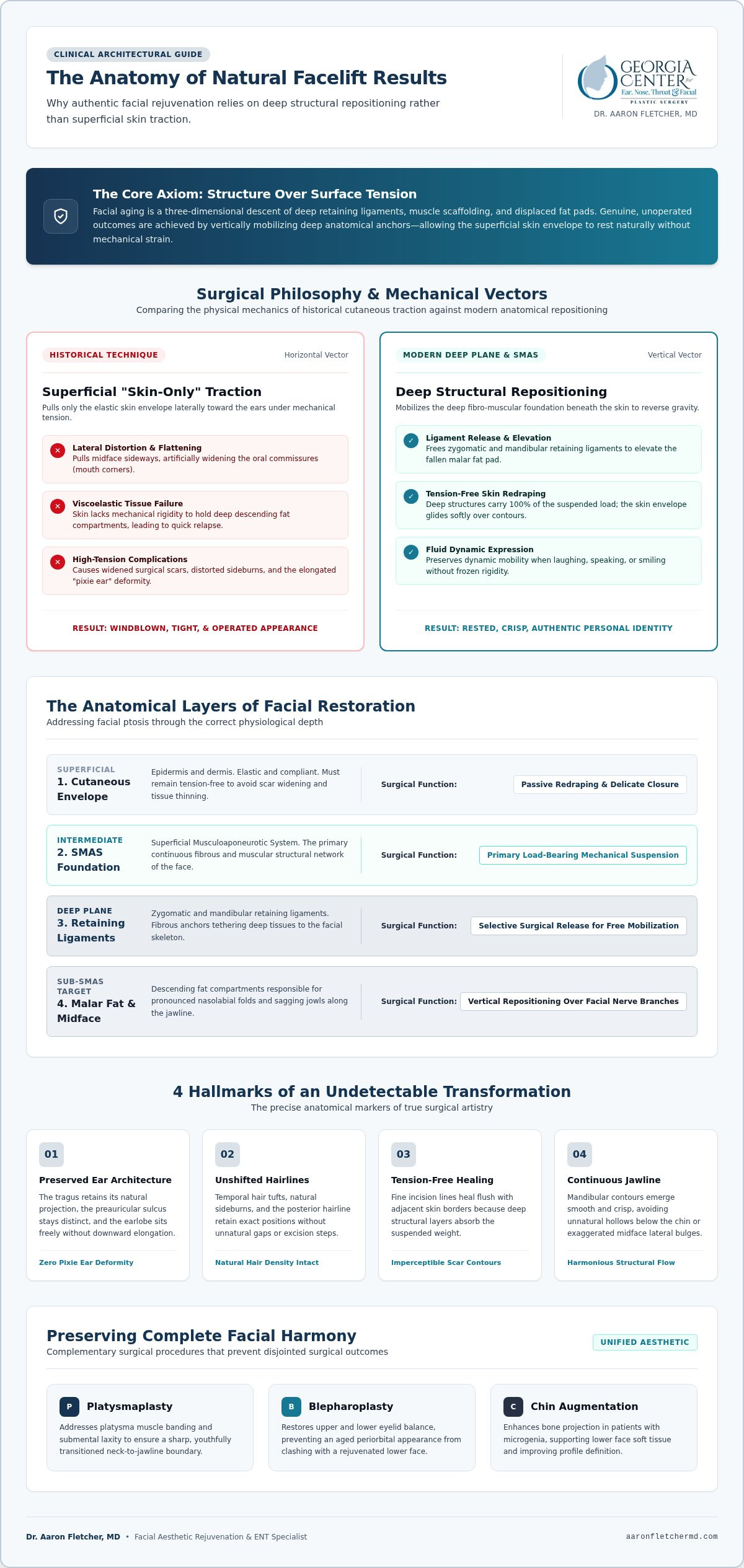
Preserving Facial Harmony: Complementary Procedures for Cohesive Results
Facial aging rarely confines itself to a single zone. When a surgeon elevates the lower face while ignoring pronounced periorbital changes or deep cervical laxity, the resulting mismatch betrays the procedure. True aesthetic excellence demands balance across all anatomical thirds. Achieving natural looking facelift results requires treating adjacent regions concurrently, ensuring the neck, eyes, and jawline present a coherent, uniform timeline. Addressing these neighboring features prevents telltale demarcation lines where treated tissue meets untreated areas.
The Critical Role of Neck Rejuvenation in Lower Face Definition
A crisp mandibular contour depends entirely on the condition of the cervical framework underneath. Isolated lower cheek lifting cannot fix muscle divergence or deep adiposity in the central neck. To establish a graceful cervicomental angle, surgeons utilize precise structural steps:
- Midline Platysmaplasty: The separated medial edges of the platysma muscle are sutured together down the center, creating an internal muscular hammock that eliminates vertical cords.
- Subplatysmal Sculpting: Conservative removal of deep cervical fat beneath the muscle layer sculpts the neck without causing surface irregularities or hollow depressions.
- Smooth Transitioning: Blending the elevated jawline into a contoured neck eliminates harsh structural borders, creating unbroken definition from the chin to the clavicle.
Restoring Midface and Periorbital Balance with Sibling Surgeries
The eyes command attention in every human conversation. If heavy, hooded upper eyelids or prominent lower fat pseudomodels remain unaddressed alongside a taut lower face, the contrast creates an incongruous look. Discover how revitalizing blepharoplasty surgery clears away resting exhaustion by refreshing the periorbital zone while preserving your unique, natural eye shape.
Structural volume loss also plays a defining role in facial deflation. While deep structural elevation places descended tissues back where they belong, severe hollows at the temples, lower periorbital rim, or midface often need architectural replenishment. Combining deep-plane structural realignment with targeted volume restoration or cheek augmentation surgery recreates authentic youthfulness without relying on synthetic over-filling. When you are ready to evaluate a balanced, comprehensive surgical plan tailored specifically to your facial framework, schedule a surgical consultation with Dr. Fletcher to explore cohesive rejuvenation.
Selecting a Specialist: How to Verify Artistry and Avoid Distorted Outcomes
Surgeon specialization in dedicated head and neck anatomy remains the single greatest determinant of whether you achieve natural looking facelift results. While many practitioners perform facial operations as part of a general cosmetic repertoire, true surgical mastery requires intimate familiarity with the intricate retaining ligaments, motor nerves, and microvascular structures unique to the face. Selecting a specialist with dual board certification across otolaryngology and facial plastic surgery ensures your procedure is grounded in both deep functional preservation and advanced aesthetic refinement.
Critical Details to Scrutinize in Before-and-After Galleries
Evaluating an online photographic portfolio requires an analytical eye rather than a casual glance. Look beyond overall impressions and inspect specific structural checkpoints:
- Earlobe Position and Tragus Shape: Ensure the earlobe hangs naturally rather than tethering directly into the jawline scar tissue. The tragus should retain its natural cartilaginous valley rather than looking flattened or blunted.
- Hairline and Sideburn Preservation: Confirm that the temporal hair tuft and posterior hairline remain at their anatomical heights without backward displacement or bald patches.
- Anatomical Parity: Seek out patients sharing your specific bone structure, skin thickness, and degree of cervical laxity. Authentic results should show uniform lighting, matching focal lengths, and unretouched, dynamic angles.
Essential Questions to Ask Your Facial Plastic Surgeon
A comprehensive consultation should function as a collaborative, educational dialogue. Rather than accepting broad assurances about subtle results, ask precise technical questions to gauge the surgeon’s operative philosophy:
- “Which anatomical layer do you release to elevate the descended midface fat pads?” This clarifies whether the surgeon truly performs deep structural mobilization or simply relies on surface tension.
- “How do you customize incision placement around my specific tragal cartilage and hairline?” Incision paths must follow natural shadow lines rather than standard pre-drawn templates.
- “What is your plan for addressing the deep neck structures, such as the subplatysmal plane, alongside my jawline?”
Arming yourself with clear evaluation criteria protects you from marketing rhetoric. Review our in-depth resource on finding a board-certified specialist to learn the clinical standards and credentialing benchmarks required to ensure your transformation remains undetectable.
Begin Your Journey Toward Balanced Facial Rejuvenation
Achieving truly natural looking facelift results is an art form rooted in profound anatomical respect. When surgical rejuvenation prioritizes vertical repositioning of deep retaining ligaments rather than tensioning surface skin, the fear of an overdone or distorted appearance disappears. By elevating the deep structural framework and harmonizing adjacent features across the jawline, neck, and eyes, modern facial techniques preserve your unmistakable individuality while turning back the clock.
Your aesthetic journey deserves the precision of a surgeon who focuses exclusively on intricate head and neck architecture. Dr. Aaron Fletcher brings dual board-certified credentials and nearly a decade of specialized surgical experience to every patient, designing individualized surgical plans centered on functional preservation and undetectable, structural elegance. When you’re ready to restore your natural contours with quiet confidence, schedule a consultation with Dr. Aaron Fletcher to explore a personalized rejuvenation plan built for you.
Frequently Asked Questions
How long do natural looking facelift results typically last?
Advanced structural facelift techniques that target deep tissue layers typically provide results that endure for 10 to 15 years. While surgery sets back the visible clock of facial aging, natural biological aging continues from that restored baseline. Maintaining sun protection, stable weight, and healthy skin habits helps preserve your surgical investment and keeps contours crisp.
Will people be able to tell that I had a facelift?
No, achieving natural looking facelift results ensures that friends and colleagues simply observe that you appear remarkably refreshed and rested. Because modern deep structural repositioning avoids pulling skin tightly, you won’t exhibit widened mouth corners, pulled ears, or a swept appearance. Most observers assume you returned from an extended vacation or changed your wellness routine, never suspecting an operative intervention took place.
What is the primary difference between a SMAS facelift and a deep plane facelift?
A standard SMAS facelift tightens or folds the muscular layer without separating it from deeper facial frameworks. A deep plane facelift enters directly beneath this fibro-muscular layer to release the retaining ligaments that anchor tissue to underlying bone. Releasing these ligaments permits true tension-free elevation of both midface fat pads and jowls, creating superior aesthetic longevity without skin strain.
How do skilled surgeons prevent the unnatural “windblown” appearance?
Surgeons prevent an unnatural appearance by avoiding lateral cutaneous traction. Vintage techniques pulled skin sideways toward the ears, flattening cheeks and distorting mouth contours. Modern specialists reposition descending muscular tissues along a vertical anti-gravity vector instead. Surface skin is then gently redraped without tension, allowing facial expressions to move dynamically and naturally while incisions heal cleanly along hidden anatomical margins.
Where are facelift incisions placed to keep scars hidden?
Incisions are meticulously positioned within the natural contours and shadows of your facial anatomy. The line typically begins within the temporal hairline, traces along the subtle crease where the ear meets the cheek, and curves behind the tragus into the ear canal. It then loops behind the earlobe and into the lower retroauricular crease, remaining completely concealed during daily social interactions.
Can a facelift restore lost facial volume in the cheeks and temples?
A facelift primarily repositions descended soft tissue rather than replenishing lost skeletal or fat volume. While vertical deep-plane repositioning restores youthful projection to fallen cheek fat pads, significant volume deflation in the temples or midface requires complementary procedures. Pairing a lift with cheek augmentation surgery or targeted fat restoration produces true three-dimensional balance without creating the artificial stiffness of over-tightened skin.
What is the typical recovery timeline before results look completely natural?
Most patients resume public and social activities within two to three weeks following surgery. Bruising and the majority of swelling resolve by week three, though subtle lymphatic drainage continues for several months. By month two, tissues soften and incision lines begin to fade into surrounding skin. Between six and twelve months post-procedure, final natural looking facelift results fully emerge with mature tissue settling.