
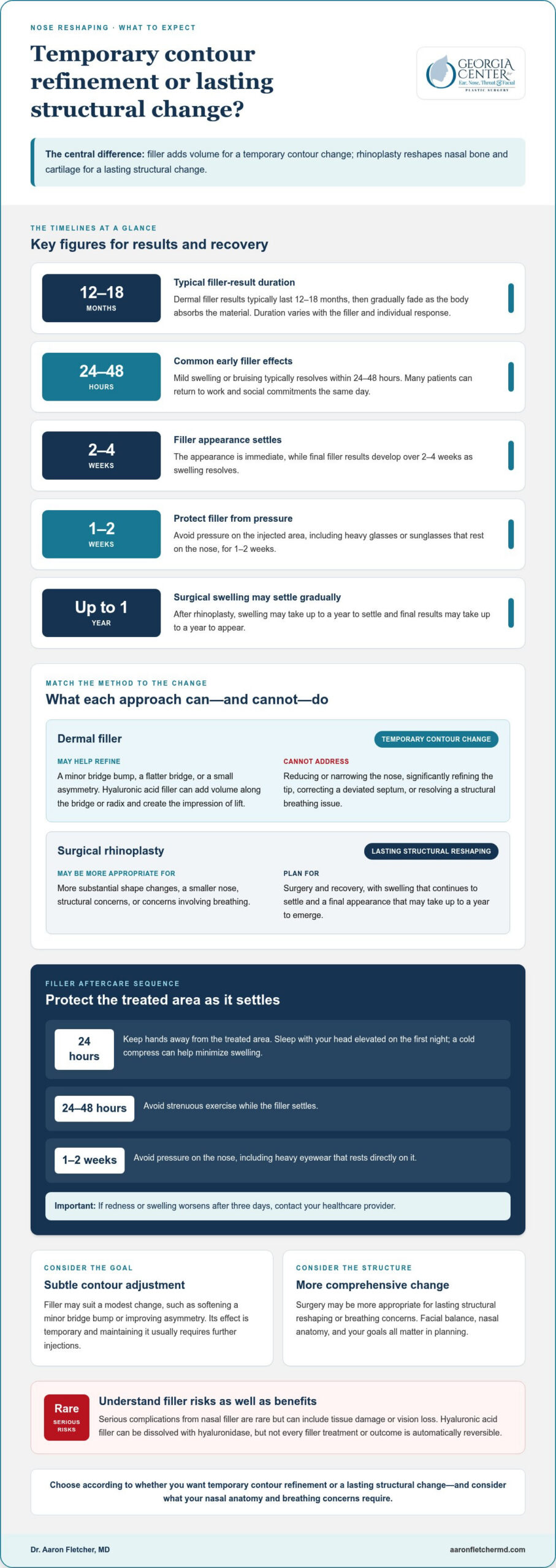
The central difference in a non-surgical nose job vs rhinoplasty is permanence: filler creates a temporary change, while surgical rhinoplasty reshapes the nose’s bone and cartilage for a lasting result. Because filler adds volume, it may refine a small contour irregularity but cannot make the nose smaller or narrower.
It’s understandable to consider a treatment that avoids surgery, especially if you’re seeking a subtle change. The right choice depends on what you want to change and how that change would support your facial balance. Filler may suit modest contour adjustments; surgery may be more appropriate for comprehensive reshaping or concerns involving nasal structure.
This guide compares the options in terms of permanence, recovery, risks, and suitability, so you can understand what each can and can’t achieve. You’ll also see how your goals, nasal anatomy, and any breathing concerns help shape the decision, and why a carefully considered plan matters as much as the procedure itself.
Key Takeaways
- Filler can refine selected contour concerns, but it adds volume rather than making the nose smaller. Match the treatment to the change you want.
- Filler results are temporary, while surgery reshapes nasal bone and cartilage for a lasting change. Consider how permanence fits your goals.
- Plan for different recoveries: filler usually involves brief aftercare, while swelling after surgery can take longer to settle.
- Understand the risks as well as the benefits; serious complications from nasal filler are rare but can include tissue damage or vision loss.
- Facial balance, nasal structure, and breathing concerns all matter when deciding which approach may suit you.
Is non-surgical rhinoplasty permanent?
No. Dermal filler changes the nose’s contour temporarily, while rhinoplasty reshapes bone and cartilage for a lasting change. Filler may suit a small cosmetic concern, but it cannot reduce nasal size or correct structural breathing problems.
Filler may suit someone seeking a subtle contour adjustment, such as softening a minor bridge bump or improving asymmetry. Rhinoplasty may be more appropriate for lasting structural change, a smaller nose, or correction of breathing concerns.
Duration of Filler Results
Dermal filler results typically last 12-18 months, then gradually fade as the body absorbs the material. Temporary gel fillers may dissolve within six months to a year, so duration varies with the filler and individual response. By contrast, surgical reshaping is permanent, although the nose continues to settle during recovery.
Hyaluronic acid fillers are commonly used for nonsurgical rhinoplasty. They can add volume along the bridge or radix, camouflage a small bump, and refine asymmetry. This changes the nose’s appearance by adding volume or creating the impression of lift, rather than removing tissue.
Temporary Results and Repeat Injections
As filler diminishes, its cosmetic effect fades. Maintaining the appearance usually requires further injections, unlike surgery’s lasting structural change. Hyaluronic acid filler can be dissolved with hyaluronidase, but that does not make every filler treatment or outcome automatically reversible.
Before choosing repeat injections, consider whether you’re comfortable maintaining a temporary result. Filler may also refine small contour irregularities after rhinoplasty, while larger structural changes require a different approach.
Filler is intended to refine contour, not reduce the nose. It may camouflage a minor bridge bump, build a flatter bridge, or improve a small asymmetry. It cannot narrow the nose, significantly refine the tip, or correct a deviated septum. If nasal structure affects breathing, filler will not resolve the underlying issue.
In the United States, cost depends on whether treatment involves filler or surgery, the correction planned, and clinical and facility factors. Rhinoplasty pricing is provided after a quote request.
| Option | Duration | Suitable concerns | Key limitation |
|---|---|---|---|
| Dermal filler | Temporary; often 12-18 months | Minor contour or symmetry adjustments | Adds volume; cannot reduce the nose or address structural breathing issues |
| Rhinoplasty | Permanent structural reshaping | More substantial shape changes or structural concerns | Involves surgery and recovery |
Choose according to whether you want temporary contour refinement or a lasting structural change.
Recovery and pressure precautions
After nose filler, many patients can return to work and social commitments the same day. Rhinoplasty involves surgical recovery, and swelling may take up to a year to settle. These differences affect daily plans, pressure precautions, and when you can assess the final appearance.
Recovery and Side Effects
After dermal filler, mild swelling or bruising typically resolves within 24-48 hours, while redness or sensitivity may last a day or two. Avoid touching or massaging the treated area for 24 hours, and sleep with your head elevated on the first night. A cold compress can help minimize swelling.
For the first 24-48 hours, avoid strenuous exercise. These steps help protect the treatment area while the filler settles. The appearance is immediate, but final results develop over 2-4 weeks as swelling resolves. If redness or swelling worsens after three days, contact your healthcare provider.
Downtime After Nose Reshaping
Filler generally involves little interruption to routine activities, unlike surgery, which reshapes nasal bone and cartilage. After rhinoplasty, swelling continues to settle, and final results may take up to a year to appear. Plan for that gradual change rather than expecting the surgical result to look final soon after the procedure.
Recovery after filler also includes pressure precautions: avoid pressure on the injected area for 1 to 2 weeks. Don’t wear heavy glasses or sunglasses during that period, since they rest directly on the nose. These restrictions matter even when you feel ready to resume normal activities.
Use a simple aftercare sequence following filler treatment:
- Keep your hands away from the treated area for 24 hours.
- Skip strenuous exercise for 24-48 hours.
- Elevate your head on the first night and use cold compresses to reduce swelling.
- Protect the nose from pressure, including heavy eyewear, for 1 to 2 weeks.
These timelines describe different stages, not conflicting advice. Bruising may fade within 24-48 hours, yet the filler continues settling for 2-4 weeks. Returning to work the same day doesn’t mean the nose is ready for pressure or vigorous exercise. Likewise, gradual swelling after rhinoplasty means appearance changes during healing; final results may take up to a year to emerge.
Choose your schedule with both recovery and your desired change in mind. If your plans involve glasses, exercise, or social commitments soon after treatment, include those details in the recovery discussion. For surgical recovery considerations, explore rhinoplasty care as you weigh the procedure against your goals.
Benefits and risks of nonsurgical treatment
In a non-surgical nose job vs rhinoplasty comparison, the key difference is the type of change each method can make. Filler can create subtle contour adjustments, while surgery reshapes bone and cartilage for broader structural changes. Because filler adds volume, it cannot make the nose smaller or narrower, or effectively refine its tip.
Filler injections can cause redness, sensitivity, swelling, or bruising. Rare but serious complications include vascular occlusion, tissue necrosis, and blindness. These risks matter even when the intended adjustment is small because blood vessels lie close to the injection area in the nose.
Nonsurgical treatment can provide a targeted cosmetic adjustment without an operation. Hyaluronic acid filler may camouflage a small bridge bump, build up the nasal bridge or radix, or improve minor asymmetry. It may also refine small contour irregularities after rhinoplasty. The effect is temporary, and filler cannot correct significant breathing problems or functional nasal issues.
Consider your desired result before choosing a method. Filler near a small dip may create a smoother-looking line, but it adds material rather than removing nasal structure, so the nose may appear slightly larger overall. A more dramatic change, such as reducing a large nose or substantially changing its tip, requires structural reshaping rather than added volume.
Filler has a specific safety concern: vascular occlusion can restrict blood supply and lead to tissue necrosis or blindness. These complications are rare, but their potential seriousness should be part of an informed decision. If redness or swelling worsens after three days, contact a healthcare provider.
Surgical rhinoplasty has a different risk profile because it reshapes bone and cartilage through an operation. It can change nasal anatomy in ways injections cannot, including addressing some structural concerns that affect breathing. Recovery also differs: swelling may take up to a year to settle, so the final appearance develops gradually.
When comparing a non-surgical nose job vs rhinoplasty, consider which method can address your specific concern. A practitioner experienced with nasal anatomy can explain how injection placement or surgical reshaping relates to your goals. Whether consulting a local specialist or researching international aesthetic centers such as Dr. Mehri Aesthetic Clinic, guidance for non-surgical treatments stresses choosing professionals with extensive expertise in facial anatomy and precision injectables.
Filler may suit a minor contour concern if added volume is acceptable. Rhinoplasty may be more appropriate for lasting structural change, substantial reshaping, or a functional concern. Neither option should be chosen on appearance alone; the method needs to match the change you want and the nasal structure involved.
Facial balance and individualized nose reshaping
The nose is perceived in relation to the whole face, so the bridge, tip, forehead, cheeks, lips, and chin all shape its appearance. The non-surgical nose job vs rhinoplasty decision becomes clearer when you identify which relationship you want to change, rather than focusing on the nose alone.
Compare your nose from the front, side, and three-quarter view. A small bridge irregularity may be noticeable in profile but barely visible from the front. A tip that seems broad in a front-facing photograph may not be the concern you notice from the side. Looking at these views helps define a specific goal instead of relying on one angle.
Filler changes contour by adding volume. For example, placing filler near a shallow bridge dip can create a smoother-looking line, but it may also make the nose appear larger. It cannot reduce a wide bridge, remove a bump, or substantially refine the nasal tip. Consider whether added volume would support the facial balance you want.
Surgery can reshape nasal bone and cartilage, making it relevant when your goal involves structural change. Reducing nasal size or changing the underlying framework requires a different approach from softening a minor contour irregularity. Breathing concerns also affect the choice because filler cannot correct significant functional problems linked to nasal structure.
Before discussing options, clarify your priorities with these steps:
- Identify the feature: Note whether your concern is the bridge, tip, width, asymmetry, or breathing.
- Choose the view: Describe whether it appears from the front, profile, or three-quarter angle.
- Define the change: Decide whether you want a smoother contour, reduced size, or structural reshaping.
- Consider permanence: Determine whether a temporary adjustment fits your goals or you want lasting change.
This comparison helps match your desired outcome to what each method can accomplish. If your concern is a small dip, added volume may create a smoother line. If you want a narrower nose, filler conflicts with that goal because it adds rather than removes volume.
Facial balance also involves considering how a change affects nearby features. For example, changing the bridge can alter how the tip and profile appear together. Use the non-surgical nose job vs rhinoplasty comparison to assess the concern, the views where it matters, and whether the intended method can make that specific change.
What does surgical rhinoplasty involve, and what are the main types?
Surgical rhinoplasty reshapes the nose’s bone and cartilage, creating a lasting structural change. Depending on the concern and nasal anatomy, it can address appearance, breathing, or both.
Traditional rhinoplasty takes 1 to 4 hours to complete. The procedure can change bony or cartilaginous anatomy, unlike filler, which adds volume without reducing nasal structure. For example, a large nose that needs to be made smaller requires surgical reshaping rather than an injectable treatment.
Understand rhinoplasty by its purpose, rather than as a single technique. Cosmetic surgery focuses on shape, such as changing the bridge or tip. Functional surgery addresses internal structures that affect breathing, including a deviated septum. When both concerns are present, a combined plan may address appearance and function together.
Functional concerns can include nasal blockage, congestion, sinus infections, nosebleeds, noisy breathing during sleep, headaches, facial pain, and sleep apnea. A deviated septum may obstruct airflow, so correcting internal structure can be part of surgical planning. Filler is generally not intended to address functional nasal concerns.
The main distinction is what needs to change. If your goal is a lasting alteration to bone or cartilage, surgery can reshape that framework. If you want to improve breathing, the internal airway and septum also matter. The surgical plan is guided by your anatomy and desired change, not simply by a preferred nose shape.
- Cosmetic rhinoplasty: Changes nasal appearance, including the bridge, tip, or overall size.
- Functional rhinoplasty: Addresses structural problems that affect nasal breathing.
- Combined rhinoplasty: Addresses appearance and functional concerns in one surgical plan when both are relevant.
These descriptions explain the purpose of surgery, not a promise that every concern can be corrected in the same way. Significant tip modification, nasal reduction, or a septum affecting breathing may require surgical rhinoplasty. Filler cannot make the nose smaller or produce comparable structural changes.
After surgery, swelling settles gradually, and final results may take up to a year to appear. That timeline matters when comparing a lasting structural change with a temporary contour adjustment. Consider both the intended change and the recovery involved before deciding which approach aligns with your goals.
To discuss whether surgical reshaping fits your goals, explore your rhinoplasty options.
Dr. Aaron Fletcher, MD: Facelift
Dr. Aaron Fletcher, MD offers rhinoplasty for patients considering a lasting change to nasal structure, appearance, or function. A discussion of your goals can help clarify whether surgical reshaping aligns with concerns such as a prominent bridge or breathing difficulty.
A facelift addresses facial aging, not nasal shape, so it serves a different purpose. If your priority is your nose, rhinoplasty is the relevant offering. If you’re considering broader facial changes, this distinction can help guide your next step.
For an individualized discussion of rhinoplasty and your goals, contact Dr. Aaron Fletcher, MD.
Choose a Next Step That Reflects Your Goals
Choosing between a non-surgical nose job and rhinoplasty is also an opportunity to clarify what you want your appearance to express. Consider which feature draws your attention, what change would feel meaningful, and whether your priorities extend beyond your nose. A thoughtful conversation can help translate those preferences into a plan that respects your features and personal goals.
Dr. Aaron Fletcher, MD offers rhinoplasty, facelift, and blepharoplasty. These options address different concerns, making an individualized discussion useful if you’re considering changes to your nose or broader facial appearance. If you’re ready to explore the possibilities, contact Dr. Aaron Fletcher, MD. You can take the next step at your own pace, with your priorities guiding the conversation.
Frequently Asked Questions
Who’s not a good candidate?
Filler is not suited to goals that require reducing or narrowing the nose, substantially refining its tip, or correcting a breathing problem. For example, added volume cannot resolve obstruction caused by a deviated septum. Someone seeking a major structural change may need to consider surgical options instead. The key distinction is whether the concern is a minor contour irregularity or a change involving nasal size, internal structure, or function.
How long does a non-surgical nose job last?
Results typically last 12-18 months, though filler type and how the body absorbs it affect duration. Temporary gel fillers may dissolve within six months to a year, and the visible effect gradually diminishes as filler is absorbed. For example, a bridge contour that initially looks smooth may become less defined over time. Maintaining the appearance requires further injections as the effect fades.
How long does recovery take?
After filler, most people can return to work and social commitments the same day, although minor swelling or bruising may last 24-48 hours. The final contour develops over 2-4 weeks as swelling resolves and filler settles. Surgical recovery follows a different course: swelling continues to resolve gradually, and final rhinoplasty results may take up to a year to appear. Plan activities around both recovery and appearance.
Are there precautions or side effects to be aware of?
Yes. After filler, avoid touching or massaging the nose for 24 hours and strenuous exercise for 24-48 hours. Protect the injection area from pressure, including heavy glasses or sunglasses, for 1 to 2 weeks. Mild swelling, bruising, redness, or sensitivity can occur. Rare serious complications include vascular occlusion, tissue necrosis, and blindness. Contact a healthcare provider if redness or swelling worsens after three days.
Can a nonsurgical nose job narrow your nose?
No. Filler adds volume, so it cannot physically narrow the nose or make it smaller. Adding material along the bridge may create a smoother-looking contour, but the nose can appear slightly larger overall. If you want a narrower bridge or reduced nasal size, filler does not address that goal. Surgical reshaping can alter bone or cartilage to make structural changes.
How do I know if I need rhinoplasty or filler?
Start by defining the change you want: filler suits selected minor contour adjustments, while rhinoplasty can reshape nasal bone and cartilage. Added volume may address a small asymmetry or shallow bridge dip. A goal of reducing nasal size, substantially modifying the tip, or addressing structural breathing concerns points toward surgical assessment. Your priorities and anatomy help distinguish a surface contour concern from a structural one.
What Is Liquid Rhinoplasty?
Liquid rhinoplasty is a nonsurgical nose treatment that uses injectable dermal filler to alter contour without surgically reshaping bone or cartilage. Hyaluronic acid filler can build up the bridge or radix, soften the appearance of a small bump, or improve asymmetry. Because it adds volume, it cannot reduce nasal size or correct structural breathing problems. Its role is limited to selected cosmetic contour changes.
What Results Can You Expect?
Filler can create an immediate, subtle contour adjustment, such as making a small bridge irregularity appear smoother or improving minor asymmetry. It adds volume rather than removing tissue, so it will not make the nose smaller or narrower. Rhinoplasty can make lasting changes to bone and cartilage, with the final appearance emerging gradually as swelling settles. The result depends on whether the method can address your specific goal.