
What if the right next step after a disappointing facelift isn’t another operation, but a clearer understanding of what’s causing your concern? If your result looks uneven, overly tight, or incomplete, it’s understandable to wonder whether the issue reflects healing, ongoing aging, or the original procedure. A revision facelift specialist can assess these possibilities before assuming additional surgery is the answer.
Revision planning calls for careful attention to your current facial anatomy and the changes made during your first procedure. Scar tissue and altered anatomy can make a second operation more complex, so an individualized evaluation matters. Dr. Aaron Fletcher, a board-certified otolaryngologist and facial plastic surgeon with nearly a decade of surgical experience, brings facial plastic surgery expertise to this assessment.
This article explains what revision facelift surgery may address, how a specialist evaluates your concerns, and what information can make a consultation more productive. You’ll also learn which records and questions to prepare, and why possible next steps depend on your anatomy, healing, goals, and examination findings.
Key Takeaways
- A concern after facelift surgery may relate to appearance, scarring, facial balance, or changes over time. More than one factor can contribute.
- A revision facelift specialist assesses your previous surgery alongside scar tissue, altered tissue planes, and your current facial anatomy.
- Use your observations as a starting point for discussion, not as a self-diagnosis. An assessment helps clarify possible next steps.
- Prepare your surgical history, available records, medication list, health history, and a clear description of the changes you want to discuss.
- Dr. Aaron Fletcher’s background in otolaryngology and facial plastic surgery informs an individualized evaluation of your concerns and goals.
What Does a Revision Facelift Specialist Evaluate?
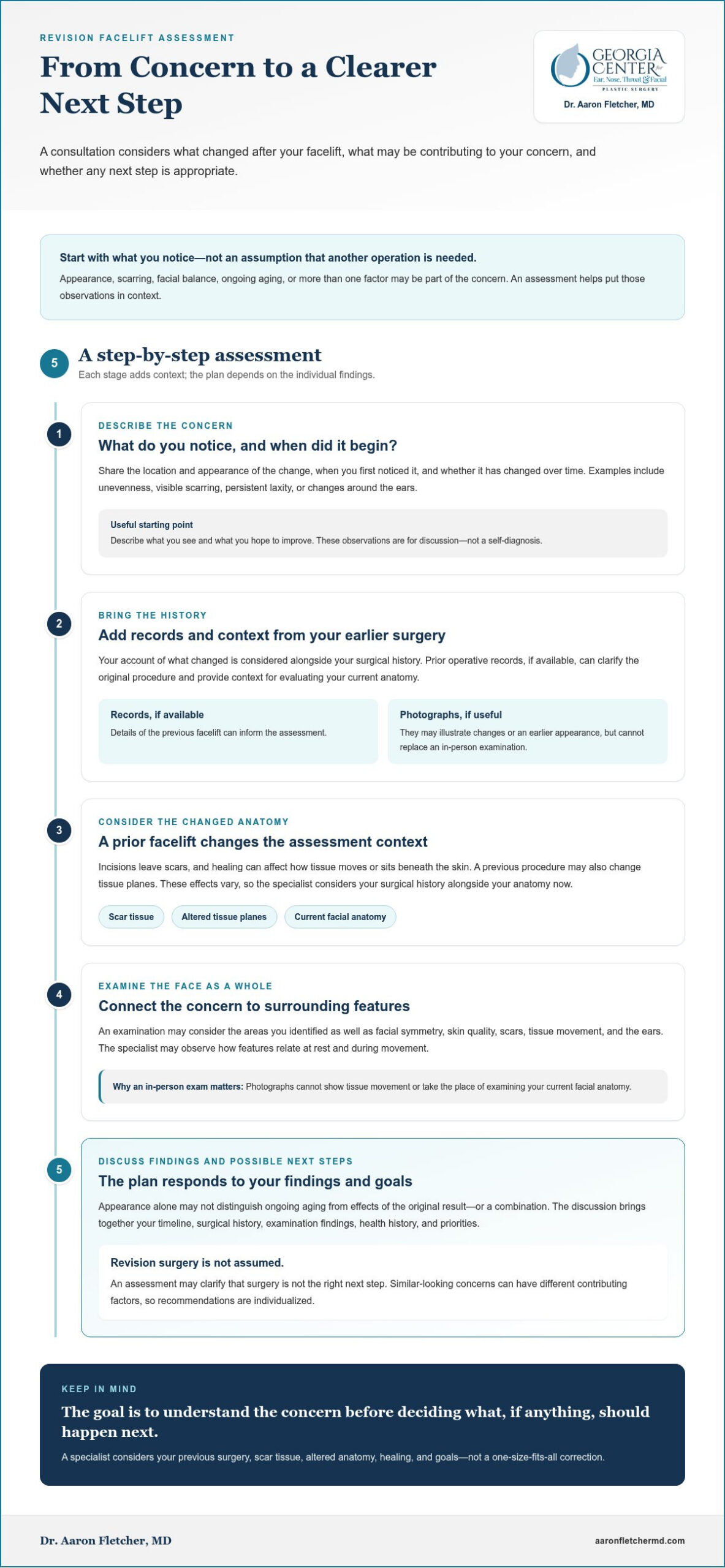
A revision facelift consultation starts with your specific concern, not an assumption that another operation is needed. It involves assessing your face after a previous facelift and considering whether treatment may be appropriate. The evaluation may address appearance, facial balance, scarring, ongoing aging, or a combination of factors.
A revision assessment looks at how your face has changed since surgery and what may be contributing to your concern. It is not simply a repeat of the original procedure. A visible difference can have more than one explanation, so the assessment helps clarify which possibilities merit discussion. Facelift procedures vary in their approach and extent. The general overview of Facelift (Rhytidectomy) provides background, but it can’t determine what is happening in an individual case.
Which concerns may prompt a revision facelift consultation?
You may want an assessment if you notice visible scarring, unevenness between the sides of your face, persistent laxity, or changes around the ears. You might also feel that your facial features look less balanced than you expected, or that the result no longer reflects your goals. These observations are useful to share, but they don’t establish that a surgical error occurred or that revision surgery is the right response.
Some people seek an assessment because their face has continued to age and the earlier result has changed over time. Others want a particular area examined. A revision facelift specialist considers the concern’s location, appearance, and timing, as well as what you hope to improve. The goal is to understand the situation before discussing next steps, which may not involve another operation.
How can aging and prior-surgery effects overlap?
Your face continues to change after a facelift. Skin, soft tissue, and facial contours can shift over time, while the effects of prior surgery remain part of your present anatomy. Renewed laxity or a change in facial balance may reflect aging, a feature of the original result, or both. Appearance alone may not make the distinction clear.
The evaluation brings together your account of what changed and when, your surgical history, and an examination of your current facial anatomy. For example, if you notice looseness near the jawline, the specialist can consider whether it appeared gradually or was present earlier, then assess it in the context of your overall facial balance. This is a framework for discussion, not a way to diagnose yourself from a photo or symptom list.
Before the consultation, note what you see, when you first noticed it, and whether it has changed. Records from your previous facelift can add context. The aim is not to assign blame or decide on surgery in advance. It is to describe the concern as precisely as possible and discuss an individualized plan based on the findings.
Why Revision Facelift Surgery Needs a More Detailed Assessment
A previous facelift changes the context in which a surgeon evaluates your face. Incisions leave scars, and healing can alter how tissue moves or sits beneath the skin. A prior procedure may also change tissue planes, the layers a surgeon considers when assessing facial anatomy. These effects vary, so the complexity of an assessment depends on your surgical history and current anatomy.
Revision planning depends on your anatomy now and the details of your previous surgery. There is no single correction that fits every patient. A revision facelift specialist examines the concern and surrounding features rather than assuming a standard approach. The goal is to understand what the findings may mean in your situation, not to predict a specific risk or outcome based only on your surgical history.
What does a specialist review during the examination?
An examination may consider facial symmetry, skin quality, scars, tissue movement, the ears, and the areas you’ve identified as concerning. The specialist can observe how features relate to one another at rest and during movement, then discuss how those observations fit your priorities. Prior operative records, if available, may clarify the original procedure and provide context for assessing your current anatomy.
Photographs can help illustrate changes or record an earlier appearance, but they can’t show tissue movement or replace an in-person examination. For general background on healing after facelift surgery, the American Society of Plastic Surgeons offers a Facelift Recovery Guide. Your recovery and surgical history still need to be considered individually.
Why is a diagnosis-led plan important?
A plan should respond to what the examination identifies, rather than default to a familiar correction. Similar-looking concerns may have different contributing factors. The discussion depends on the findings, your health history, and what you hope to change. An assessment may also clarify when surgery is not the right next step.
This measured process can make a second-surgery consultation feel more manageable. You can describe what you notice and ask how the findings relate to your goals. The surgeon can explain the reasoning behind a recommendation and its limitations. No assessment can guarantee a particular degree of change or how long a result will last. Clear expectations come from discussing what is known, what remains uncertain, and which options may be appropriate for you.
If you’re considering an evaluation of concerns after facial surgery, a facial plastic surgery consultation provides an opportunity to review your priorities and relevant history with Dr. Aaron Fletcher, a board-certified otolaryngologist and facial plastic surgeon with nearly a decade of surgical experience.
How to Compare Revision Facelift Concerns and Possible Next Steps
Before a consultation, organize what you’ve noticed without deciding what caused it. Describe the visible change, where it appears, when you first became aware of it, and whether it has stayed the same or progressed. These details give a revision facelift specialist a useful starting point. The examination helps determine what the concern may mean and what, if anything, to do next.
Is the concern related to contour, scars, or facial balance?
Use plain, observational language instead of assigning a medical cause. For example, note that one side looks different, a scar is visible, the contour seems irregular, or the skin near an ear has changed. Include when you first noticed the difference and whether it has changed. The table offers questions to help describe your concern, not a way to diagnose it.
| What you observe | Questions to discuss |
|---|---|
| Contour or appearance | Which area looks different, and is the change present at rest, during expression, or both? |
| Facial balance | When did you notice the difference between sides, and has it changed over time? |
| Scar or ear-area change | Where is the change, when did you first observe it, and what about it concerns you? |
| Gradual laxity or aging | Did the concern appear gradually after an earlier result, or did you notice it soon after surgery? |
These categories can overlap. A visible change may involve more than one area or develop over time, so record what you observe rather than trying to match it to a specific cause. A broader facelift specialist selection guide can also help you understand what to consider when choosing a surgeon for facial surgery.
Could the concern reflect renewed aging instead?
Compare the timeline of your earlier result with the concern you have now. Did the feature seem different during recovery, or did it become noticeable later? Has it changed gradually? Facial appearance continues to evolve, so a later change may reflect aging, effects of prior surgery, or both. The timeline helps frame the conversation, but it can’t establish the cause on its own.
After examining your anatomy and reviewing your history and priorities, the specialist can discuss whether observation, surgery, or another clinical recommendation is appropriate. A consultation isn’t a commitment to operate. Its purpose is to connect your concern with the findings and explain the reasoning behind possible next steps, including when no intervention is recommended.
What to Prepare Before Meeting a Revision Facelift Specialist
A little preparation can help you use consultation time well. You don’t need to arrive with a diagnosis or a decision about surgery. Bring the information you have, describe what matters to you, and stay open to what the examination reveals. The goal is a clear conversation about your concerns, health, and possible next steps.
Which records and observations are useful to bring?
Gather what’s readily available. Missing documents shouldn’t prevent you from explaining your experience. Use this checklist to organize what you have:
- Your surgical history, including the date and type of facelift and any other facial procedures.
- Operative notes, prior photographs, and relevant follow-up information, if available.
- A current medication list, health conditions, and other relevant medical history.
- A short timeline of when each concern began and whether it has changed.
- A note describing which changes matter most to you and what you hope may be different.
Be specific about your goals without prescribing a solution. Explain which area draws your attention and how it affects your sense of facial balance. You can also identify what you’d prefer to preserve. This helps the specialist understand your priorities while leaving room for examination findings to shape the discussion.
What questions can clarify the proposed plan?
A useful consultation should leave you with a clearer understanding of how your concern is being assessed. Consider asking:
- What does the examination identify, and how does that relate to the change I’ve noticed?
- How would the proposed plan address that specific concern?
- What recovery, risks, and limitations should I understand for my individual situation?
- What follow-up would be part of the plan?
- Are there alternatives, or reasons to observe or defer surgery in my case?
Timing is individual, too. Whether another operation is considered can depend on healing, examination findings, health history, and personal circumstances. There isn’t one interval that applies to everyone. Ask how these factors inform the recommendation for you and what additional information may be needed before making a decision.
Financial planning may also be part of preparing for a facelift consultation. Include questions about the financial aspects of a proposed plan alongside questions about its scope, recovery, and alternatives. Discussing these considerations as part of the overall decision can help you understand what the options involve.
Bring your questions, even if they feel difficult to phrase. A consultation with Dr. Aaron Fletcher, a board-certified otolaryngologist and facial plastic surgeon with nearly a decade of surgical experience, can help you review your concerns and goals. Arrange a facial plastic surgery consultation to begin the conversation.
How Dr. Aaron Fletcher Approaches Revision Facelift Care
Considering another facial procedure can bring questions as well as hope for a clearer understanding of what has changed. Dr. Aaron Fletcher is a board-certified otolaryngologist and facial plastic surgeon with nearly a decade of surgical experience. His background in facial plastic surgery informs an individualized discussion of your concerns, history, and goals. A consultation is an opportunity to understand the findings before considering what may come next.
A consultation centered on your history and priorities
Dr. Fletcher can review relevant information about your previous treatment and listen to what you’ve noticed since surgery. Explain which features concern you, when you became aware of them, and what changes you hope to discuss. Sharing what you’d like to preserve is useful, too. A revision facelift specialist considers these priorities alongside examination findings rather than treating a requested change as a predetermined surgical plan.
The conversation can also address uncertainty. Ask what the examination suggests, what remains difficult to determine, and how your goals relate to possible options. Questions about risks, recovery, and the limits of surgery are appropriate. Understanding these points helps you consider recommendations realistically, without feeling that you need to decide on an operation during the consultation.
Possible next steps depend on your individual circumstances. Dr. Fletcher can discuss how the findings and your priorities inform a tailored plan, including whether surgery is appropriate or another course is worth considering. No particular result can be promised. A thoughtful assessment helps clarify the reasoning behind a recommendation and what it may involve.
When you are ready to discuss your options
If you’re deciding how to approach a consultation, broader facelift specialist selection guidance can help you think about the experience and communication that matter to you. Use that information to prepare questions relevant to your own history, rather than trying to match your situation to someone else’s experience.
When you feel ready, you can discuss your facelift concerns with Dr. Fletcher. Bring your questions and explain what you hope to understand. The aim is a measured conversation about your concerns and possible next steps, with space to consider the information before making a decision.
Take the Next Step With Confidence
You don’t need to arrive at a consultation certain that surgery is the answer. You can begin with a question, a concern that’s difficult to describe, or a wish to understand how your face has changed. A thoughtful conversation can help you consider your options at a pace that feels right for you, including whether further treatment makes sense.
Dr. Aaron Fletcher is a board-certified otolaryngologist and facial plastic surgeon with nearly a decade of surgical experience. If you’re ready to discuss your concerns with a revision facelift specialist, bring the questions that matter most to you. You don’t need to have every answer before you begin.
Discuss your facelift concerns with Dr. Fletcher and take a considered first step toward greater clarity.
Frequently Asked Questions
Is revision facelift surgery more complicated than a first facelift?
It can be, because prior incisions, scar tissue, and changes to tissue planes may affect the surgeon’s assessment and planning. That doesn’t mean every revision is equally complex or that a particular complication will occur. A revision facelift specialist considers your anatomy and surgical history to explain which factors matter in your case. Ask which findings influence the plan and what uncertainties remain before deciding how to proceed.
When can I consider a revision facelift after my first surgery?
There isn’t one appropriate interval for everyone. The timing discussion depends on your healing, examination findings, health, and the nature of your concern. If you’re unsure whether a change is still evolving, note when it appeared and how it has progressed, then discuss that timeline during an assessment. The clinician can explain whether it’s useful to evaluate the concern now or whether waiting would better inform a decision.
Can a revision facelift correct visible scars or changes around the ears?
A specialist can assess visible scars or changes near the ears and discuss whether treatment may be appropriate. Options depend on the specific finding, its location, your previous surgery, and your anatomy. An examination is needed to evaluate these details. Before the visit, note whether the area looks or feels different in certain positions, and identify what concerns you most. No particular correction or result can be assumed in advance.
What should I bring to a revision facelift consultation?
Bring any records you have, such as operative notes, follow-up information, and photographs from different stages after your first procedure. A current medication list and a brief account of relevant health conditions can provide context. If records aren’t available, write down the approximate timing of the surgery and subsequent changes. A short note about your main questions can also help you make the most of the conversation.
What happens if my concern is caused by aging rather than my previous facelift?
An assessment can help explore whether your concern relates to changes that developed over time, the earlier procedure, or a combination. If aging appears to be a factor, the specialist can explain what the examination shows and discuss whether observation or treatment is appropriate for your goals. You don’t need to determine the cause before your visit. Describe when the change began and how it has evolved, then review the possibilities together.
Will I need another full facelift for every revision concern?
No. A concern doesn’t automatically call for another full facelift. The appropriate next step depends on what the examination identifies, the extent of the concern, your health, and your priorities. In some situations, the discussion may focus on a specific finding. In others, broader facial changes may be relevant. Ask what the proposed approach is intended to address and whether observation or another recommendation may be reasonable.