
What if the secret to achieving a more refined nose isn’t actually found on the nose itself? Many patients arrive for a consultation feeling that their nose is disproportionately large, only to discover that the true culprit is a recessed jawline. When the chin lacks projection, it fails to provide the necessary visual anchor for the face, which often makes a rhinoplasty and chin implant the most effective combination for true facial harmony. This common aesthetic imbalance creates a “weak” jawline that can make you feel self-conscious in every photograph.
We understand the confusion that comes with deciding between one procedure or both. You’ll learn how combining these surgeries creates a harmonious facial profile through the science of structural synergy. This guide explores the meticulous methodology used to balance your features, ensuring that your results look natural and tailored to your unique anatomy. By the end, you’ll have the clarity needed to move from uncertainty toward a professional, patient-centered plan that prioritizes both your appearance and your quality of life. We’ll examine how modern excellence in facial plastic surgery allows us to address your concerns with precision and compassionate care.
Key Takeaways
- Understand why profileplasty is the gold standard for achieving a balanced silhouette by addressing the relationship between your nasal tip and chin.
- Discover how a combined rhinoplasty and chin implant streamlines your surgical journey with a single anesthesia session and a unified aesthetic vision.
- Learn what to expect during the recovery roadmap, including essential dietary restrictions and how to manage your initial healing phase effectively.
- Identify why selecting a surgeon with dual certification in otolaryngology and facial plastic surgery is vital for protecting your airway and nasal function.
- Gain clarity on how structural synergy creates results that look natural and permanent, moving beyond the limitations of isolated procedures.
The Science of Profileplasty: Understanding Facial Proportions
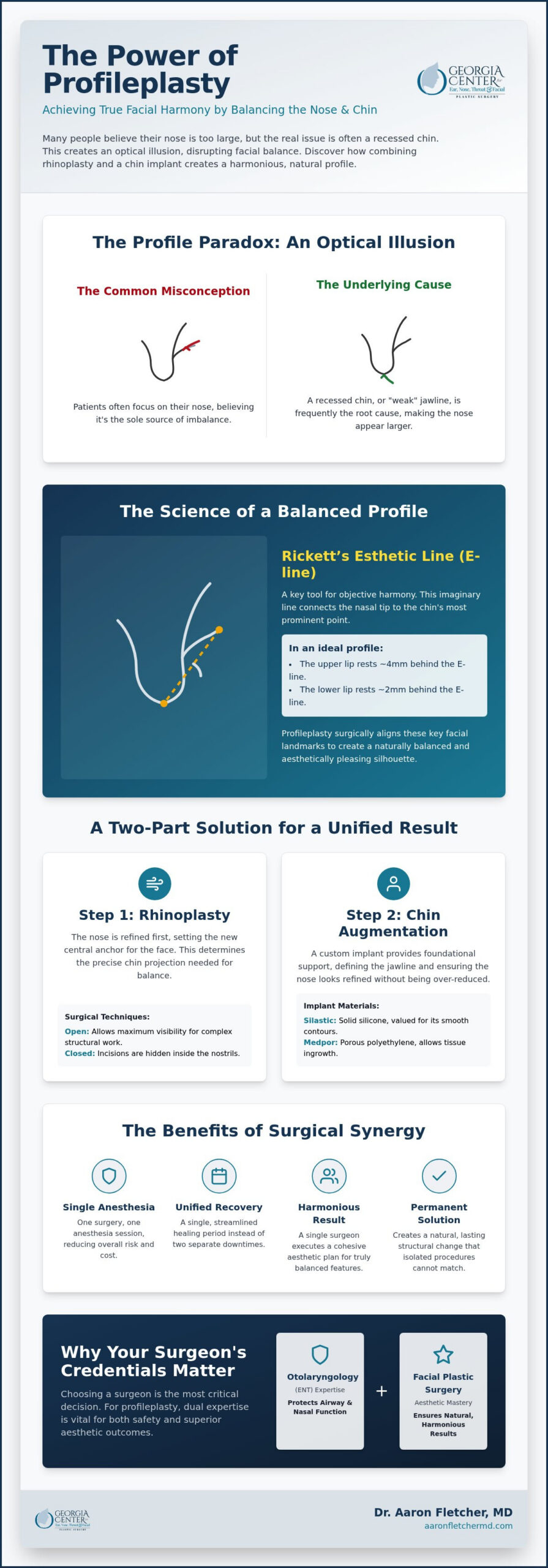
Profileplasty represents a sophisticated surgical philosophy where the face is viewed as a singular, interconnected canvas. Instead of focusing solely on a single feature, this approach seeks the simultaneous enhancement of the nose and chin for a balanced silhouette. The relationship between the nasal tip and the mental protuberance, or chin, dictates how others perceive the symmetry of your profile. When these two points are out of alignment, the entire face can feel “off,” even if the individual features are otherwise attractive. A recessed chin often creates the optical illusion of a larger nasal hump, leading many patients to believe their nose is the primary issue when a lack of lower face projection is the root cause. Achieving a balanced, “strong” profile does more than change your appearance; it often provides a profound psychological boost, fostering a sense of quiet confidence that reflects in every photo and social interaction.
The Mathematics of the Perfect Profile
Surgeons rely on precise clinical tools to move beyond subjective “beauty” and into the realm of objective harmony. One such tool is Rickett’s Esthetic Line, or E-line, which is an imaginary line connecting the tip of the nose to the most prominent part of the chin. In an ideal profile, the lips sit just slightly behind this line. We also utilize the “Golden Ratio,” a mathematical proportion of 1:1.618, to determine the ideal chin projection relative to the forehead and midface. Profileplasty is the correction of the relationship between the midface and lower face. By applying these meticulous standards, we ensure that your rhinoplasty and chin implant results are grounded in proven structural principles rather than guesswork.
Why Rhinoplasty Alone Isn’t Always Enough
In many cases, attempting to fix a profile through rhinoplasty alone can lead to diminishing returns. If a surgeon reduces the nose too aggressively to compensate for a weak jawline, they risk compromising the internal airway or creating a “scooped” look that appears unnatural. The chin serves as the essential “anchor” for nasal aesthetics. While the technical term for surgical chin reshaping is Genioplasty, a custom chin implant is often the most effective way to provide this foundation. This structural synergy defines the jawline and creates a crisp transition to the neck, ensuring the nose looks smaller and more refined without sacrificing its functional integrity. Choosing a combined rhinoplasty and chin implant allows for a holistic transformation that respects your unique anatomy and prioritizes long-term quality of life.
Combining Rhinoplasty and Chin Augmentation: The Procedure
Executing a successful profile transformation requires a methodical surgical workflow where the nose is typically addressed before the chin. By refining the nasal structure first, the surgeon establishes the new central point of the face, which dictates the precise amount of chin projection needed to achieve harmony. During the rhinoplasty phase, we choose between endonasal (closed) or external (open) techniques based on the complexity of the nasal tip work required. Closed rhinoplasty involves incisions hidden entirely within the nostrils, while the open approach utilizes a small incision across the columella to provide maximum visibility for structural grafting. This deliberate sequencing ensures that the rhinoplasty and chin implant work together as a single, cohesive unit rather than two disjointed changes.
Material selection for the chin is equally critical for long term stability and biocompatibility. We often utilize Silastic (solid silicone) or Medpor (porous polyethylene) implants. Silastic is favored for its smooth contours and ease of placement, while Medpor allows for tissue ingrowth, which can provide a more integrated feel. Safety remains the paramount concern, particularly regarding the airway. Having an ENT-trained facial plastic surgeon manage your procedure means your internal breathing passages are monitored with the same level of expertise as your external aesthetics. If you are curious about which materials best suit your anatomy, you can schedule a consultation to explore a personalized surgical plan.
Customizing the Chin Implant
The placement of a chin implant is a nuanced process that considers both your bone structure and your desired gender expression. Incisions can be placed intraorally (inside the mouth) or submentally (under the chin), with the latter often preferred for its precision and reduced risk of infection. For patients opting for an intraoral approach, maintaining a pristine oral environment is vital; resources like dental11.ch emphasize the importance of dental health in preventing post-operative complications. The implant must complement the new nasal bridge height; a high bridge requires a more prominent chin to maintain the profile line. We also tailor the implant shape to achieve your goals, whether that means creating a broader, more masculine jawline or a softer, tapered feminine appearance. For more detailed information on candidacy and risks, you can review the guide from the American Society of Plastic Surgeons on chin surgery.
A significant advantage of this combined approach is the ability to address functional concerns like a deviated septum while simultaneously refining the nasal tip. We don’t just focus on the “look” of the nose; we prioritize the internal nasal valves to prevent long term collapse or breathing difficulties. By integrating internal valve repair with the aesthetic transformation, we ensure that your rhinoplasty and chin implant results are as functional as they are beautiful. This holistic method maintains the structural support of the nose, providing a durable foundation that stands the test of time while enhancing your overall quality of life.
Surgical Synergy: The Benefits of Concurrent Procedures
Choosing a concurrent approach offers more than just convenience; it provides a framework for structural harmony that separate surgeries often fail to achieve. By undergoing a rhinoplasty and chin implant in a single anesthesia session, you reduce the cumulative medical risk and downtime associated with multiple separate procedures. This streamlined approach is also highly efficient from a logistical standpoint. Patients benefit from consolidated facility fees and surgical center costs, making the investment in their well-being more manageable. Perhaps most importantly, it allows for a “one and done” recovery period. Instead of navigating two separate healing timelines months apart, you undergo a single, unified process that prioritizes your comfort and a faster return to your daily routine.
Aesthetic Superiority of the Combined Approach
The clinical advantage of this combination is profound. When a surgeon addresses the nose in isolation, there is often a temptation to over-resect the nasal bridge to make it appear smaller against a weak chin. This can lead to an unnatural, “scooped” appearance that compromises the face’s structural integrity. By providing a chin anchor, we can maintain a more conservative and natural nasal profile. This synergy also improves the submental area, creating a crisp and defined transition between the face and neck. According to this NIH clinical review on profile balancing, the simultaneous correction of these features is the most reliable way to achieve a balanced silhouette that respects the patient’s unique facial proportions.
The Surgeon’s Perspective on Symmetry
From a technical standpoint, performing these procedures together allows for real-time adjustments that simply aren’t possible during staged surgeries. Once the nasal structure is set, the surgeon can fine-tune the chin implant selection to ensure the final proportions are exact. We utilize advanced 3D imaging during the planning phase to show you the projected synergistic effect, helping you visualize the transformation before surgery begins. This level of precision requires the expertise of a board-certified specialist who understands the complex interplay of facial geometry and soft tissue. Meticulous planning ensures that the nose and chin are designed to work together, resulting in a rhinoplasty and chin implant outcome that feels both authentic and refined.
The Combined Recovery Roadmap: What to Expect
Recovery from a rhinoplasty and chin implant requires a methodical approach to ensure both surgical sites heal with structural integrity. The first 48 hours are a period of quiet transition where you’ll wear a nasal splint to protect the new internal framework and a chin compression garment to minimize fluid buildup. Managing these dual sites simultaneously is manageable, but it demands strict adherence to our post-operative protocols. Dietary choices play a functional role in your recovery during this early phase. Soft foods like yogurt, smoothies, and lukewarm soups are essential for the first week to avoid putting undue stress on the chin implant site, especially if intraoral incisions were used. Most patients find they are socially presentable within 10 to 14 days, as the most visible bruising and swelling begin to dissipate.
We prioritize your quality of life during this journey, ensuring you have the tools needed for a comfortable experience. If you are ready to begin your transformation, you can schedule your consultation here to discuss a personalized recovery plan. With a 97.8% patient satisfaction rate for chin implants and 85 to 90% for rhinoplasty, the long-term results are well-documented and provide a lasting sense of resolution for those seeking profile harmony.
Managing Post-Operative Comfort
Maintaining an elevated sleeping position is critical during the first two weeks to minimize facial pressure. We recommend using a wedge pillow or several standard pillows to keep your head above your heart, which significantly reduces morning swelling. Pain management is typically straightforward, involving a combination of prescribed medication and cold compresses applied to the cheeks and jaw. Activity restrictions are vital for protecting your results. While light walking is encouraged within 24 hours to promote circulation, you must avoid the gym and heavy lifting for at least three to four weeks to prevent blood pressure spikes that could cause internal bleeding or displacement.
The Healing Timeline: Week 1 to Month 6
- Day 7: This is a major milestone where the nasal splint and any external sutures are removed. You’ll see the initial shape of your new profile, though it will still be obscured by significant swelling.
- Month 1: By this stage, approximately 70% of the swelling has resolved. The definition of your jawline becomes much clearer, and the bridge of the nose begins to look more refined.
- Month 3 to 6: The “socially presentable” phase has long passed, and you’re now seeing the subtle nuances of the surgery. The transition between the nose and chin looks more natural as the tissues fully integrate with the underlying structures.
While major swelling subsides in weeks, final nasal refinement can take up to a year.
Selecting Your Surgeon: Why Dual Certification Matters
Choosing the right practitioner for a combined procedure is a decision that extends far beyond aesthetic preference. While many surgeons can perform a standard nose job, the specific demands of a rhinoplasty and chin implant require a profound understanding of both skeletal structure and soft tissue dynamics. When you evaluate potential surgeons, your focus should be on their ability to manage the entire facial profile as a single unit. A meticulous surgeon will provide a gallery that showcases diverse profile outcomes, allowing you to see how they balance the projection of the chin against various nasal shapes. This transparency is vital for establishing the trust and security necessary for a successful surgical journey.
The consultation serves as your opportunity to assess the surgeon’s scholarly approach to your care. You should ask specific questions about their experience with profileplasty and their methodology for maintaining structural integrity. A dedicated service provider will prioritize natural-looking outcomes, ensuring that the final result feels like a refined version of yourself rather than an artificial change. This detail-oriented philosophy is what distinguishes an industry leader from a generalist, as it requires a high degree of expertise to ensure the chin augmentation perfectly anchors the new nasal silhouette.
The Expertise of Dr. Aaron Fletcher, MD
Dr. Aaron Fletcher, MD, brings a unique perspective to profile balancing by leveraging his extensive background as a board-certified otolaryngologist and facial plastic surgeon. This dual expertise is critical for protecting your nasal function while enhancing your appearance. By addressing the internal airway and external form simultaneously, he provides a holistic approach to well-being that few others can match. His practice is built on a patient-centered perspective that values the educational aspect of the journey, ensuring you feel heard and well-informed at every stage of the process.
Next Steps: Your Profile Consultation
Preparing for your evaluation involves more than just identifying the features you wish to change; it’s about understanding the possibilities of your unique anatomy. We utilize advanced 3D simulation to help you visualize the synergistic effect of your procedure, providing a sense of clarity before you ever enter the operating room. This technological precision, combined with a compassionate approach, ensures that your transition is as steady and thorough as possible. If you’re ready to move toward a more harmonious profile, you can schedule your comprehensive profile evaluation with Dr. Fletcher to begin your transformation with confidence.
Embrace a New Perspective on Facial Harmony
Achieving true symmetry is a journey that looks beyond individual features to the structural relationship of the entire face. By understanding how these elements interact, you can move from feeling self-conscious toward a sense of quiet confidence. A combined rhinoplasty and chin implant provides the definitive solution for profile concerns, offering a permanent anchor that supports a more refined nasal appearance. This unified approach ensures that every surgical adjustment respects your unique anatomy while prioritizing your long-term quality of life.
Dr. Aaron Fletcher, MD, utilizes his dual expertise as a board-certified otolaryngologist and facial plastic surgeon to deliver results that are both functional and naturally beautiful. His meticulous focus on structural integrity and patient-centered care provides a sense of security throughout your transformation. By choosing a practitioner who understands the intricate geometry of the face, you ensure an outcome that feels authentic and lasting.
Schedule a Consultation for Profile Balancing with Dr. Fletcher. We are here to provide the clarity and expertise you need to move forward with your aesthetic goals, ensuring a steady path toward a more balanced silhouette.
Frequently Asked Questions
Is it better to get a chin implant and rhinoplasty at the same time?
Performing these procedures together is often the preferred clinical choice for achieving total profile harmony. By combining a rhinoplasty and chin implant, you benefit from a single anesthesia session and a unified recovery period. This approach allows your surgeon to evaluate and adjust your facial proportions in real time, ensuring the nose and chin complement each other perfectly. Most patients find this “one and done” strategy more convenient and aesthetically superior than staging the surgeries months apart.
Will a chin implant change the way I talk or smile?
You may experience some temporary stiffness in your lower lip or chin area during the initial weeks of healing. This is a natural response to the surgical placement and swelling; however, these effects typically resolve as the tissues integrate with the implant. When placed by a meticulous facial plastic surgeon, the implant sits securely against the bone, which preserves your natural muscle movement. Your smile and speech patterns should return to their authentic state once the healing process is complete. For those who want to ensure their teeth and gums are expertly cared for during this time, you can discover Dental Plus for professional hygiene and routine check-ups.
Most visible swelling and bruising resolve within the first two to four weeks, making you socially presentable for work and public outings. While the chin typically settles into its final position faster, the nose continues to undergo subtle refinements for several months. You’ll see approximately 70% of your final result by the one month mark. It’s important to remember that complete resolution of internal nasal swelling can take up to a year to fully manifest across your profile.
Can I get a chin implant if I have a deviated septum?
Having a deviated septum doesn’t prevent you from receiving a chin implant; in fact, these issues are frequently addressed together. Dr. Fletcher’s dual certification as an otolaryngologist allows him to perform a functional septorhinoplasty while simultaneously enhancing your profile with an implant. This ensures that your internal breathing passages are optimized while your external aesthetics are refined. Correcting your airway and your profile in one session provides a comprehensive improvement to your overall quality of life and respiratory health.
What are the risks of combining these two facial procedures?
Combining these procedures involves standard surgical risks such as infection, swelling, or adverse reactions to anesthesia. Specific concerns for profile surgery include potential implant displacement or minor nasal asymmetries during the healing phase. Choosing a surgeon with extensive experience in both ENT and plastic surgery significantly mitigates these risks. We prioritize structural integrity and meticulous technique to ensure a safe transition. Our team provides comprehensive post-operative instructions to help you navigate the rhinoplasty and chin implant recovery process with confidence.
Will people be able to tell I had a chin implant?
The hallmark of a successful chin augmentation is a result that looks entirely natural and integrated with your existing features. Most observers will notice that you look more balanced or refreshed without being able to identify the specific surgical change. We select the implant size and shape based on your unique bone structure to avoid an overdone appearance. The goal is to create a subtle, permanent enhancement that provides the necessary anchor for your new profile without appearing artificial.
How do I know if I need a chin implant or just a nose job?
Determining whether you need one or both procedures involves a professional evaluation of your facial proportions and the Rickett’s Esthetic Line. If your jawline is recessed, even a perfectly shaped nose can appear disproportionately large. During your consultation, we use 3D imaging to demonstrate how a chin implant provides the balance needed to make a rhinoplasty truly successful. This visual data helps you understand the structural synergy required to achieve the harmonious silhouette you desire for your unique profile.
What is the cost difference between doing the procedures together vs. separately?
Undergoing these procedures concurrently is generally more cost-effective than scheduling them as separate events. When you combine surgeries, you consolidate the facility fees and anesthesia costs into a single session rather than paying for them twice. This streamlined approach also reduces the total time you spend away from work, which adds to the overall financial efficiency. While specific quotes require a personal consultation, the logistical advantages of a combined procedure offer a clear benefit to most patients seeking a total transformation.