
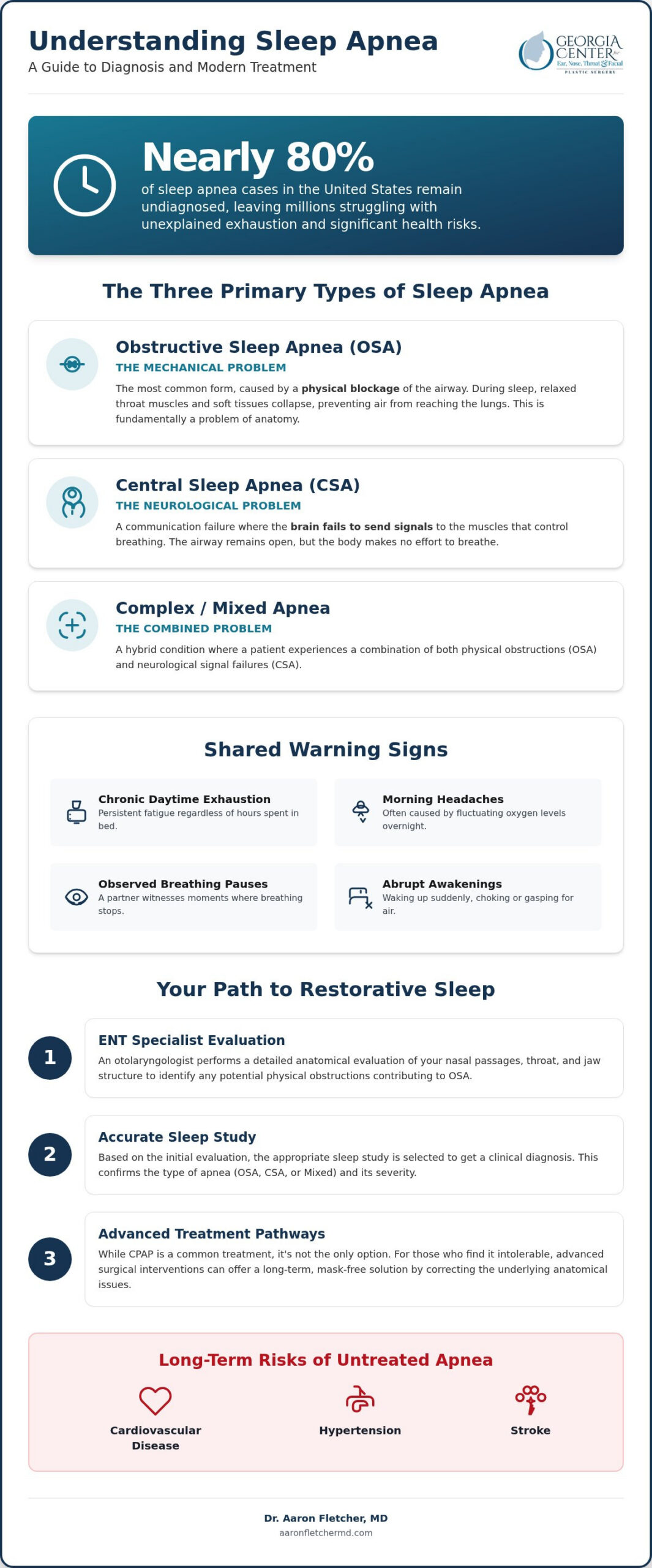
Did you know that nearly 80 percent of sleep apnea cases in the United States remain undiagnosed, leaving millions of adults to struggle with a profound exhaustion they cannot quite explain? You’re likely here because you’re tired of waking up feeling as though you haven’t slept at all. The dense clinical terminology surrounding your symptoms can feel like a significant barrier. Additionally, the fear of a lifelong dependency on CPAP machines often prevents many from seeking the help they deserve. We understand that your quality of life depends on more than just a generic label. It requires a precise identification of your specific apnea type to ensure the treatment matches your unique anatomy and neurological needs.
In this comprehensive guide, we’ll demystify the mechanical and neurological differences between Obstructive Sleep Apnea (OSA) and Central Sleep Apnea (CSA). You’ll gain a clear understanding of the diagnostic steps required to move beyond guesswork toward clinical certainty. We’ll also explore advanced pathways to restorative, mask-free breathing, highlighting modern surgical alternatives that prioritize your long-term comfort and health. By the end of this article, you’ll have the knowledge needed to manage your journey toward better sleep with quiet confidence and professional clarity.
Key Takeaways
- Distinguish between the three primary classifications of sleep disorders to understand how your specific apnea type dictates your clinical path.
- Recognize how physical obstructions in the nasal passages or throat contribute to the physiological collapse of your airway during sleep.
- Explore the neurological mechanisms of Central Sleep Apnea, where the brain’s failure to signal respiratory muscles requires a distinct diagnostic approach.
- Learn about the essential role of an otolaryngologist in evaluating your anatomy and selecting the appropriate sleep study for an accurate diagnosis.
- Discover advanced surgical interventions for those who find CPAP therapy intolerable, focusing on long-term, mask-free breathing solutions.
Defining the Spectrum: The Three Primary Apnea Types
Sleep apnea is far more than a disruptive snoring habit. It’s a serious medical condition characterized by the repeated cessation of breathing during sleep cycles, which can occur dozens or even hundreds of times in a single night. These interruptions deprive the brain and body of vital oxygen, triggering a physiological stress response that prevents deep, restorative rest. Clinicians generally recognize the three primary types of sleep apnea, each originating from distinct physiological or neurological failures.
Among the various forms, Obstructive Sleep Apnea (OSA) stands as the most prevalent, occurring when the soft tissues in the throat collapse and physically block the airway. In contrast, Central Sleep Apnea (CSA) is a communication failure between the brain and the respiratory muscles; the brain simply neglects to signal the body to take a breath. Some patients experience Complex Sleep Apnea Syndrome, often referred to as mixed apnea, which involves a combination of both physical obstruction and neurological signaling issues. Identifying your specific apnea type is the foundational step toward reclaiming your health and vitality.
Why Classification Matters for Your Treatment
Choosing a treatment without a precise diagnosis is often counterproductive and frustrating. For instance, while a Continuous Positive Airway Pressure (CPAP) machine is the gold standard for OSA, it may be ineffective or even problematic for those with pure CSA without specific pressure adjustments. Untreated apnea across all categories carries severe long-term health implications, including increased risks of hypertension, cardiovascular disease, and stroke. A board-certified otolaryngologist plays a critical role in this classification process. By performing a meticulous anatomical evaluation, an ENT specialist can determine if the root cause is a physical blockage or a deeper systemic issue, ensuring you don’t waste time on therapies that don’t address your specific needs.
Common Symptoms Shared Across All Types
While the underlying mechanisms differ, the outward manifestations of these disorders often overlap significantly. Recognizing these signs is the first step toward seeking professional intervention. Most patients report a similar cluster of symptoms that erode their daily quality of life:
- Chronic daytime exhaustion: A persistent sense of fatigue, or hypersomnia, that remains regardless of how many hours you spend in bed.
- Morning headaches: These are frequently caused by fluctuating oxygen levels and poor sleep quality throughout the night.
- Observed breathing episodes: Partners often report witnessing moments where the sleeper stops breathing entirely, followed by a sudden gasp or snort.
- Abrupt awakenings: You might wake up suddenly while feeling as though you are choking or gasping for air, which is the body’s emergency response to oxygen deprivation.
Obstructive Sleep Apnea (OSA): The Role of Physical Anatomy
While many associate sleep disorders primarily with lifestyle factors, the most common apnea type, Obstructive Sleep Apnea (OSA), is fundamentally a problem of physical architecture. During sleep, the muscles supporting the soft tissues in your throat, including the tongue and soft palate, naturally relax. In a healthy airway, this relaxation doesn’t impede breathing. However, if these tissues are overly bulky or the surrounding space is naturally narrow, they can collapse inward to create a physical seal. This blockage prevents oxygen from reaching the lungs, forcing the brain to trigger a survival wake-up call. Your facial structure and jaw alignment also influence this dynamic; for example, a recessed jaw can push the tongue further back into the throat, significantly reducing the diameter of the airway.
Nasal Obstruction and Breathing Efficiency
Breathing efficiency begins at the nose, which serves as the primary gateway for air. If the nasal passage is restricted by a deviated septum or enlarged turbinates, the body must work significantly harder to draw air through a smaller opening. Clinicians often explain this through the “Starling Resistor” model, where the upper airway acts as a collapsible tube. When the nose is blocked, the increased negative pressure generated during inhalation makes the throat tissues much more likely to collapse. Addressing these functional nasal issues often requires the expertise of a board-certified ENT and facial plastic surgeon to restore proper airflow. You can learn more about how these procedures balance aesthetics and breathing in this guide to mastering rhinoplasty and functional nasal surgery.
Risk Factors Beyond Lifestyle
Anatomical risk factors for this apnea type are often hereditary rather than behavioral. Some individuals are born with a naturally narrow airway or a larger-than-average tongue, known as macroglossia, which predisposes them to airway obstruction regardless of their weight. Chronic sinusitis also contributes to the severity of symptoms by causing persistent inflammation and congestion. This inflammation forces mouth breathing, which is a less stable way to maintain an open airway during deep sleep. As we age, the natural loss of muscle tone in the upper airway further increases the likelihood of tissue collapse. If you’ve struggled with persistent congestion or mouth breathing, an anatomical evaluation is a vital step toward long-term relief; you might consider exploring advanced sinus surgery to optimize your respiratory health.
Central and Complex Apnea: Neurological and Mixed Factors
While the anatomical blockage of OSA is widely recognized, this specific apnea type operates on a neurological level. In Central Sleep Apnea (CSA), the physical airway remains open, but the brain fails to transmit the necessary signals to the muscles that control breathing. This creates a distinct clinical profile. In obstructive cases, a patient’s chest and abdomen visibly struggle to draw air against a blockage. In central cases, there is a complete lack of respiratory effort; the body simply stops attempting to breathe for a period. This failure is often linked to underlying medical conditions such as congestive heart failure or a previous stroke, which can damage the brain’s delicate respiratory control centers.
The Mechanics of Central Sleep Apnea
The primary driver behind CSA is often an imbalance in carbon dioxide (CO2) sensitivity within the blood. The brain’s respiratory center monitors CO2 levels to determine when to trigger a breath. If this system is hypersensitive, it can lead to Cheyne-Stokes breathing, a pattern of crescendo and decrescendo breathing followed by a long pause. Certain medications, particularly long-term opioid use, can also suppress the respiratory drive, making it harder for the brain to maintain a steady rhythm. When you begin Navigating the Diagnostic Journey, your specialist will look for these neurological markers to ensure your treatment plan addresses the root cause rather than just the symptoms.
Comparing OSA, CSA, and Complex Apnea
Understanding the nuances of each apnea type is essential for effective intervention. Complex Sleep Apnea, also known as treatment-emergent central sleep apnea, is a hybrid state where obstructive events are cleared by CPAP therapy, only for central events to emerge in their place. This transition requires a highly sophisticated approach to management.
| Condition | Primary Cause | Primary Symptom | Typical Treatment |
|---|---|---|---|
| OSA | Physical airway collapse | Loud snoring, gasping | CPAP, Oral Appliances, Surgery |
| CSA | Neurological signaling failure | Shortness of breath, insomnia | Treating underlying condition, BiPAP |
| Complex | Mixed physical and neurological | Emergent pauses during CPAP | Adaptive Servo-Ventilation (ASV) |
Because Complex Sleep Apnea involves a fluctuating respiratory drive, it often necessitates the use of Adaptive Servo-Ventilation (ASV) machines. These devices use advanced algorithms to monitor your breathing breath-by-breath, providing pressure support only when the brain fails to initiate a breath. This level of personalized medicine ensures that even the most difficult-to-treat cases can achieve stable, restorative sleep.
Navigating the Diagnostic Journey: Identifying Your Type
The journey toward restorative sleep begins with a precise clinical consultation. While many patients start with a general practitioner, a board-certified otolaryngologist provides the specialized expertise needed to determine your specific apnea type. This initial meeting is more than a simple interview; it’s a meticulous investigation into your medical history, sleep patterns, and physical symptoms. During this phase, we look for clinical indicators that suggest whether your breathing pauses are anatomical or neurological in nature.
A central component of this diagnosis is measuring your Apnea-Hypopnea Index (AHI). This metric represents the average number of times your breathing stops or becomes shallow each hour. An AHI under 5 is considered normal, while anything over 30 indicates severe apnea. However, the AHI is only a numerical value. To understand the “why” behind the numbers, we utilize two primary diagnostic tools: Polysomnography (in-lab sleep study) and Home Sleep Apnea Testing (HSAT). While HSAT is a convenient option for diagnosing straightforward obstructive cases, an in-lab study is essential for identifying central or complex apnea, as it provides a much more detailed picture of your physiological state.
What to Expect During a Sleep Study
During polysomnography, you’ll be monitored by a suite of non-invasive sensors while you sleep. These sensors track brain waves (EEG) to determine sleep stages, oxygen saturation levels (SpO2), heart rate (EKG), and respiratory effort. To distinguish between obstructive and central events, technicians monitor the movement of your chest and abdomen. In obstructive events, the effort to breathe continues despite the blockage; in central events, the effort itself ceases. Some patients may undergo a “split-night” study, where the first half of the night is used for diagnosis and the second half is dedicated to CPAP titration if the apnea is found to be severe.
The ENT Evaluation: Looking Beyond the Data
While sleep study data is invaluable, it cannot dictate a surgical plan on its own. A thorough physical ENT exam is required to rule out structural blockages that sensors might miss. We frequently use fiberoptic nasal endoscopy, a procedure where a thin, flexible camera is used to visualize the airway while you’re awake or under light sedation. This allows us to see exactly where the collapse is occurring, whether it’s at the level of the soft palate, the tongue base, or the lateral pharyngeal walls. Imaging, such as CT scans, further assists in identifying chronic sinusitis or septal deviations that contribute to breathing resistance. If you’re ready to move beyond temporary fixes and address the anatomical root of your exhaustion, we invite you to explore our advanced Sleep Apnea Treatment options.
Advanced Treatment Pathways: From CPAP to Surgical Intervention
You’ve likely been told that Continuous Positive Airway Pressure (CPAP) is the definitive answer for your sleep disorder. While CPAP remains a highly effective conservative intervention for many, it’s not the only path to restorative sleep. Bi-level Positive Airway Pressure (BiPAP) offers an alternative for those who require different pressures for inhalation and exhalation, particularly in complex cases. However, clinical data suggests that long-term adherence to these devices can be challenging due to mask discomfort, skin irritation, or feelings of claustrophobia. If you’ve struggled to maintain compliance, identifying your specific apnea type is the first step toward exploring advanced, mask-free alternatives.
Surgical candidacy is often the next logical step for patients who find conservative therapies intolerable. In many instances, the failure of a CPAP machine is rooted in a physical obstruction that hasn’t been addressed. For example, correcting a deviated septum or resolving chronic inflammation through sinus surgery can significantly lower the pressure required for a machine to work effectively. By optimizing the nasal passage, we often make pressure therapy more comfortable or, in some cases, entirely unnecessary. The ultimate goal of any surgical intervention is permanent airway stabilization and a profound improvement in your daily quality of life.
Surgical Options for Permanent Relief
Modern surgical techniques have evolved to prioritize functional results with a meticulous, detail-oriented approach. Uvulopalatopharyngoplasty (UPPP) remains a viable option for oropharyngeal obstruction, though modern refinements focus on preserving more tissue while maximizing the airway diameter. For patients whose breathing is hindered by nasal congestion, Balloon Sinuplasty offers a minimally invasive method to open the sinus passages and enhance airflow. More advanced procedures, such as genioglossus advancement or hyoid suspension, specifically target the collapse of the tongue base. These methods ensure that the airway remains structurally sound throughout every stage of the sleep cycle.
A Holistic Approach to Sleep Health
We believe that lasting results come from a synergy between surgical excellence and comprehensive wellness. This holistic philosophy includes managing allergies and weight to reduce the cumulative stress on your respiratory system. Long-term follow-up care is a vital component of our practice, ensuring that your airway patency remains stable and that your sleep remains restorative as your body changes over time. By addressing the anatomical root of your apnea type, you can move beyond temporary fixes and reclaim control over your health. For more insights on how functional improvements can enhance your overall well-being, explore our guide to balancing form and function in nasal surgery.
Reclaiming Your Vitality Through Precise Diagnosis
Achieving a life of restorative sleep requires more than just managing symptoms; it demands a thorough understanding of the physiological mechanisms at play. We’ve explored how identifying your specific apnea type is the critical first step in moving from chronic exhaustion toward clinical resolution. Whether your condition is rooted in anatomical obstruction or neurological signaling, the path to recovery is built on a foundation of precise diagnostic data and expert evaluation. You deserve a solution that addresses the root cause of your sleep disruption rather than merely masking it.
By leveraging advanced diagnostic technology and a meticulous, patient-centered surgical philosophy, it’s possible to find permanent relief that moves beyond the constraints of a mask. If you’ve found conservative therapies intolerable, you don’t have to accept a lifetime of fragmented rest. Specialized intervention can stabilize your airway and restore the quality of life you deserve. We invite you to consult with Dr. Aaron Fletcher, MD for a comprehensive sleep evaluation and benefit from his board-certified otolaryngology expertise. You’re not alone on this path to wellness, and a future of clear breathing and renewed energy is well within your reach.
Frequently Asked Questions
Is obstructive sleep apnea more dangerous than central sleep apnea?
Both conditions carry significant health risks, though they impact the body through different mechanisms. Obstructive sleep apnea causes immediate cardiovascular strain as the heart works harder to overcome a physical blockage. Central sleep apnea is often a clinical indicator of an underlying neurological issue or heart failure. Both types lead to chronic oxygen deprivation, which increases the long-term risk of stroke and heart disease if left unmanaged by a specialist.
Can you have more than one type of sleep apnea at the same time?
Yes, this condition is known as Complex Sleep Apnea Syndrome or mixed apnea. It typically occurs when a patient shows signs of obstructive airway collapse, but also experiences central pauses where the brain fails to signal the respiratory muscles. This hybrid state is often discovered during a sleep study or when obstructive events are cleared by CPAP, only for central events to emerge in their place.
How do I know if my snoring is actually a specific apnea type?
Snoring is a common symptom, but it doesn’t always indicate a serious apnea type. The primary warning signs of a clinical disorder include “heroic” snoring followed by periods of silence and sudden gasping. If you experience chronic daytime exhaustion or morning headaches, simple snoring has likely transitioned into a sleep disorder. A formal evaluation by a board-certified otolaryngologist is necessary to distinguish benign snoring from a life-threatening breathing interruption.
What happens if I leave my sleep apnea untreated for years?
Untreated sleep disorders lead to severe physiological consequences, including hypertension, Type 2 diabetes, and a heightened risk of sudden cardiac events. Since metabolic health is intrinsically linked to sleep quality, seeking expert nutritional guidance is often beneficial; for instance, you might visit Dr. Renato Lobo to learn how specialized medical nutrology can optimize your performance and recovery. The chronic lack of restorative rest also impairs cognitive function and increases the likelihood of workplace or motor vehicle accidents. Research shows the annual economic cost of undiagnosed sleep apnea in the United States is nearly $150 billion, reflecting the profound impact this condition has on both personal health and societal productivity.
Surgical intervention can achieve permanent airway stabilization and significantly reduce your Apnea-Hypopnea Index. While the term “cure” depends on individual anatomical factors, many patients experience a total resolution of symptoms and no longer require CPAP therapy. Success is highly dependent on a meticulous evaluation to identify the exact site of collapse. Procedures like balloon sinuplasty or septoplasty often improve breathing efficiency enough to restore a high quality of life without masks.
Why does my sleep apnea seem to get worse when I lie on my back?
Lying in a supine position allows gravity to pull the tongue and soft palate backward toward the throat. This physical shift narrows the airway, making a total collapse much more likely. While side-sleeping can offer temporary relief for positional apnea, it doesn’t address the underlying anatomical issues. For those considering how structural alignment of the jaw and teeth impacts breathing, you can discover Aesthetic Smiles and explore their orthodontic guidance. An ENT specialist can determine if your apnea type is primarily positional or if structural obstructions require a more permanent surgical solution for long-term safety.
Certain substances can suppress the brain’s respiratory drive and interfere with breathing rhythms. Long-term use of opioid medications is a frequent cause of central sleep apnea because these drugs dull the brain’s sensitivity to carbon dioxide levels. When the brain doesn’t detect rising CO2, it fails to trigger the signal to breathe. If you take prescription pain relievers, it’s vital to discuss their impact on your sleep quality with a medical professional.
How often should I re-evaluate my apnea type and treatment plan?
You should re-evaluate your treatment plan annually or whenever you experience significant changes in your health. Weight fluctuations, new medical diagnoses, or a return of daytime fatigue are all signs that your current therapy needs adjustment. If you’ve struggled with CPAP compliance for more than six months, a consultation for surgical alternatives is recommended. Regular assessments ensure your airway remains patent and your sleep continues to provide the restoration your body requires.