
What if the reflection you see exactly twelve months after your procedure isn’t just a recovered version of yourself, but your new biological baseline for the next decade? It’s common to feel a mix of excitement and quiet apprehension as you approach this milestone. You might still notice a subtle patch of numbness or find yourself checking your incisions for any lingering visibility. Understanding what to expect 1 year after facelift surgery is vital for distinguishing between the final stages of subclinical edema and your permanent, rejuvenated result.
This transition marks the point where surgical changes integrate fully into your anatomy, becoming your new physiological starting line. You deserve to know that the healing journey has a definitive conclusion. We’ll examine the physical and sensory shifts that occur at this twelve-month mark, providing you with the clinical clarity needed to feel confident in your outcome. From the completion of nerve re-innervation to the final maturation of scar tissue, you’ll discover how this anniversary serves as a reset for your aging process and how to maintain your natural, sophisticated appearance for the long term.
Key Takeaways
- Learn exactly what to expect 1 year after facelift, from the final resolution of subclinical edema to the stabilization of your permanent facial contours.
- Understand the physiological timeline of scar maturation as incisions transition from hyperemic pink lines to subtle, silvery-white traces that blend with your natural skin.
- Discover how nerve regeneration typically reaches completion by this milestone, restoring full sensation and eliminating any lingering “wooden” or tight feeling.
- Identify the essential maintenance protocols, including medical-grade skincare and consistent SPF protection, that are required to preserve your surgical results for years to come.
- Recognize why the twelve-month mark is the clinical gold standard for establishing your new aging baseline and capturing definitive “after” documentation.
The 1-Year Milestone: Transitioning to Your New Baseline
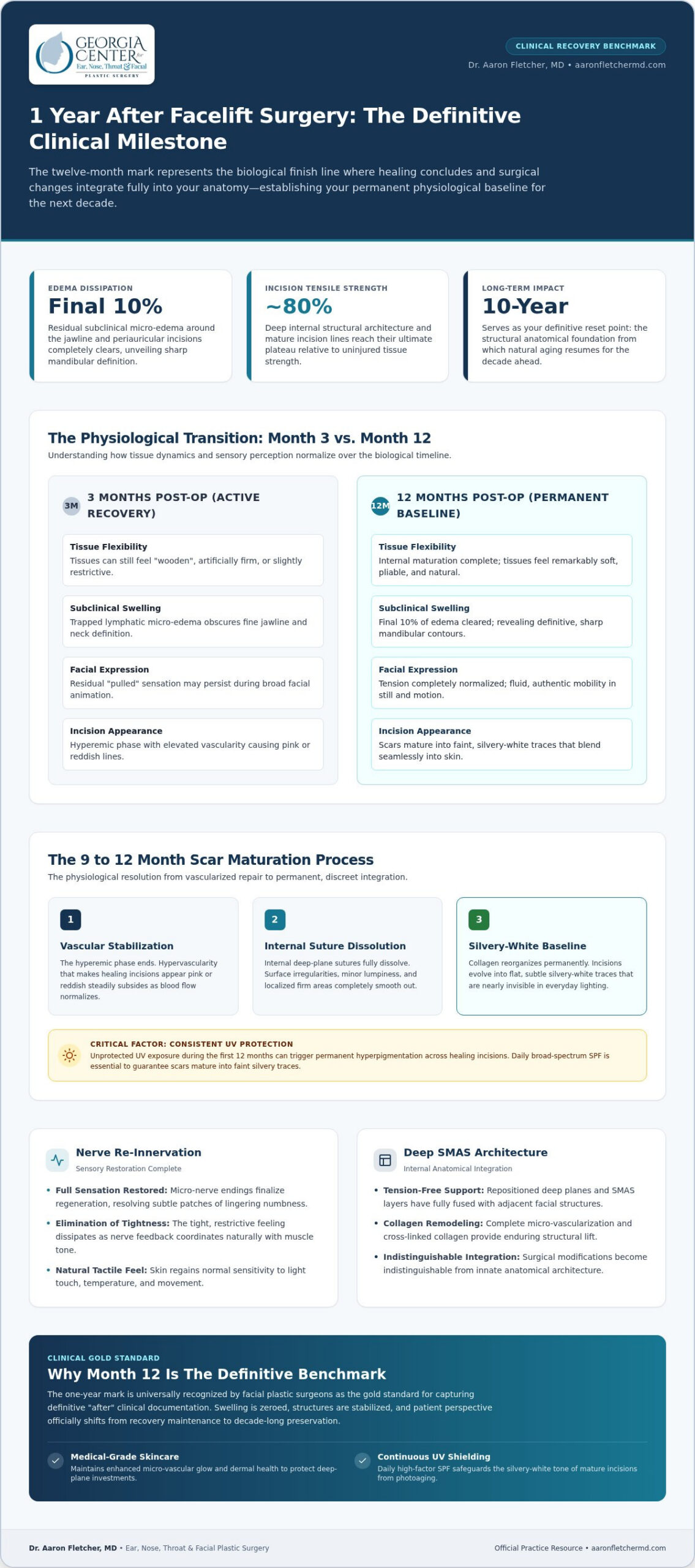
The twelve-month mark represents more than just a calendar anniversary; it’s the biological finish line where your surgical changes become your permanent anatomy. Many patients spend the first few months post-operatively focused on the minutiae of healing, but understanding what to expect 1 year after facelift surgery allows you to finally shift your perspective from recovery to long-term enjoyment. At this stage, the final 10% of subclinical micro-edema, often trapped around the periauricular incisions and jawline, has completely dissipated. This reveals the definitive, sharp definition of the mandible and neck that was previously obscured by subtle lymphatic fluid.
Transitioning from a “surgical patient” to your natural appearance in daily life brings a significant psychological shift. You’re no longer looking for signs of healing; instead, you’re simply living with your results. This milestone provides the first real opportunity to see your permanent profile without the interference of fluctuating swelling or tissue reactivity. It’s a moment of clarity where the initial investment of time and patience finally yields its full aesthetic dividend.
The Biological Timeline of Tissue Settling
During the first year, your body undergoes a sophisticated process of collagen remodeling and micro-vascularization. While initial results are visible early on, the deep planes and SMAS layers continue to integrate with the surrounding tissues for many months. Various rhytidectomy surgical techniques focus on repositioning these deeper structures to ensure a tension-free result, and by month twelve, this internal architecture is fully stabilized. The tensile strength of your incisions has plateaued at approximately 80% of uninjured tissue. This internal maturation is why your face feels significantly softer and more pliable at one year than it did at the three-month mark, when tissues can still feel “wooden” or artificially firm.
Validation of the Natural Outcome
One of the most rewarding aspects of this milestone is the relaxation of any residual “pulled” look that can sometimes persist during early healing. As the tissues settle into their final positions, your facial expressions regain their full, fluid mobility, ensuring that your results look as natural in motion as they do in still photographs. This is the moment when the surgical work becomes indistinguishable from your natural features. Your new baseline is the permanent structural foundation of the face, serving as the reset point from which you’ll continue to age naturally. Reaching this stage provides a profound sense of resolution and confidence, confirming that the meticulous surgical approach has yielded a harmonious, enduring transformation.
Visible Changes: Scar Maturation and Skin Texture at 12 Months
The visual landscape of your face reaches its definitive state at the one-year mark. When considering what to expect 1 year after facelift surgery, the most striking change is the resolution of surface irregularities. Any minor lumpiness or firm areas around the incisions, which are common during the initial six months, should have completely smoothed out as internal sutures dissolve and deep tissues fully integrate. This period marks the end of the hyperemic phase. The increased blood flow required for healing finally stabilizes, leading to a more consistent and radiant skin tone across the cheeks and jawline.
At this stage, you’re no longer viewing a work in progress. You’re seeing the final harmony between the repositioned deep structures and the overlying skin. It’s a rewarding phase where the meticulous surgical technique translates into a refreshed, natural appearance that stands up to close scrutiny in any lighting.
The Final Stage of Scar Remodeling
Physiologically, the scar maturation cycle reaches its conclusion between nine and twelve months. During this time, the hypervascularity that causes incisions to appear pink or reddish subsides. As collagen fibers reorganize, the scars transition into faint, silvery-white traces that are often nearly invisible. Clinical data indicates that the tensile strength of these scars plateaus at approximately 80% of uninjured tissue by this milestone. Consistent sun protection is the most critical factor in determining this final color. UV exposure during the first year can cause permanent hyperpigmentation that obscures the quality of the repair. If you’re curious about the typical appearance of these mature incisions, you can browse before and after galleries to see 1-year scar outcomes.
Skin Quality and Global Rejuvenation
While a facelift excels at repositioning deep structures like descending fat pads and the platysma muscle, it’s essential to distinguish between structural lifting and skin quality. By the twelve-month mark, the synergy between the new internal architecture and the skin draping creates a sophisticated, harmonious look. However, a facelift does not eliminate fine sun-damaged rhytids or surface crepiness. Mayo Clinic’s guide to face-lift recovery and outcomes notes that lifestyle factors and medical-grade skincare remain vital for maintaining the skin’s surface integrity. For patients with residual pigment or texture concerns, this is the appropriate window to consider adjunctive treatments like laser resurfacing. If you have questions about your specific progress, it’s helpful to consult with a specialist to evaluate your final baseline.
Sensory and Structural Integration: How Your Face Feels
Beyond the visible maturation of incisions, the internal healing process reaches a vital milestone at twelve months. When assessing what to expect 1 year after facelift surgery, patients often find that the most profound change is how their face feels to the touch and during movement. The early postoperative period is frequently characterized by a “wooden” or artificially firm sensation. By the one-year mark, however, the tissues have fully integrated with the underlying structural repairs. This creates a result that doesn’t just look natural but feels like your own anatomy once again. You’ll no longer experience the “twinges” or occasional sharp sensations that are common during the mid-recovery phase. These sensations are signals of active nerve repair, and their absence at twelve months indicates that the biological healing cycle is reaching its conclusion.
Nerve Regeneration and Sensory Return
During the procedure, small sensory nerve branches are temporarily disrupted. These nerves regenerate at a biological rate of approximately one millimeter per day, which translates to roughly one inch per month. This deliberate pace explains why localized numbness or “pins and needles” can persist for several months. The area around the ears is typically the final region to regain full feeling because it’s the site of the most significant tissue repositioning. According to the American Society of Plastic Surgeons’ expectations for facelift results, sensory return is a gradual process that culminates as subclinical swelling fully subsides. In clinical practice, 95-100% of sensory function typically returns by the one-year mark. This restoration of feeling is a hallmark of complete recovery, allowing you to move past the “patient” phase of your journey.
The ‘Soft’ Result: Flexibility and Movement
A successful facelift relies on the precise repositioning of the superficial musculoaponeurotic system (SMAS) rather than simply pulling the skin. By twelve months, this deep structural integration is complete. The result is a face that possesses youthful elasticity rather than surgical tightness. You’ll notice that your facial expressions are fluid and move without any sense of restriction or resistance. This structural integrity is now so stable that you can confidently resume all high-impact physical activities, from distance running to heavy weightlifting, without concern for your results. The “tight” feeling of the early months has been replaced by a soft, natural pliability that mirrors the characteristics of unoperated tissue. Your face now moves in harmony with your emotions, providing the ultimate validation of a sophisticated surgical outcome.
Longevity and Maintenance: Protecting Your Investment
Reaching the twelve-month mark is a significant milestone, but it’s also the beginning of the maintenance phase. While your surgery has effectively reset the clock, it hasn’t stopped it entirely. Understanding what to expect 1 year after facelift surgery includes recognizing that your lifestyle choices now play a primary role in the longevity of your results. Weight stability is perhaps the most critical factor; significant fluctuations can stretch the skin or deplete the facial fat that provides youthful volume. Consistent hydration and restorative sleep support the cellular health of your newly draped tissues, ensuring they remain vibrant and resilient. By identifying what to expect 1 year after facelift, you can better understand when subtle “tweakments” might be appropriate to sustain your new baseline.
Complementary Procedures for a Holistic Look
Many patients find that once their lower face and neck have settled, other areas may benefit from refinement to maintain a balanced appearance. For instance, a blepharoplasty can address heavy eyelids or under-eye bags that a standard facelift isn’t designed to treat. If you’re looking to further refine the lower third of the face, buccal fat removal can help create a more chiseled contour if it wasn’t part of your initial surgical plan. Additionally, fat grafting or high-quality fillers can address midface volume loss that naturally occurs over time, ensuring your structural results remain supported by youthful fullness and soft contours.
Skincare Protocols Post-Year One
Your skin serves as the canvas for your surgical results, making medical-grade skincare a non-negotiable part of your daily routine. Consistent application of SPF 30+ is essential to prevent UV-induced collagen breakdown and hyperpigmentation of your mature scars. Incorporating retinoids, Vitamin C, and peptides helps stimulate ongoing collagen production and maintains the skin’s elasticity. While the surgery addressed the deep planes, non-invasive skin tightening treatments can help preserve that “lifted” state as the years progress. Scheduling an annual follow-up with your board-certified surgeon ensures that any subtle changes are addressed proactively rather than reactively. If you’re ready to design a long-term preservation plan, contact our office to schedule a maintenance consultation and discuss your next steps.
Why the One-Year Mark is the Gold Standard for Final Results
The twelve-month milestone serves as the clinical gold standard for assessing your surgical outcome. While earlier months offer a glimpse of the transformation, understanding what to expect 1 year after facelift surgery provides the definitive confirmation that your tissues have reached a permanent state of harmony. Surgeons prioritize this anniversary for official “after” documentation because it represents the stabilized result, free from the subtle fluctuations of subclinical edema. This stability offers a profound sense of psychological peace, as you can finally trust that the refreshed reflection in the mirror is your enduring new baseline.
Choosing a practitioner who prioritizes long-term structural integrity over immediate, aggressive “tightness” is essential for a result that lasts. A meticulous approach ensures the face ages gracefully, avoiding the telltale signs of surgery that can appear when skin is placed under excessive tension. When evaluating what to expect 1 year after facelift results, the primary indicator of success is the absence of surgical distortion. At one year, a superior result doesn’t look like a procedure; it looks like a version of yourself from a decade ago, naturally restored and refreshed.
The Art of the Long-Term Result
Dr. Aaron Fletcher, MD utilizes a surgical technique that focuses on the underlying anatomy to ensure results that age naturally with the patient. There is a distinct difference between a “surgical” look and a “restored” look. The former is often the result of excessive skin tension, while the latter is achieved through the precise, tension-free repositioning of deeper structures. By twelve months, these layers have fully integrated, creating a look that is sophisticated and indistinguishable from unoperated tissue. For those reaching their one-year anniversary, the focus shifts from the anxiety of recovery to the long-term enjoyment of this natural appearance. Dr. Aaron Fletcher, MD emphasizes that a successful outcome is measured not by how much the skin is pulled, but by how harmoniously the facial features interact during natural animation.
Your Next Steps in the Aesthetic Journey
Now that your structural foundation is secure, you can evaluate your aesthetic goals with total clarity. This is the ideal time to plan for the next decade of facial health, ensuring your skin quality remains as vibrant as your new contours. Whether you’re assessing the need for complementary volume restoration or simply finalizing your surgical records, this milestone is a moment of resolution. You’ve navigated the complexities of healing and arrived at a place of stability. If you’re ready to finalize your journey or explore a new path toward rejuvenation, schedule your long-term follow-up or initial consultation with Dr. Aaron Fletcher, MD to ensure your results remain elegant and enduring.
Embracing Your Permanent Rejuvenation
Reaching the twelve-month milestone is a definitive moment of resolution. By this stage, the final remnants of subclinical edema have vanished, and your incisions have matured into subtle, faint traces. Understanding what to expect 1 year after facelift surgery provides the clarity needed to move forward with absolute confidence in your results. You’ve transitioned from the recovery phase to your new anatomical baseline; your face moves with natural fluidity and full sensation has returned.
Dr. Aaron Fletcher, MD, double board-certified by the American Board of Otolaryngology, utilizes his unique expertise in both functional ENT and aesthetic facial surgery to ensure your outcome is as enduring as it is sophisticated. His focus on meticulous, natural-looking surgical outcomes ensures that you don’t just look refreshed; you look like a more vibrant version of yourself. This anniversary is the perfect time to evaluate your long-term aesthetic goals and establish a preservation plan that protects your investment for the decade ahead.
Whether you’re celebrating your one-year success or just beginning to explore your options, we’re here to guide you through every step of the educational journey. Book a Consultation to Discuss Your Facelift Journey. Your most confident self is waiting to be revealed.
Frequently Asked Questions
Will my facelift scars be completely gone after one year?
Facelift scars don’t disappear entirely, but they reach clinical maturation by the twelve-month mark. During this period, the hyperemic phase ends and the initial redness fades into faint, silvery-white traces that blend with your natural skin. The quality of these marks depends heavily on your commitment to sun protection during the first year. Most patients find that their incisions are nearly invisible to the untrained eye once the remodeling process is complete.
Is it normal to still have some numbness 12 months after a facelift?
While 95% to 100% of sensory function typically returns by this milestone, very minor residual numbness around the ears can occasionally persist. Peripheral nerves regenerate at a slow, methodical pace of approximately one inch per month. If you’re still noticing subtle “pins and needles” sensations, it usually indicates that the final stages of re-innervation are still occurring. Understanding what to expect 1 year after facelift surgery helps you recognize these sensory shifts as a normal part of the final settling phase.
Can I get a revision facelift if I’m not happy with the results at one year?
The one-year anniversary is the mandatory clinical threshold for evaluating or performing any revisionary surgery. Surgeons require this twelve-month window to ensure that all subclinical micro-edema has resolved and that the micro-vascularization of the tissues is fully stable. Operating earlier is often contraindicated because the tissues are still undergoing internal remodeling. This milestone provides the structural clarity and tissue softness necessary for a board-certified surgeon to safely plan a secondary procedure.
How much aging will occur in the first year following my surgery?
You’ll continue to age at your normal biological rate, but you’re doing so from a significantly restored baseline. A facelift doesn’t stop the aging process; it resets the clock. While natural changes in skin elasticity and bone density continue, you’ll remain visually younger than your chronological peers indefinitely. The structural integrity provided by the deep plane or SMAS repositioning ensures that the most significant signs of laxity are held at bay for the foreseeable future.
What happens if I lose or gain weight one year after my facelift?
Weight stability is vital for maintaining the harmony and longevity of your surgical results. Significant fluctuations, typically those exceeding ten pounds, can either stretch the skin or deplete the facial fat that provides necessary volume. Gaining weight can obscure the sharp jawline definition achieved during surgery, while substantial weight loss may lead to premature skin laxity. Maintaining a stable weight ensures that the tension-free integration of your surgical planes remains pristine and effective.
Do I still need to wear sunblock every day once my scars have faded?
Daily application of SPF 30+ remains a non-negotiable part of your long-term maintenance protocol. Even after scars have matured into pale lines, UV exposure continues to break down the collagen and elastin that support your surgical results. Sun damage is the primary cause of skin laxity and textural irregularities. Protecting your skin every day ensures that the structural lift achieved during your procedure isn’t undermined by preventable environmental aging or pigment changes.
When should I consider non-surgical treatments like Botox after my facelift?
The one-year mark is an excellent time to evaluate maintenance options with your provider. While a facelift addresses structural sagging and deep tissue repositioning, it doesn’t eliminate dynamic wrinkles caused by muscle movement. Many patients choose to incorporate additional skincare treatments or annual follow-ups into their routine at this stage to refine their overall appearance. Focusing on medical-grade skincare ensures that your surgical foundation is supported by healthy, resilient skin as you age.
How long will the results I see at the one-year mark typically last?
The results visible at twelve months represent a permanent shift in your anatomy that typically lasts for a decade or more. Advanced techniques, such as deep plane repositioning, often provide ten to fifteen years of primary rejuvenation. Standard SMAS procedures generally maintain their integrity for seven to ten years before natural skin laxity catches up. Your individual longevity depends on genetics, skin quality, and how meticulously you follow long-term maintenance protocols like sun protection.