
The most successful facial rejuvenation isn’t measured by how much skin is removed, but by how much of your original character remains intact. When searching for a facelift near me, the goal is rarely a total transformation. Instead, it’s a desire to align your outward appearance with the vitality you feel inside. You’ve likely noticed the subtle shift of jowls or a softening neck line, yet the fear of looking over-pulled or unnatural can be a significant barrier to moving forward.
It’s understandable to feel overwhelmed by conflicting information regarding surgical techniques and the nuances of various board certifications. You deserve a clear path toward a naturally refreshed appearance that prioritizes your safety and long-term well-being. In this guide, you’ll learn how to evaluate surgical expertise, compare modern techniques, and select the ideal board-certified specialist for your facial rejuvenation journey. We’ll examine the structural foundations of the face and the methodical approach required to achieve long-lasting, sophisticated results that honor your unique anatomy.
Key Takeaways
- Understand why your search for a facelift near me should prioritize surgical expertise and clinical authority over simple geographic convenience.
- Learn how the American Board of Facial Plastic and Reconstructive Surgery serves as the gold standard for verifying a specialist’s dedication to facial anatomy.
- Compare the structural differences between SMAS and Deep Plane techniques to determine which approach offers the most natural, long-lasting correction.
- Gain a clear framework for your consultation to ensure you ask critical questions about surgical facility accreditation and patient safety protocols.
- Discover how a surgeon with dual certification in Otolaryngology and Facial Plastic Surgery ensures that aesthetic results never compromise underlying facial function.
Why ‘Facelift Near Me’ Should Mean ‘Qualified Excellence’
Searching for a facelift near me is often the first step in a deeply personal journey toward self-restoration. While physical proximity simplifies the logistics of post-operative visits, it shouldn’t be the primary metric for your decision. A successful rhytidectomy is a significant structural investment in your future appearance. For a comprehensive overview of the facelift procedure, it’s helpful to view it as a sophisticated recalibration of the facial architecture. In 2026, the standard of care has moved beyond simple skin tightening. We now focus on deep tissue repositioning to ensure results that look authentic and last for a decade or more. This evolution reflects a broader industry shift toward longevity and anatomical integrity.
The Shift from Convenience to Quality
Choosing a specialist based on their clinical authority rather than their zip code often yields a superior return on investment. High-volume, generalist practices that offer everything from body contouring to facial work may lack the nuanced precision required for the face’s complex anatomy. You should look for practitioners who focus exclusively on the face and neck. Identifying red flags is part of being a well-informed patient. Be cautious of practices that prioritize aggressive marketing or fail to provide transparent information about their surgical facility’s accreditation. A scholar-surgeon prioritizes education and safety over sales, ensuring you feel secure at every stage of the process.
Defining the Modern Facelift Goal
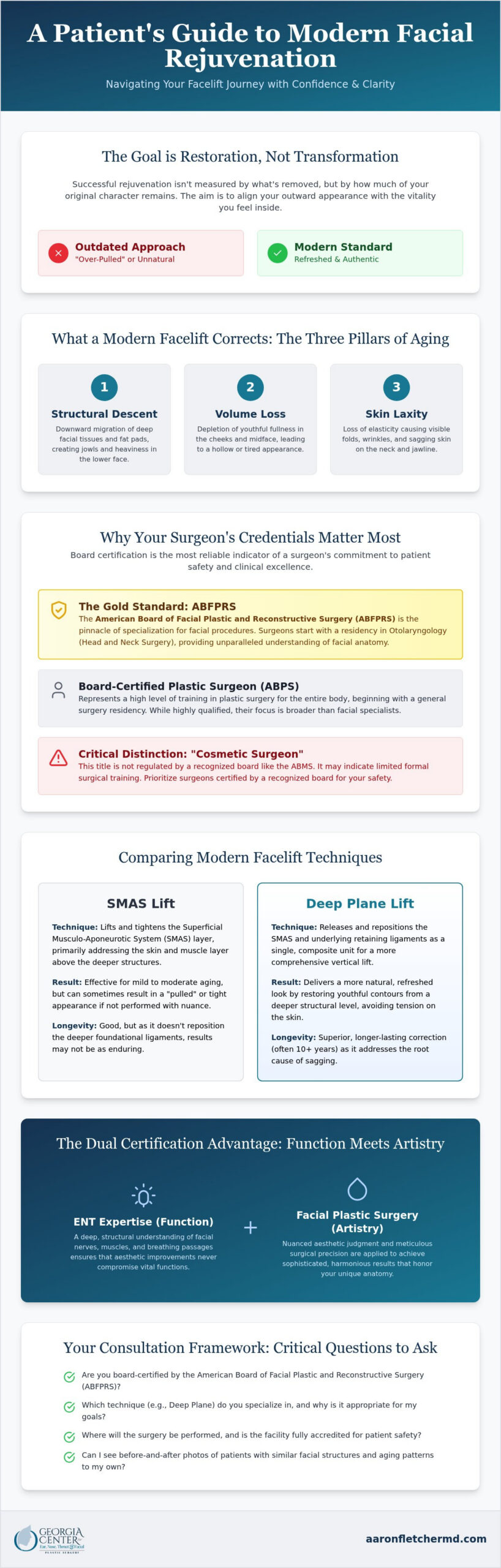
The objective of modern surgery is what we call quiet excellence. This means achieving a look that’s refreshed and vibrant without the telltale signs of having been operated on. To reach this goal, a surgeon must address the three pillars of facial aging:
- Structural descent: The downward migration of the SMAS layer and underlying fat pads that creates jowls.
- Volume loss: The depletion of youthful fullness in the cheeks and midface areas.
- Skin laxity: The loss of elasticity that leads to visible folds and neck sagging.
Restoring your self-image is an emotional process. It’s about ensuring that when you look in the mirror, the person staring back matches the energy and confidence you feel internally. This requires a methodical approach that respects your unique bone structure and skin quality. By viewing your facial rejuvenation through a clinical lens, you can move away from the anxiety of looking over-pulled and toward the confidence of looking like your best self. This guide provides the framework you need to evaluate surgical providers with the same level of care you’d apply to any major life decision.
The Critical Importance of Board Certification
When you search for a facelift near me, the results often present a confusing array of titles and accolades. However, board certification remains the most reliable indicator of a surgeon’s commitment to patient safety and clinical excellence. For those seeking facial rejuvenation, the American Board of Facial Plastic and Reconstructive Surgery (ABFPRS) is the gold standard for facial specialization. In 2026, these standards have evolved to require rigorous, ongoing peer review and evidence of clinical mastery. This ensures your surgeon isn’t just relying on past training but is actively engaged in the latest surgical safety protocols and ethical standards.
ABFPRS vs. ABPS: Understanding the Distinction
Understanding the distinction between various boards is vital for your peace of mind. While both the American Board of Plastic Surgery (ABPS) and the ABFPRS represent high levels of training, an ABFPRS-certified surgeon typically begins with a residency in otolaryngology. This specialized focus on the head and neck provides a deeper understanding of facial nerves and delicate functional structures. It’s also critical to distinguish medical designations from marketing jargon. A “cosmetic surgeon” may have limited surgical training in a variety of fields, whereas a “plastic surgeon” has met rigorous standards for board-certified plastic surgeons. This distinction is paramount when the goal is a safe, predictable outcome.
The Value of Scholarly Authority
A surgeon’s clinical authority often stems from their role as a scholar and innovator. When a practitioner contributes to medical literature or refines surgical techniques, it demonstrates a meticulous attention to detail that directly benefits their patients. This scholarly mindset is essential for complex procedures that require a balance of form and function. For instance, the ability to master facial harmony through rhinoplasty shows a breadth of expertise that informs every facelift they perform. This holistic view of facial anatomy ensures that the structural correction of the lower face remains in balance with your overall features.
Choosing a specialist who values transparency and education will help you feel heard throughout your surgical journey. If you’re looking for a practitioner who combines technical precision with a patient-centered approach, learning more about the Fletcher Method can help you identify the level of care you deserve. A scholar-surgeon doesn’t just perform a procedure; they guide you through a comprehensive educational process that prioritizes your long-term quality of life.
Comparing Modern Facelift Techniques: Deep Plane vs. SMAS
Choosing a facelift near me requires more than just looking at before-and-after photos; it involves understanding the surgical architecture used to achieve those results. Most modern procedures focus on the SMAS (Superficial Musculoaponeurotic System), which is the fibrous layer of tissue that connects your facial muscles to the skin. While a traditional SMAS lift provides excellent results by tightening and trimming this layer, the Deep Plane Facelift takes a more comprehensive approach. By operating beneath the SMAS layer, a surgeon can reposition the entire facial unit as a single entity. This method allows for a more significant lifting of the midface and jawline without the tension that often characterizes older techniques. According to Mayo Clinic’s guide to facelift surgery, understanding these technical variations is essential for setting realistic expectations regarding your recovery and final outcome.
Structural Correction vs. Surface Tightening
The most common fear among patients is looking over-pulled or “windblown.” This unnatural appearance usually happens when a surgeon relies on skin tension rather than structural repositioning. To avoid this, a meticulous specialist focuses on releasing the deep facial ligaments that tether the tissue in place. Once these ligaments are released, the tissue can be moved vertically to a more youthful position without any pulling of the skin itself. This tension-free approach is the hallmark of modern excellence. It doesn’t just look more natural; it also offers superior longevity. While less invasive surface treatments might provide a temporary refresh, a deep tissue correction typically lasts 10 to 15 years. This durability makes the procedure a long-term investment in your self-confidence.
Customizing the Surgical Approach
Every face ages differently, which is why a scholarly practitioner never uses a “one size fits all” strategy. Some patients may only require a Mini Facelift to address early signs of jowling, while others benefit from a full procedure that includes a neck lift for a seamless transition along the jawline. We also frequently incorporate volume restoration through fat transfer. As we age, we don’t just lose elasticity; we lose the subcutaneous fat that provides youthful contours. When searching for a facelift near me, it’s important to recognize that the best results come from a surgeon who treats your face as a unique anatomical puzzle. By combining structural lifting with volume replacement, we can achieve a truly holistic rejuvenation. Many patients also find that addressing chin projection alongside their facelift dramatically enhances overall facial balance; understanding the chin augmentation cost and long-term value of a permanent implant can help you evaluate whether this complementary procedure belongs in your customized surgical plan. For a detailed analysis of how these various techniques impact the overall financial and clinical commitment, you can refer to our comprehensive facelift investment and value guide. This transparent approach ensures you’re fully informed about the clinical rationale behind your customized surgical plan.
Evaluating Your Surgeon: The Consultation Framework
The initial consultation is far more than a standard medical appointment; it’s a scholarly interview where you assess the surgical philosophy of your potential provider. When searching for a facelift near me, you’re looking for a partner who prioritizes transparency and clinical precision. During this meeting, you should observe whether the surgeon takes a methodical approach to explaining your unique facial anatomy. A meticulous expert will use this time to educate you, moving beyond high-level promises to discuss the specific structural changes required for your rejuvenation. Evaluate their “Before and After” galleries with a critical eye. Look for consistent lighting, various angles, and results that honor the patient’s original identity rather than creating a generic, operated-on appearance. This attention to detail in their portfolio often reflects the precision they bring to the operating suite.
The 5 Essential Questions for Your Specialist
A scholarly surgeon welcomes rigorous questioning. It’s the best way to establish a sense of security and professional rapport. Use these questions to gauge their depth of expertise:
- Procedure Volume: “How many procedures of this specific type do you perform annually?” High frequency in facial surgery is a primary indicator of refined technique.
- Anatomical Strategy: “Can you explain the specific anatomical changes you plan to make for my face?” This reveals if they use a “one size fits all” approach or a customized plan.
- Safety Protocols: “What is your protocol for managing the facial nerve during a deep plane lift?” This question assesses their technical mastery and commitment to functional safety.
- Facility Standards: “Is your surgical facility accredited, and what are the specific qualifications of your anesthesia providers?”
- Recovery Management: “How do you handle post-operative care to ensure a seamless transition back to my daily life?”
Assessing the Patient-Centered Perspective
The most distinguished practitioners function as both technicians and caring guides. They prioritize your quality of life and long-term well-being over aggressive surgical intervention. This patient-centered perspective is evident in how they discuss the recovery timeline. They won’t downplay the healing process; instead, they’ll provide a transparent, day-by-day framework for what you can expect. A meticulous expert handles the educational aspect of the journey by ensuring all your questions are answered before you leave the room. If you’re ready to experience a consultation rooted in transparency and clinical excellence, you can schedule your evaluation with our specialized team. This deliberate flow of information is designed to replace anxiety with clarity, allowing you to move forward with quiet confidence.
The Fletcher Method: Where Artistry Meets ENT Expertise
The Fletcher Method represents a convergence of specialized disciplines. While many providers offer facial surgery, few possess the dual certification in Otolaryngology and Facial Plastic Surgery that defines our practice. This combination is a significant advantage for anyone seeking a facelift near me. An otolaryngologist’s foundational training provides an unparalleled depth of knowledge regarding the intricate nerves, muscles, and functional structures of the head and neck. When this clinical precision is paired with the artistic eye of a facial plastic surgeon Atlanta patients trust for both form and function, the result is a procedure that prioritizes both form and function. This dual-lens approach offers several distinct benefits:
- Nerve Preservation: A deep understanding of cranial nerve pathways ensures maximum safety during deep-plane repositioning.
- Functional Integrity: Ensuring that aesthetic changes don’t interfere with natural facial expressions or muscle movement.
- Structural Mastery: Utilizing ENT precision to rebuild the foundation of the face for longer-lasting, stable results.
Our commitment to modern excellence means providing high-end care rooted in scholarly evidence. We avoid hyperbolic claims in favor of quiet, predictable results that honor your unique identity. By focusing on the underlying architecture of the face, we ensure that your rejuvenation looks authentic rather than operated on. This methodical approach is designed to instill a sense of security, knowing your surgeon understands the “wiring” of the face as intimately as its outward appearance.
A Holistic Approach to Facial Well-being
Structural integrity is the secret behind a result that looks subtle and lasts for years. By understanding the deep layers of the face, we can ensure that every adjustment supports the overall health and harmony of your features. The Fletcher philosophy views the surgeon as both a meticulous technician and a caring guide. We don’t just perform a surgery; we manage a comprehensive transition. Moving from the research phase to a personalized surgical consultation is a significant step in your journey. It’s where we translate broad clinical principles into a specific roadmap tailored to your unique anatomy and quality of life goals.
Your Journey Toward Renewed Confidence
Modern surgical techniques have reached a level of safety and efficacy that allows for transformative changes with manageable recovery timelines. The power of a procedure tailored to your specific identity cannot be overstated. It’s about more than just correcting jowls or neck laxity; it’s about restoring the confidence that comes with looking as vibrant as you feel. We invite you to experience a compassionate, patient-centered journey that honors your individuality and prioritizes your long-term well-being. If you’re ready to take the next step toward a naturally refreshed appearance, we encourage you to Schedule a comprehensive consultation with Dr. Aaron Fletcher, MD. This collaborative partnership is dedicated to providing the clarity and technical excellence you deserve.
Securing Your Aesthetic Future Through Precision
Selecting a facelift near me is a significant decision that impacts your quality of life for years to come. By prioritizing board certification and technical mastery over simple geographic convenience, you ensure your results are both safe and sophisticated. You now possess the framework to evaluate surgical philosophy, from the structural depth of the deep plane technique to the clinical authority of a specialist who understands the face’s complex anatomy. This knowledge replaces uncertainty with clarity, allowing you to approach your rejuvenation journey with a sense of stability and order.
Dr. Aaron Fletcher, MD provides a unique perspective as a specialist board-certified in both Otolaryngology and Facial Plastic Surgery. This dual-certification ensures that your aesthetic goals are achieved with the meticulous precision of a technician and the compassionate care of a dedicated guide. Our patient-centered, scholarly approach to facial aesthetics focuses on natural-looking surgical outcomes that honor your individual identity. When you’re ready to move from the research phase to a personalized plan, we’re here to answer every question with transparency. Begin your transformation with a meticulous consultation at the Georgia Center for ENT and discover the confidence that comes from specialized expertise.
Frequently Asked Questions
How do I find the best facelift surgeon near me?
To find the best facelift near me, you should prioritize board certification through the American Board of Facial Plastic and Reconstructive Surgery. Look for a specialist who focuses exclusively on the face and neck rather than a generalist. It’s essential to review their clinical authority by examining peer-reviewed contributions and consistent before-and-after galleries. This ensures you receive the highest standard of care from a scholarly practitioner who values transparency.
What is the difference between a traditional facelift and a deep plane facelift?
A traditional SMAS lift primarily tightens the fibrous tissue layer under the skin, while a deep plane facelift repositions the entire facial unit by releasing deep tethering ligaments. This advanced technique allows for a more significant, tension-free lift of the midface and jawline. By operating beneath the SMAS layer, a surgeon can achieve a naturally refreshed appearance that avoids the over-pulled look and provides superior longevity compared to traditional methods.
What is the average recovery time for a facelift in 2026?
Most patients can expect a social recovery timeline of approximately 10 to 14 days. During this period, initial swelling and bruising gradually subside, allowing you to return to public activities with confidence. While the primary healing occurs within the first two weeks, the final structural refinement can take several months to fully settle. A meticulous specialist will provide a detailed, day-by-day framework to ensure your recovery is predictable and well-managed.
At what age should I consider getting a facelift?
There is no chronological perfect age for a facelift, as the decision depends entirely on your unique facial anatomy and the degree of structural descent. Many patients begin to notice significant jowling or neck laxity in their late 40s or 50s. The goal is to perform the procedure when the skin still retains some elasticity, which often leads to more seamless, long-lasting results that age naturally with your features.
Will I have visible scarring after my facelift procedure?
Modern surgical techniques prioritize the discreet placement of incisions within the natural contours of the ear and hairline. When performed by a meticulous expert, these scars become virtually imperceptible once fully healed. The key to minimizing visibility is a tension-free closure, which ensures the skin isn’t pulled during the healing process. This methodical approach allows you to wear your hair up without concern for telltale signs of surgery.
Is a facelift better than non-surgical thread lifts or fillers?
A facelift is the only definitive solution for correcting significant structural sagging and muscle laxity. While fillers address volume loss, they cannot reposition descended tissue. Similarly, thread lifts provide only a temporary, subtle lift that lacks the durability of a surgical correction. When searching for a facelift near me, it’s important to recognize that surgery offers a comprehensive, long-term investment in your appearance that non-surgical alternatives simply cannot match.
How long do the results of a modern facelift typically last?
The results of a modern, deep-tissue facelift typically last between 10 and 15 years. Longevity depends on the surgical technique used and your individual skin quality. Procedures that address the underlying structural foundations of the face, such as the deep plane method, tend to provide more durable outcomes than surface-level tightening. While the natural aging process continues, you’ll generally look significantly younger than you would have without the surgical intervention.
Does insurance cover any part of a facelift or neck lift?
Insurance providers generally don’t cover facelifts or neck lifts, as these are considered elective cosmetic procedures. However, if you are undergoing concurrent functional surgery, such as certain ENT-related corrections, those specific portions of the care might be eligible for coverage. It’s always advisable to consult with your provider and the surgical office to understand the clinical rationale and any potential financial considerations before moving forward with your treatment plan.