
The incision approach can influence recovery as much as the calendar. The brow lift recovery process typically allows most people to return to work or school within 10 to 14 days, while final results may take until after the six-month mark to emerge. Recovery is generally easier after an endoscopic lift than after a coronal lift, so the technique matters when planning time away and setting expectations.
It’s understandable to wonder when swelling will ease and you can return to your usual routine. Preparation matters too: following your surgeon’s instructions and planning a gradual return to activity can make recovery more manageable. This guide covers practical steps before surgery, what to expect during early healing, how endoscopic and coronal recovery may differ, and ways to support your results over time.
Key Takeaways
- Plan for an initial recovery period of about 10 to 14 days, while allowing more time for swelling and bruising to settle.
- Prepare for time away by arranging support and planning a gradual return to work, exercise, and everyday activities.
- Endoscopic and coronal techniques can involve different recovery experiences, so the surgical approach matters when setting expectations.
- Daily sun protection and attentive skin care can help support your results over time.
How Can You Maintain Your Brow Lift Results Post-Recovery?
During the first week, swelling and bruising can affect the forehead, brows, and under-eye area. These changes may increase during the first few days, then improve substantially during weeks 1-2. Temporary changes in forehead or scalp sensation may occur during recovery.
Pain is generally managed with medication prescribed for your recovery, taken according to your surgeon’s instructions. Follow-up care includes keeping scheduled visits and following guidance for dressings, medication, incision care, scar treatment, and activity restrictions. Contact your surgeon promptly about progressive pain that prescribed medication does not relieve; after endoscopic surgery, report vision changes. Contact your healthcare provider promptly if you develop a fever during recovery.
To manage early swelling, rest with your head elevated, especially while sleeping during the first week. Soft gel packs or iced gauze pads may help when used as directed; iced gauze is recommended for the first 48 hours. Keep your face calm for two weeks, and avoid strenuous exercise until your surgeon clears a gradual return. These measures support healing without placing unnecessary strain on recovering tissues.
- Track changes in swelling, bruising, pain, and sensation between follow-up appointments.
- Use only the incision-care products and medications recommended for your recovery.
Results become clearer as swelling resolves and the brow settles. Final results are generally visible after the six-month mark, while residual swelling can take up to six months to resolve. Brow lift results can last 10 years or more with daily sun protection and medical-grade skin care. Daily sunscreen with SPF 45 or higher helps protect healing skin and supports long-term maintenance.
Healing varies by surgical approach and from person to person. Consistent aftercare, sun protection, and follow-up visits help you care for your results and identify complications that need attention.
What Pre-Operative Steps Can Ensure a Smoother Brow Lift Recovery?
Preparation begins before surgery. Tell your plastic surgeon about all medications and supplements you take, including aspirin and anti-inflammatory medicines. Some can increase bleeding risk, so discuss any changes before stopping a prescribed medication. Guidance advises avoiding medicines and supplements that increase bleeding risk for two weeks before surgery. Aspirin and anti-inflammatory medicines are generally avoided for two weeks before and after endoscopic surgery unless you have discussed them with your surgeon.
Nicotine can affect healing, so avoid smoking, vaping, and nicotine products for six weeks before and after surgery. Follow advice to avoid alcohol for several weeks before and after surgery. Avoid chemically treating your hair for two weeks before surgery, and avoid tanning beds and sun exposure for at least two weeks beforehand. These steps help reduce avoidable recovery concerns.
Plan time away from work around your duties and the surgical approach. Most people can return to work or school within 10 to 14 days, while physically demanding work may require a longer break. Arrange help with lifting and household tasks. For the first few weeks, avoid lifting more than 10 pounds; strenuous exercise and bending are also restricted during the early healing period.
Resume activity in stages, not according to appearance alone. Light daily tasks can return as comfort allows, while other exercise and heavy lifting are generally resumed gradually after three weeks. Light to moderate exercise may be possible after one month. The timing depends on healing and the activity’s intensity. Keep the head elevated during early recovery, and follow instructions for facial care and incision protection. Discuss your desired brow position, youthful appearance goals, and any concerns involving the eyelids during surgical planning. A personalized discussion about brow lift surgery can help align recovery planning with your work and activity needs.
Returning to work or school after surgery
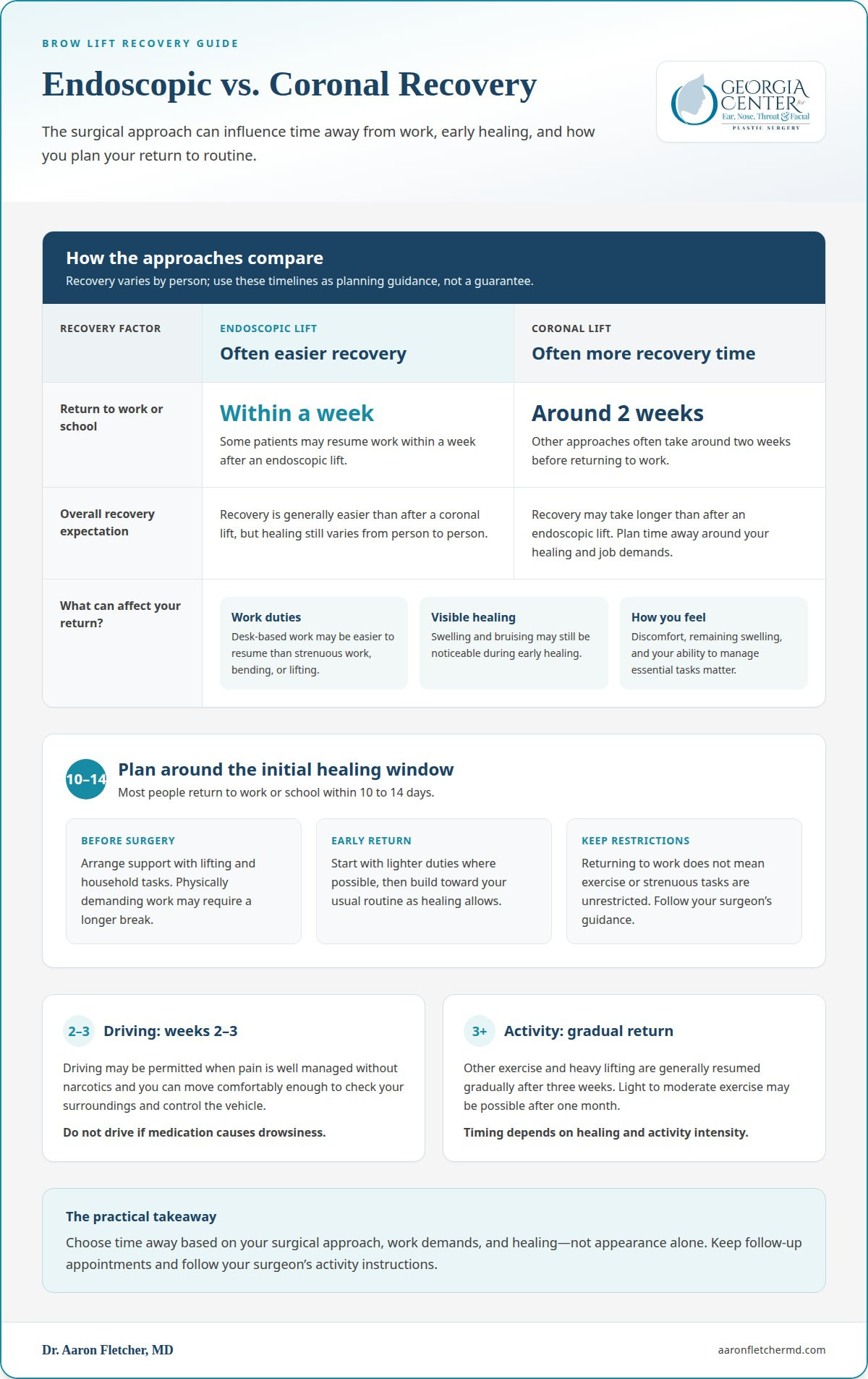
Most people return to work or school within 10 to 14 days after a brow lift. The initial healing period often spans the same interval, so plan time away rather than assuming you’ll feel ready immediately. Planning around the brow lift recovery process also means considering the surgical technique: patients may resume work within a week after an endoscopic brow lift, while other approaches often take around two weeks.
Consider your job demands when planning time away. Desk-based work may be easier to resume than a role involving strenuous activity, bending, or lifting. Swelling and bruising may still be noticeable during early healing, even if you feel ready to work. If your job involves frequent public interaction, think about how visible changes around your forehead and eyebrows may affect your comfort when you return.
Driving requires more than reaching a particular date. During weeks 2-3, driving may be permitted when pain is well managed without narcotics and mobility has returned. You need to move comfortably enough to check your surroundings and control the vehicle. If pain medication causes drowsiness, don’t drive. Arrange rides for appointments or errands until these conditions are met.
Plan a gradual return to school or work. Start with lighter duties where possible, then build toward your usual routine as healing allows. For example, someone who works at a computer may be able to return before someone whose job requires repeated lifting. As the brow lift recovery process progresses, the tasks involved, your discomfort, and any remaining swelling all affect how manageable a workday feels.
You can resume everyday activities in stages, but returning to work does not mean you can exercise without restrictions. Follow the activity limits in your recovery instructions, especially for strenuous tasks. Keep follow-up appointments so your surgeon can assess healing and discuss next steps. A safe return depends on both the time elapsed and your ability to carry out essential tasks.
Endoscopic versus coronal brow lift recovery
The main difference is the incision approach. An endoscopic brow lift uses smaller incisions, usually hidden within the hairline, and recovery is generally easier than after a coronal brow lift. These smaller access points are associated with faster recovery than other brow lift techniques. This may affect visible healing and when you resume cosmetic routines, but careful aftercare is still important.
With endoscopic surgery, swelling and bruising often peak 36 to 48 hours after surgery. Pain and discomfort should begin decreasing within 48 hours. Forehead or scalp numbness often returns within a few weeks. Brows can look excessively elevated during the first 2 to 3 weeks as tissues settle; the final position is expected at approximately 6 months. These early changes are part of the evolving appearance, not a reliable preview of the result.
Incision care also shapes the endoscopic recovery. Avoid rubbing, massaging, or placing tension on incisions for at least 4 weeks. Patients are advised to sleep with the head elevated for 4 weeks and avoid vigorous exercise for at least 3 weeks. Follow medication and wound-care directions closely. These measures protect healing tissue while the brow settles into position.
A coronal approach differs in its recovery, and endoscopic recovery is generally easier. The technique best suited to facial rejuvenation depends on the surgical plan and the changes being addressed. The key takeaway: compare recovery expectations alongside the intended lift, not incision size alone. Your surgeon can explain how the chosen approach affects healing, activity, and follow-up. Contact Dr. Aaron Fletcher, MD to discuss which brow lift approach fits your goals and recovery priorities.
Dr. Aaron Fletcher, MD: Brow Lift Surgery
Dr. Aaron Fletcher, MD offers Brow Lift Surgery for patients considering a change to their brow position and forehead appearance. A consultation is an opportunity to discuss your goals, review the surgical approach, and understand how incision placement may shape healing and aftercare.
Ask practical questions about time away from work, activity restrictions, incision care, and follow-up visits. Discussing these details before surgery can help you arrange support at home and set realistic expectations. Your facial features and desired outcome also help guide the choice of approach.
If you’re considering surgery or want to understand what recovery may involve for your goals, contact Dr. Aaron Fletcher, MD.
Take the Next Step With a Clear Plan
Your recovery plan should consider more than the change you want in your brow position. Think about how surgery fits your work, daily responsibilities, and broader facial goals. Sharing these priorities in a consultation can focus the discussion on the approach, healing expectations, and practical support that matter to you. Planning the brow lift recovery process is easier when you understand how your goals and everyday routine fit together.
Dr. Aaron Fletcher, MD also offers facelift, blepharoplasty, and rhinoplasty. These procedures may be relevant if your goals include other areas of facial appearance in addition to your brow concerns. A thoughtful conversation can help clarify which concerns to address and how to plan for recovery.
To discuss your goals and next steps, contact Dr. Aaron Fletcher, MD. A well-informed decision begins with a plan shaped around your needs.
Frequently Asked Questions
What happens after a brow lift procedure?
A brow lift is an outpatient procedure, followed by healing at home. Swelling and bruising may increase during the first few days and can extend across the forehead, brows, or under-eye area. Keep your head elevated while resting, and follow your postoperative instructions for dressings and incision care. Set up your recovery space so essentials are within easy reach without bending or lifting.
How do I care for myself after surgery?
Follow your surgeon’s directions for medication, wound care, dressings, and activity. During the first 48 hours, iced gauze pads may be used on the eyes and forehead as instructed. Keep your head raised while resting, and avoid rubbing or putting tension on incisions. Before washing your hair or returning to a salon, follow your care instructions. Keep follow-up appointments so healing and incision care can be reviewed.
What can I expect after surgery?
Swelling, bruising, soreness, tightness, and temporary numbness can occur after surgery. These symptoms may be most noticeable during the first few days, then gradually ease as healing progresses. Forehead or scalp numbness often returns within a few weeks. After an endoscopic procedure, the brow may look unusually elevated during early healing. Give the tissues time to settle before judging the appearance.
When can you expect to return to normal activities after a brow lift?
Most people return to work or school within 10 to 14 days, while exercise and strenuous tasks require a more gradual return. Driving during weeks 2-3 is permitted when pain is well managed without narcotics and mobility has returned. For example, a job involving lifting may require more recovery time than desk work. Resume activities according to your surgeon’s instructions, rather than using appearance alone as a guide.
When should I see my healthcare provider?
Contact your healthcare provider promptly for progressive pain that prescribed medication does not relieve, or for vision changes after endoscopic brow lift surgery. Cleveland Clinic advises contacting your healthcare provider immediately for a fever of more than 100 degrees Fahrenheit (37.77 degrees Celsius). If a new symptom concerns you, describe when it began and how it has changed when you call. Clear details help your care team assess the concern.
What is the typical recovery timeline after a brow lift?
The early healing period generally covers the first 10 to 14 days, when bruising and swelling begin to improve and many patients return to work or school. Activity then increases gradually, with strenuous exercise potentially resuming later than everyday tasks. Brow lift recovery is mostly complete by the fifth or sixth month, and final results generally emerge after the six-month mark as the brow settles.