
The smaller-incision option isn’t automatically the better fit. In the endoscopic brow lift vs. traditional brow lift decision, the approach depends on your forehead height, hairline, degree of brow descent, and skin laxity. Endoscopic surgery uses small incisions and a camera to reposition underlying tissues; a traditional lift uses a longer incision and may allow more direct removal of excess skin.
It’s understandable to focus on incision size, but the right comparison also considers the correction your anatomy needs and the recovery involved. An endoscopic approach may suit mild to moderate brow drooping, while a traditional technique can provide more correction when sagging or forehead furrows are pronounced. Recovery varies by technique and individual, and healing continues beyond the first few days after surgery. This article explains how the procedures differ, what recovery may involve, and how forehead height, hairline, and brow descent help guide the choice.
Key Takeaways
- Understand how the endoscopic approach uses a camera and small incisions, while a classic coronal lift uses a longer scalp incision.
- Plan for recovery with the understanding that swelling, bruising, and return to normal activities can vary by technique and individual healing.
- Use forehead height, hairline position, skin laxity, and the pattern of brow descent to understand which approach may better suit your goals.
- Compare the techniques by the degree of correction needed, incision placement, and tissue adjustment, rather than choosing by incision size alone.
What is an Endoscopic Brow Lift?
An endoscopic brow lift uses small incisions and a camera to reposition brow tissues. A traditional coronal lift uses one longer incision in the scalp to adjust tissue directly.
Endoscopic Incisions and Instruments
The endoscopic technique uses several small incisions just behind the hairline. Through them, the surgeon guides an endoscope, a small camera that shows the underlying tissue, and uses instruments to release and reposition brow muscles. The endoscopic approach uses smaller incisions and typically avoids direct skin removal. This less invasive access can address brow descent, forehead wrinkles, and a heavy appearance around the eyelids.
Incision Placement and Scarring
Endoscopic incisions sit behind the hairline, where hair may conceal the incision lines. A traditional coronal lift uses one long incision across the top of the scalp, typically behind the hairline; some traditional techniques extend it from ear to ear. Incision length and placement affect where scars may occur, but neither technique eliminates scarring. After endoscopic surgery, swelling decreases over several weeks as incision lines refine and fade. These differences may matter if concealing the incisions within the hairline is a priority.
Results Duration and Complications
There is no single duration that applies to every endoscopic or traditional brow lift. Results change as the face continues to age, and the extent of correction and tissue characteristics influence how the brow looks over time. Both procedures carry surgical risks and possible complications. The endoscopic approach may reduce some complication risks compared with traditional surgery, but specific risks depend on the procedure and individual circumstances.
| Technique | Incision and access | Tissue adjustment | Healing detail |
|---|---|---|---|
| Endoscopic | Several small incisions behind the hairline; camera-guided view | Releases underlying muscles without removing skin | Swelling and incision lines continue to settle over several weeks |
| Classic coronal | One long incision across the scalp, typically behind the hairline | Direct muscle tightening and excess-skin removal | Longer incision across the scalp |
Choose an approach by matching the needed tissue correction and incision placement to your forehead and hairline.
Recovery time
Recovery follows a different pace after each procedure. After an endoscopic lift, initial healing may take 10 to 14 days, while complete recovery can continue for several months.
Recovery Timelines by Procedure
After an endoscopic brow lift, patients may return to normal activities in about 7 to 10 days. Initial healing may take 10 to 14 days, and complete recovery can take several months. Traditional brow lift recovery may take two weeks or more, partly because of more extensive tissue manipulation. These timelines describe different milestones: resuming routine activities does not mean every aspect of healing is complete.
Postoperative Symptoms and Healing
Swelling and bruising commonly shape early recovery after an endoscopic procedure and often ease within a week or two. Postsurgical discomfort is generally minimal, though each patient’s experience differs. As swelling decreases, incision lines continue to refine over several weeks. This gradual change can affect how refreshed the facial area looks at first. The early appearance is not the final result while tissues and muscles heal.
Returning to Normal Activities
Patients may return to work and other normal activities in about 10 to 14 days after an endoscopic lift; some may resume sooner. The 7-to-10-day estimate for normal activities offers another useful reference, not a separate guarantee. Traditional methods may require two weeks or more before recovery allows a return to routine. The extent of tissue adjustment and the body’s healing response shape this progression, so activity should build gradually rather than follow appearance alone.
For either procedure, distinguish returning to routine activities from full recovery. You may feel ready to resume everyday tasks while swelling or incision lines are still healing. Recovery is a sequence, not a single date: initial healing, a gradual return to activities, and continued tissue settling. Keeping these stages separate helps set practical expectations for work, social plans, and the refreshed appearance you hope to see.
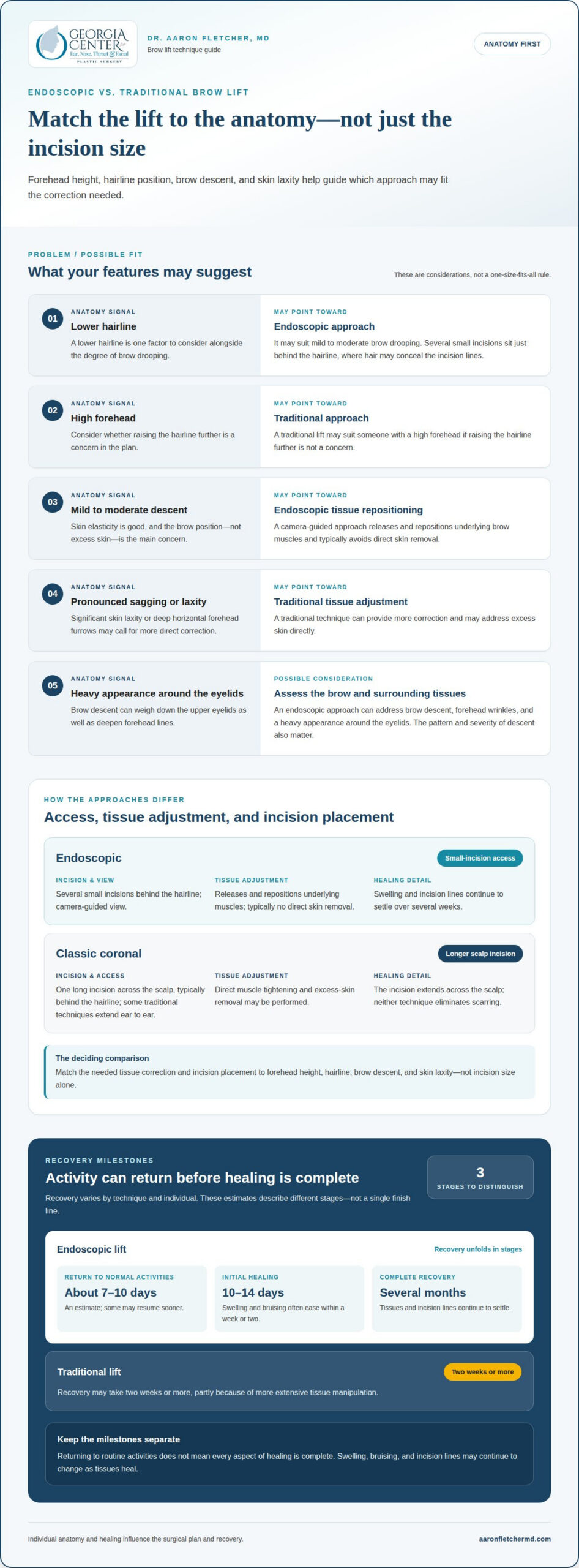
Choosing a technique based on forehead height, hairline, and brow descent
The right approach depends on how brow position, forehead height, and skin laxity relate to your facial features. A lower hairline, deep forehead furrows, or brow descent affecting the upper eyelids can each raise different surgical considerations.
Forehead Height and Hairline
An endoscopic brow lift vs traditional comparison starts with forehead height and hairline position. An endoscopic lift may suit someone with a lower hairline who wants to address mild to moderate brow drooping. A traditional lift may suit someone with a high forehead if raising the hairline further is not a concern. The surgical plan should account for the hairline’s position before surgery, not just the eyebrows.
Brow Descent and Skin Laxity
Gravity and skin laxity can lower the eyebrows, weigh down the upper eyelids, and deepen horizontal forehead lines. An endoscopic approach may suit mild to moderate descent when skin elasticity is good. More pronounced sagging, significant laxity, or deep horizontal furrows may make a traditional technique more suitable because it can address excess skin directly. The pattern and severity of brow descent matter as much as the visible lines.
The location of lines also helps clarify the concern. Deep worry lines between the eyebrows, known as glabellar lines, differ from horizontal furrows across the forehead. A brow lift repositions underlying muscles and tissues to open the eye area, while a traditional approach may provide more correction for severe sagging or deep furrows. These distinctions help focus rejuvenation on the structures causing the change, rather than treating every wrinkle as the same issue.
During a consultation, the assessment connects forehead height and hairline position with brow movement, skin laxity, and upper-eyelid heaviness. Mild outer-brow descent with good elasticity, for example, differs from heavy sagging and deep forehead creases. For an endoscopic brow lift vs traditional decision, the technique should match that pattern and the desired degree of correction. With a high forehead, consider whether lifting could raise the hairline further; a lower hairline may support considering an endoscopic approach.
Comparison with traditional brow lift surgery
An endoscopic brow lift vs traditional brow lift comparison is most useful when it considers the correction needed, not incision size alone. Traditional surgery may use an incision from ear to ear, allowing direct muscle tightening and removal of excess skin. That access can provide more dramatic correction for severe sagging or deep furrows. Endoscopic surgery uses a camera to guide tissue adjustment through smaller incisions, with less skin trauma than older techniques.
The endoscopic method lets the surgeon view underlying tissues on a screen and adjust the brow without removing skin. Traditional surgery directly addresses skin laxity, which may matter when excess skin is a central concern. Both are surgical approaches to brow rejuvenation, but they affect tissues differently. The endoscopic brow lift vs traditional surgery decision therefore depends on your anatomy, degree of brow descent, and the correction being considered.
In the United States, insurance coverage for brow lift surgery depends on the terms of the individual plan. A procedure pursued for appearance may be treated differently from one connected to a documented functional concern, such as upper-eyelid skin affecting vision. Plan requirements and clinical documentation influence coverage decisions.
Relevant specialty training and a clear explanation of the proposed technique, tissue changes, and potential complications are important considerations for brow lift surgery. Dr. Aaron Fletcher, MD performs Brow Lift Surgery. A careful discussion can connect your concerns with the surgical approach and degree of correction being considered.
To discuss the surgical options and your goals, schedule a Brow Lift Surgery consultation with Dr. Aaron Fletcher, MD.
Dr. Aaron Fletcher, MD: Brow Lift Surgery
Dr. Aaron Fletcher, MD offers Brow Lift Surgery for people considering a surgical approach to brow descent, forehead lines, or changes around the upper eyelids. After comparing endoscopic and traditional techniques, discuss how your forehead height, hairline, skin laxity, and desired degree of correction relate to the options. These details help frame a thoughtful decision about brow and forehead rejuvenation.
If your concerns also involve eyelid skin or broader facial aging, Blepharoplasty or Facelift may be relevant to discuss alongside brow surgery. Each procedure addresses different features, so the conversation can focus on your concerns and the approach that fits them. Contact Dr. Aaron Fletcher, MD to discuss Brow Lift Surgery and your questions about the techniques.
Take the next step with clarity
Choosing between an endoscopic brow lift and a traditional brow lift is not simply a choice between smaller and larger incisions. It is about addressing your concerns while respecting your facial features and priorities. Use what you have learned to identify the questions that matter most to you, such as how an approach may affect your hairline or which areas need attention.
Dr. Aaron Fletcher, MD also offers Facelift, Blepharoplasty, and Rhinoplasty. These procedures address different facial concerns and may be relevant to a broader conversation about your goals. A personalized evaluation can connect your priorities with appropriate surgical options, without assuming one technique suits everyone.
Contact Dr. Aaron Fletcher, MD to discuss your brow lift questions and possible next steps. A thoughtful conversation can help you move forward with greater clarity and confidence.
Frequently Asked Questions
What is a Classic Forehead Lift?
A classic forehead lift is a traditional brow procedure that accesses the forehead through a long scalp incision, typically placed behind the hairline. The surgeon can adjust underlying muscles directly and remove excess skin. This approach may be considered when pronounced sagging or deep furrows call for more extensive correction. Incision placement and the planned change in brow position are important parts of the surgical discussion.
What is the recovery time?
Recovery varies, but initial healing after an endoscopic brow lift may take 10 to 14 days, with complete recovery continuing for several months. Traditional brow lift recovery may take two weeks or more. Swelling and bruising can affect early appearance, so returning to routine activities does not mean healing is finished. Work plans and social commitments should account for both early healing and continued tissue settling.
What should I expect during the procedure?
The surgical plan depends on the chosen technique and the areas being addressed. An endoscopic brow lift is usually performed under general anesthesia or local anesthesia with sedation. The surgeon uses a camera to view underlying tissue and instruments to adjust brow muscles. Before surgery, the planned incision locations and intended brow position are reviewed so you can understand how the procedure relates to your facial features.
What is the difference between an endoscopic and traditional brow lift?
An endoscopic lift accesses the forehead through several small incisions and uses a camera to guide tissue adjustment. A traditional approach generally uses a longer scalp incision, allowing more direct muscle tightening and removal of excess skin. The practical difference is how the surgeon reaches and treats the tissues. The endoscopic method involves less skin trauma, while a traditional lift may address more pronounced laxity.
Who is a good candidate for an endoscopic vs traditional brow lift?
An endoscopic approach may suit someone with mild to moderate brow drooping and good skin elasticity. A traditional lift may better match significant skin laxity, heavy sagging, or deep forehead furrows. Hairline position matters too: a lower hairline may favor consideration of endoscopic access, while a high forehead may suit a traditional approach if further hairline elevation is not a concern. The pattern of descent helps guide the choice.
How is an endoscopic brow lift performed step by step?
An endoscopic brow lift generally follows a sequence: the surgeon places several small incisions behind the hairline, inserts a camera to view the underlying tissue, then uses instruments to release and reposition brow muscles. The technique does not remove skin. The intended change is planned around brow position and forehead concerns, with incision placement chosen to provide access while keeping the openings concealed by the hairline.