
What matters most may not be the exact day your eyelid swelling disappears, but whether it is steadily improving. If you’re wondering how long does blepharoplasty swelling last, it’s understandable to watch every change closely, especially when bruising or puffiness looks uneven. Swelling often peaks in the first 48 to 72 hours, then begins to ease. Noticeable bruising and swelling commonly improve over 10 to 14 days, while subtle puffiness can take longer to settle.
Recovery doesn’t follow one exact schedule, and temporary differences between the eyelids can be unsettling. This guide explains what swelling may look like from the first few days through the following weeks and months, what can influence your recovery, and which symptoms warrant prompt guidance from your surgeon. The overall trend matters: gradual improvement is generally reassuring, while sudden or worsening changes deserve attention. Dr. Aaron Fletcher, MD, a board-certified otolaryngologist and facial plastic surgeon, provides individualized evaluation and follow-up to help patients understand their healing and address concerns.
Key Takeaways
- The answer to “how long does blepharoplasty swelling last” depends on your procedure and individual healing, so use general timelines as a guide, not a personal prediction.
- Pay attention to how swelling changes over time. Uneven puffiness alone can’t determine whether healing is normal.
- Know which changes, such as sudden worsening or vision changes, call for prompt guidance from your surgeon.
- Follow your surgeon’s written directions for medication, compresses, activity, and incision care rather than relying on a one-size-fits-all routine.
- Sharing when swelling began, how it has changed, and any accompanying symptoms can help your surgeon assess your recovery.
How long does blepharoplasty swelling last? A stage-by-stage overview
Swelling is a common part of healing after blepharoplasty, but its degree and duration vary from person to person. The type and extent of the procedure, your individual healing response, and your surgeon’s instructions all shape recovery. A general timeline can help set expectations, but it can’t predict exactly when your eyelids will look or feel settled.
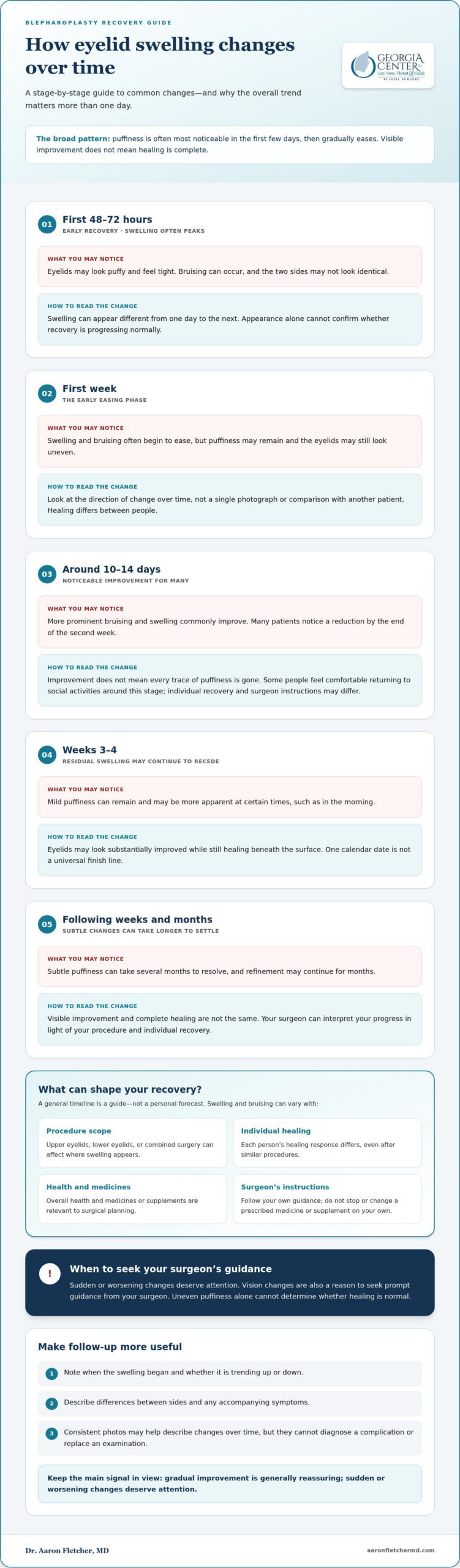
In brief: swelling is often most noticeable during the first few days, then gradually improves over the following weeks. Bruising and more prominent puffiness commonly ease within 10 to 14 days, while subtle swelling can take several months to resolve. Visible improvement is not the same as complete healing.
What swelling may look like during early recovery
In the first days after surgery, your eyelids may look puffy and feel tight. Bruising can also occur, though its extent varies. The two sides may not look identical as they heal, and swelling can appear to change from one day to the next. These observations alone can’t confirm whether recovery is progressing normally.
It’s natural to study photographs or compare your appearance with another patient’s, but those comparisons can mislead. Surgical details and individual healing differ. For general background on postoperative swelling and bruising, see Blepharoplasty Recovery and Outcomes. Your surgeon’s assessment remains the relevant guide to your own healing.
When should swelling be mostly improved?
During the first week, swelling and bruising often begin to ease. By the end of the second week, many patients notice a reduction, though that doesn’t mean all puffiness has disappeared. Some people feel comfortable returning to social activities around this stage; your recovery and your surgeon’s instructions may differ.
Over weeks three and four, residual swelling may continue to recede. Mild puffiness can be more apparent at certain times, such as in the morning. Your eyelids may look substantially improved while still healing beneath the surface. Refinement can continue for months, so don’t treat one date as a universal finish line.
If you’re asking how long does blepharoplasty swelling last, focus on the overall direction of change rather than a single day on the calendar. The usual pattern is early puffiness followed by gradual improvement, but only your surgeon can interpret that pattern in light of your procedure and recovery. Share concerns during follow-up, especially if swelling changes unexpectedly or you’re unsure whether your progress fits your personalized expectations.
Why blepharoplasty swelling varies from patient to patient
A recovery timeline describes a common pattern, not a personal forecast. Two people can have similar procedures and still notice different amounts of puffiness, bruising, or unevenness as they heal. The question “how long does blepharoplasty swelling last” therefore has no single answer for everyone. Your surgeon can interpret your progress in the context of the operation performed and your individual healing course.
Procedure type and individual healing both affect recovery variability. The area treated, the extent of surgery, and each patient’s response to healing all contribute to how swelling appears and how quickly it settles. These differences don’t automatically indicate a problem, but they make one-size-fits-all comparisons unreliable.
Does upper or lower blepharoplasty affect swelling differently?
Upper blepharoplasty addresses the upper eyelids, while lower blepharoplasty involves the lower eyelid area. Combined surgery treats both. As a result, patients may notice swelling in different places: lower-eyelid puffiness can be especially visible beneath the eyes, while upper-eyelid swelling can change the lid’s contour. This doesn’t mean one procedure always heals faster. A comprehensive blepharoplasty guide can provide broader context, while your surgeon can explain what your planned approach means for recovery.
Which personal and procedural factors can influence recovery?
The scope of surgery is one consideration. Treating one eyelid area may look and feel different from treating both upper and lower lids. Individual healing also varies, so a general timeline can’t account for every person’s experience. Your surgeon considers these details alongside the pattern of swelling over time, rather than judging recovery from appearance alone.
Your overall health and the medicines or supplements you use are also relevant to surgical planning. Share a complete, current list with your surgical team before the procedure, and ask for specific instructions about anything you take. Don’t stop or change a prescribed medicine or supplement on your own. The appropriate plan depends on your circumstances and your surgeon’s guidance.
To make follow-up more useful, note when swelling began, whether it is trending up or down, and whether one side looks or feels different. Mention any accompanying symptoms and bring questions about changes that concern you. Photos taken consistently may help you describe changes over time, but they can’t diagnose a complication or replace an examination.
An individualized discussion can clarify what recovery may look like for your upper, lower, or combined procedure. If you’re considering eyelid surgery or want guidance about your recovery, you can discuss your blepharoplasty care with Dr. Aaron Fletcher, MD, a board-certified otolaryngologist and facial plastic surgeon.
Expected swelling or a reason to call your surgeon?
Some swelling, bruising, or tightness can occur during healing after blepharoplasty, and mild day-to-day changes may happen. Consider the pattern alongside your surgeon’s instructions rather than judging recovery from one glance or a photograph. Swelling by itself can’t establish whether healing is routine or needs medical assessment.
The comparison below can help you decide what to report, but it isn’t a diagnosis. If you’re uncertain about a change, contact the surgeon who performed your procedure and describe what you’re noticing.
Gradual changes that may fit a healing pattern
- Swelling or bruising that slowly lessens over time, even if it varies somewhat from day to day.
- Mild puffiness or tightness that remains within the expectations outlined in your postoperative instructions.
- Differences between the eyelids that aren’t suddenly worsening and can be discussed at follow-up.
Changes that warrant prompt contact with your surgeon
- Swelling that worsens after the first few days or increases suddenly, especially on one side.
- Severe pain that isn’t controlled by the medication prescribed for your recovery.
- Increasing redness, warmth, or discharge near an incision, or fever or chills.
- Any sudden change in vision.
What recovery changes can be consistent with routine healing?
A gradual overall reduction in swelling may be reassuring, even if your appearance isn’t identical every day. Bruising and a sensation of tightness can also accompany recovery. These are possible patterns, not guarantees, and they shouldn’t override instructions specific to your surgery. Follow your surgeon’s guidance about what to expect and how to report changes.
Online photographs can’t provide a reliable comparison. Lighting, camera angle, timing, and differences in procedure can alter how swelling appears. Instead, note how your own symptoms change and compare them with the recovery information your surgical team provided. If the pattern concerns you, ask for an individualized assessment.
Which symptoms need prompt medical attention?
Contact your operating surgeon promptly if swelling is suddenly marked, worsening rather than improving, or accompanied by concerning symptoms. Sudden vision changes and severe pain warrant urgent guidance. Fever, chills, increasing redness or warmth, and incision discharge are also reasons to seek prompt medical advice. Don’t rely on an article to determine that a symptom is harmless.
If vision changes occur or swelling escalates rapidly, treat the situation as urgent and contact your surgeon immediately for instructions. Be ready to explain when the change began, whether it is getting worse, and what other symptoms are present. If you’re asking how long does blepharoplasty swelling last, remember that duration alone is less informative than the direction of change and any accompanying symptoms. Your surgeon can assess those details in the context of your procedure and healing.
What can you do to support a steady blepharoplasty recovery?
Careful aftercare starts with the plan your surgical team gives you, not a general timeline or someone else’s routine. If you’re wondering how long does blepharoplasty swelling last, personalized instructions explain what to do at each stage and when to raise a concern. Medication, compresses, incision care, and activity limits should reflect your procedure and recovery.
Follow your personalized postoperative instructions
Keep your written instructions accessible and use them as your reference when questions arise. Don’t add, stop, or change medication or care measures based on online advice. If directions are unclear or don’t seem to fit what you’re experiencing, contact your surgical team for guidance. Instructions tailored to your care take priority over general suggestions.
- Review your care plan. Before surgery or discharge, make sure you understand the instructions for medication, compresses, incision care, and follow-up. Ask the surgical team to clarify anything that feels uncertain.
- Use medication as directed. Follow the prescribed dose and timing. Discuss current medicines and supplements with the team, and don’t make changes unless they advise you to do so.
- Apply compresses and care for the eyelids as instructed. The recommended method and timing can vary. Check with your team before adding products or changing how you care for the surgical area.
- Respect activity limits and follow-up plans. Ask which activities to pause and when to resume them. Attend scheduled follow-up so your surgeon can assess your healing and address questions.
Plan work, travel, and social activities realistically
Visible recovery doesn’t follow the same schedule for everyone. If possible, leave flexibility around work, social plans, and important events rather than relying on a fixed return date or expecting a particular appearance by a deadline. Keep plans adjustable while you see how your recovery progresses.
Discuss driving, travel, exercise, and other activities with your surgical team. Ask how your recovery, medication, or temporary changes in vision may affect plans, and follow the specific restrictions you’re given. Don’t assume that feeling ready means every activity is appropriate to resume.
Stay organized by keeping your instructions, medication schedule, follow-up details, and questions together. Note any change you want to discuss, including when it began and whether it is improving or worsening. This gives your surgeon useful context and helps you avoid relying on memory when you’re focused on healing.
For individualized guidance about your procedure and recovery plan, discuss your blepharoplasty recovery questions with Dr. Aaron Fletcher and his team.
How your blepharoplasty surgeon can assess swelling and recovery
General timelines can help you understand the broad course of healing, but they can’t determine whether your own recovery is progressing as expected. Your surgeon can interpret swelling in context, including whether you had upper, lower, or combined blepharoplasty, what your procedure involved, when swelling began, and how it has changed. An assessment offers individualized guidance, not a promise of a particular healing date or result.
If you’re still asking how long does blepharoplasty swelling last, share the pattern you’ve noticed rather than focusing only on the calendar. A gradual change may be understood differently from sudden worsening, especially if other symptoms are present. Your surgeon can determine whether an examination or another step is appropriate.
What to share at a recovery check-in
A concise account of your symptoms can make a check-in more informative. Before your visit or call, note when the swelling started, whether it has improved, stayed the same, or worsened, and whether one eyelid appears or feels different. Include accompanying concerns, such as pain, changes in vision, redness, warmth, or discharge, and note when they began.
- Describe the timing and direction of change, not just how the eyelids look today.
- Bring questions about your instructions, activity, or symptoms, and attend your scheduled postoperative visits.
- Share photographs if they help show changes over time, but remember that images don’t replace clinical evaluation.
Photos taken at different times may help you explain what you’ve observed. For a useful comparison, tell your surgeon when each image was taken and whether the lighting or angle differs. A photograph alone can’t assess the full healing process or establish a diagnosis.
When an individualized evaluation can help
Reach out to your operating surgeon if swelling persists in a way that concerns you, worsens, or changes suddenly. Seek urgent guidance for vision changes, severe pain, or sudden marked swelling. Don’t use an online timeline or photograph comparison to decide that a concerning symptom is harmless. If you’re unsure how quickly to report a change, contact your surgical team and describe what is happening.
Dr. Aaron Fletcher, MD, is a board-certified otolaryngologist and facial plastic surgeon. His surgical expertise informs an individualized approach to blepharoplasty assessment, with attention to the details of your procedure and healing course. Follow-up evaluates recovery and guides next steps based on your needs, without guaranteeing a specific outcome.
For further context on the procedure and individualized care, explore the comprehensive blepharoplasty guide. Bring recovery questions to your surgical team; clear communication can help you understand what your symptoms mean and what guidance is appropriate for you.
Take the Next Step With Confidence
Healing can feel less uncertain when you have a clear way to discuss what you’re noticing. Rather than trying to judge every change on your own, keep track of questions as they arise and bring them to your surgical team. If you’re still wondering how long does blepharoplasty swelling last, an individualized conversation can put your recovery in context without relying on a fixed deadline.
Dr. Aaron Fletcher is a board-certified otolaryngologist and facial plastic surgeon with nearly a decade of surgical experience. His practice includes blepharoplasty as part of facial plastic surgery care, with guidance tailored to each patient’s concerns and healing course.
Discuss your blepharoplasty recovery questions with Dr. Fletcher’s team and take a considered next step toward understanding your healing. With individualized guidance, you can approach recovery with greater clarity and confidence.
Frequently Asked Questions
How long does swelling last after blepharoplasty?
Swelling generally improves gradually, but how long does blepharoplasty swelling last depends on the procedure and your individual healing. More noticeable puffiness and bruising often lessen over about 10 to 14 days, while subtle residual swelling may take longer, sometimes several months, to settle. These are general ranges, not a personal forecast. Your surgeon can assess your progress in light of your surgery and recovery.
Is swelling normal after eyelid surgery?
Some swelling can be part of healing after blepharoplasty, although its appearance and duration vary. Consider whether it is generally trending toward improvement and whether other symptoms have appeared. A new or worsening change is different from a familiar fluctuation. Follow your postoperative instructions, and contact your surgical team about unexpected, worsening, or concerning symptoms. General information can’t determine whether a particular person’s healing is normal.
When does swelling peak after blepharoplasty?
Swelling is often more noticeable early in recovery and may peak within the first 48 to 72 hours, but the timing isn’t identical for everyone. The procedure and individual healing can affect what you see. A single day isn’t a reliable measure of progress. Follow the instructions you received, and seek guidance from your surgeon if swelling worsens, changes suddenly, or causes concern.
Can upper and lower blepharoplasty swelling last different amounts of time?
Yes. The area treated and the extent of surgery can affect where puffiness appears and how long it remains noticeable. Lower-eyelid swelling may be particularly apparent beneath the eyes, while upper-eyelid swelling affects the lid contour. That doesn’t mean one type always heals faster. Ask your surgeon what to expect from your specific procedure, especially if both upper and lower eyelids were treated.
What helps reduce swelling after blepharoplasty?
Follow your operating surgeon’s instructions for medication, compresses, activity, and eye care. These directions should be specific to your procedure and circumstances, so don’t add treatments, change medication, or adjust care based on general advice. If you’re unsure whether an activity or product is appropriate, ask your surgical team. Contact them promptly if swelling is worsening or occurs with symptoms that concern you.
When should I worry about swelling after eyelid surgery?
Sudden or marked worsening, severe pain, or any change in vision warrants urgent medical guidance from your surgical team. Also report swelling that is getting worse rather than improving, or symptoms such as increasing redness, warmth, discharge, fever, or chills. Don’t try to diagnose the cause yourself or assume a severe symptom is routine. Describe what changed and when, and follow the instructions you’re given.
Can I go to work while my eyelids are still swollen?
Possibly, but returning to work depends on your procedure, recovery, job demands, and surgeon’s guidance. A desk-based role may feel different from work involving physical exertion, close visual tasks, or public-facing responsibilities. Visible swelling can also affect comfort or confidence even if you feel well. Plan flexibly, and ask your surgical team about work, driving, and activity restrictions rather than counting on a specific return date.