
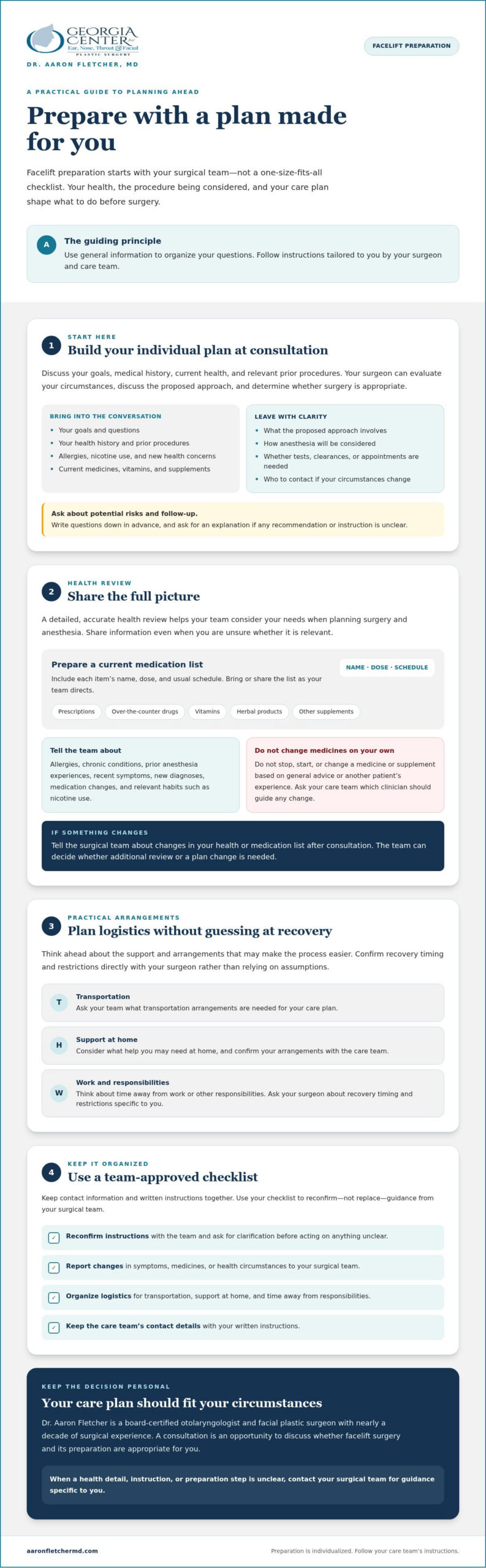
If you’re wondering how to prepare for facelift surgery, start with your surgical team, not a checklist written for someone else. Your health, the procedure being considered, and the care plan all affect what you should do before surgery. Bring questions about medicines, anesthesia, and recovery arrangements to your consultation, and ask for instructions that fit your circumstances.
Planning ahead can make practical details easier to manage. This guide covers what to discuss at your consultation, how health reviews and medical clearances fit into preparation, and what to confirm with your care team before the procedure.
You can also begin thinking about transportation, support at home, and time away from work or other responsibilities. Treat this information as a framework for questions, not personal medical instructions. If something about your health or preparation is unclear, contact your surgical team.
Key Takeaways
- Learn how to prepare for facelift surgery by bringing a complete health and medication history to your consultation.
- Ask how your medical history may affect preoperative assessment and anesthesia planning.
- Make practical arrangements ahead of time, but confirm recovery timing and restrictions with your surgeon.
- Use a written checklist to reconfirm instructions, report health changes, and organize logistics.
- Bring questions to Dr. Fletcher and contact the surgical team when you need guidance specific to you.
How to Prepare for Facelift Surgery Starts With an Individual Plan
Preparing for a facelift means reviewing your health, arranging practical support, and following the instructions your surgeon gives you. There isn’t one checklist that applies to every patient. Your medical history, current health, and the surgical approach being considered all help shape your plan.
Begin with a consultation. You and your surgeon can discuss your goals, review relevant health information, and go over what to expect. For general background on the procedure and its terminology, read this overview of facelift surgery. Use it for context, not as a substitute for advice about your care.
What happens during a facelift consultation?
Your surgeon will ask about your goals, medical history, current health, and relevant prior procedures. Share information fully, including details that may not seem connected to facial surgery. Ask about the proposed approach, anesthesia planning, potential risks, and follow-up. After evaluating your circumstances, the surgeon can determine whether surgery is appropriate and recommend an individualized plan.
Dr. Aaron Fletcher is a board-certified otolaryngologist and facial plastic surgeon with nearly a decade of surgical experience. A consultation with him gives you an opportunity to discuss whether facelift surgery and its preparation are appropriate for you. Your assessment, rather than a generic checklist, will guide the recommendations you receive.
Which questions should you bring to your surgeon?
Writing down questions in advance can help you leave the consultation with clear next steps. Consider asking:
- Which prescription medicines, over-the-counter drugs, supplements, or health conditions need review before surgery?
- What tests, medical clearances, or preoperative appointments are needed for my situation?
- What anesthesia plan is being considered, and what should I understand about its risks?
- Whom should I contact if my symptoms, medication list, or health circumstances change?
These questions are a starting point, not a substitute for a complete medical review. Tell the team about allergies, nicotine use, and new health concerns, even if you’re not sure they matter. Don’t stop or change a medicine based on general online guidance. Ask the surgical team for instructions tailored to you.
Keep the team’s contact information and written instructions together. If a recommendation is unclear, ask for an explanation before acting on it. That is a practical first step in learning how to prepare for facelift surgery safely and thoughtfully.
Review Your Health, Medicines, and Anesthesia Plan Before Facelift Surgery
A detailed health review helps your surgical team consider your needs when planning for facelift surgery and anesthesia. Share a complete, accurate picture, even if a medicine or past health issue seems unrelated. Your surgeon can assess the information and determine whether further review or preparation may be appropriate.
How should you discuss medicines and supplements?
Prepare a current list of everything you take, including each item’s name, dose, and usual schedule. Include prescriptions from every clinician, over-the-counter drugs, vitamins, herbal products, and other supplements. Bring the list to your consultation or follow the team’s instructions for sharing it. The American Society of Plastic Surgeons offers general preparation information in its Review Your Health guidance, but your care team must tell you what applies to your situation.
Medication changes before facelift surgery must be individualized by the care team. Don’t stop, start, or change a medicine or supplement based on general advice or another patient’s experience. Ask the surgical team which clinician should guide any change, particularly if another provider manages the medicine. Confirm the instructions, and ask again if anything is unclear.
What health information should you disclose?
Tell the surgeon about allergies, chronic conditions, prior anesthesia experiences, and recent changes in your health. Mention nicotine use and other habits that may be relevant to your care. Be candid and specific. Your care team needs the information to assess your circumstances; don’t try to decide in advance whether a detail will affect your candidacy.
Make a note of recent symptoms, new diagnoses, and medication changes. Include when they began and what has changed. If your health or medication list changes after your consultation, tell the surgical team rather than waiting until the day of surgery. Your surgeon can decide whether the update calls for additional review or a change to the plan.
Ask how anesthesia will be addressed in your case, what information the team needs, and whom to contact with questions. The specific plan depends on your health and the surgery being considered, so don’t rely on instructions intended for another patient.
For a personalized discussion of facelift surgery and preoperative planning, you can learn about Dr. Fletcher’s facelift care. Clear communication gives your team the information it needs to make recommendations for your circumstances.
Plan Your Facelift Surgery Logistics Without Guessing at Recovery
You can organize some practical details early, while other decisions depend on your surgeon’s assessment and instructions. Make flexible plans for support, but don’t use an online recovery timeline to decide when you can return to work, drive, or resume activities. When considering how to prepare for facelift surgery, confirm procedure-specific details with your care team.
What should you arrange before surgery?
Confirm the arrival time, location, transportation requirements, and support arrangements with the surgical team. Ask who should accompany you and whether someone needs to be available afterward. Follow the instructions you receive rather than assuming that another patient’s arrangements will apply to you.
Think through the daily tasks that could be harder to manage immediately after surgery. Depending on your household and responsibilities, you may want to arrange help with meals, errands, childcare, or caring for someone else. Ask the practice whether it recommends particular supplies, clothing, or home preparations. The American Society of Plastic Surgeons also provides general guidance on preparing for a facelift. Use it for background, then confirm your own instructions with your surgeon.
How can you plan time away from responsibilities?
Discuss activity restrictions, follow-up visits, and the factors that will guide your return to work and regular routines. Recovery varies, and recommendations may depend on your health, the procedure, and how healing progresses. If your responsibilities are difficult to pause, raise that early so you can consider options and build flexibility into your schedule.
A general timeline may help you prepare questions, but it isn’t personal clearance to resume activity. Avoid firm commitments based only on a typical recovery estimate. Ask which milestones the care team will use to assess your progress and when to check in if you’re uncertain.
- Confirm arrival and transportation arrangements with the practice.
- Ask what support is expected after surgery and organize help accordingly.
- Discuss activity limits, follow-up, and time away from work or caregiving.
- Keep plans flexible until your surgeon advises you about your recovery.
Dr. Fletcher’s team can help clarify which arrangements apply to your facelift plan. You can learn about facelift care with Dr. Fletcher and bring practical questions about transportation, support, and scheduling to your discussion.
Use a Surgeon-Approved Checklist in the Days Before Facelift Surgery
A short written checklist can keep final preparations organized without turning general advice into personal medical instructions. As you consider how to prepare for facelift surgery, use the list below to record the directions your surgical team gives you. If the practice’s instructions differ from a general checklist, follow the practice’s guidance.
What should you confirm with the practice?
Before surgery, verify the practical details and make sure you understand what the team expects. Fasting, bathing, skin care, and medication instructions must come directly from your surgical team. Don’t assume standard rules apply to you. Ask for clarification if an instruction is unclear.
- Arrival time: ______________________________
- Location details provided by the practice: ______________________________
- Best contact number for questions: ______________________________
- Food and drink instructions: ______________________________
- Medication instructions, confirmed with the care team: ______________________________
- Bathing or skin-care instructions: ______________________________
- Outstanding tests, clearances, or documents: ______________________________
Reconfirm anything you’re unsure about instead of relying on another patient’s instructions or an online checklist. Check whether the team needs updated health information or outstanding preoperative documents. Note whom you spoke with and any follow-up steps.
What should you do if your health changes?
Contact the surgical team promptly if you develop a new illness, fever, unexpected symptoms, or another significant health change before surgery. Report medication changes as well. Don’t decide on your own whether a change is minor or whether surgery should proceed. The clinician will assess the information and determine whether further evaluation or a change in plans is needed.
Keep the checklist accessible and update it if the practice gives you revised instructions. A written record helps distinguish confirmed directions from questions that still need answers.
Final check: I have reconfirmed my instructions, shared relevant health changes, completed the arrangements requested by the practice, and know whom to contact with questions.
Questions to clarify: ____________________________________________________
If you need help confirming preparation instructions for your facelift plan, contact Dr. Fletcher’s practice before acting on advice that wasn’t given to you directly.
Know What to Expect and Discuss Facelift Preparation With Dr. Fletcher
Preparation is most useful when it reflects your health, the procedure being considered, and your care team’s instructions. A generic checklist can help organize questions, but it can’t determine whether you’re ready for surgery or which steps are appropriate. Bring your health information and concerns to a qualified surgical consultation, and ask for clarification before making decisions based on assumptions.
How can a consultation make preparation clearer?
Use the consultation to discuss your goals, concerns, medical history, and any practical constraints that could affect planning. Ask the surgeon to explain the options being considered, their potential risks, and the next steps in evaluation. Find out who will answer questions before surgery and how to contact the care team if something changes.
Dr. Aaron Fletcher is a board-certified otolaryngologist and facial plastic surgeon who offers facelift surgery. He has nearly a decade of surgical experience; this describes his overall surgical experience, not a stated number of facelift procedures. An individualized assessment helps determine whether facelift surgery is appropriate and which preparation recommendations apply to you.
Before the visit, consider bringing an up-to-date health and medication history, a list of questions, and notes about work, caregiving, or other responsibilities that could affect your planning. You don’t need to arrive with every answer. The consultation can help identify what needs further discussion and which instructions to follow.
What should patients remember before moving forward?
Readiness depends on your health, clinical assessment, and understanding of the proposed plan. Ask about anything that remains unclear, including preparation instructions, risks, follow-up expectations, and whom to contact with a concern. Take time to consider the information and discuss unanswered questions before agreeing to surgery.
As you learn how to prepare for facelift surgery, treat online guidance as general education, not personal clearance or a substitute for your surgeon’s directions. Contact the practice if your circumstances change or instructions are confusing. The care team’s current instructions take precedence over a general checklist.
To explore whether facelift surgery and its preparation may be appropriate for you, learn about Dr. Fletcher’s facelift care.
Move Forward With a Preparation Plan Built Around You
Knowing how to prepare for facelift surgery starts with a conversation, not a one-size-fits-all checklist. Bring your health history, medication and supplement list, and questions to a qualified surgical consultation. Your surgeon can assess your circumstances and explain which evaluations, instructions, and practical arrangements apply. Confirm medication, food, and skin-care directions with the surgical team, and contact them if your health changes or guidance is unclear.
Dr. Aaron Fletcher is a board-certified otolaryngologist and facial plastic surgeon who offers facelift surgery, with nearly a decade of surgical experience across his practice. A consultation gives you a chance to discuss your goals, understand potential risks and next steps, and determine whether surgery and its preparation are appropriate for you. A general guide cannot replace that individualized assessment.
If you’re ready to explore your options, learn about Dr. Fletcher’s facelift care.
Frequently Asked Questions
How do I prepare for facelift surgery?
Follow a plan tailored to your health and procedure rather than relying on a generic checklist. Share your medical history and a current list of medicines and supplements with your surgeon. Confirm any required evaluations, transportation, home support, and final instructions with the practice. Ask about anything unclear, especially medication, food and drink, skin care, and activity guidance. Contact the surgical team if your health changes before the procedure.
What medications should I stop before facelift surgery?
Don’t stop, start, or change any medication or supplement without guidance from the clinician managing your care. Some medicines and supplements may need review because of potential effects on surgery, but the right plan depends on your health and what you take. Provide a complete list, including prescriptions, over-the-counter drugs, vitamins, and herbal products. Ask the surgical team which clinician should advise you about changes, and confirm instructions before acting.
Do I need to stop smoking before facelift surgery?
Tell your surgical team if you smoke or use nicotine, and ask whether you should stop and when. Nicotine use is relevant to surgical planning and healing, but the appropriate recommendation and timing should come from your care team. Don’t assume advice intended for another patient applies to you. Share your nicotine use candidly so your surgeon can assess its relevance and explain next steps.
Do I need to fast before facelift surgery?
Follow only the food and drink instructions provided by your surgical team. Fasting requirements can depend on your anesthesia plan and individual circumstances, so a general online rule may not be appropriate. Confirm when to stop eating and drinking, and ask whether any regular medicines should be taken with a small amount of water. If you’re unsure or the instructions conflict, contact the practice before making assumptions.
Should someone drive me home after facelift surgery?
Ask the practice what transportation and support are required for your plan, and arrange a responsible adult in advance if instructed. Anesthesia or other aspects of care may affect whether you can travel independently. Don’t plan to drive yourself unless your surgical team explicitly clears you to do so. Confirm whether someone needs to stay with you afterward and for how long, since support requirements should come from your care team.
What should I tell my surgeon before facelift surgery?
Share your complete medical history, current health concerns, allergies, prior anesthesia experiences, and relevant prior procedures. Bring a list of prescription medicines, over-the-counter drugs, vitamins, and supplements, including doses and usual schedules. Tell the surgeon about nicotine use and any recent changes in your health or medication. This information helps the clinician assess your circumstances and decide what needs further review before surgery.
What should I do if I get sick before facelift surgery?
Contact your surgical team promptly if you develop an illness, fever, new symptoms, or another significant health change before surgery. Report medication changes as well. Don’t decide on your own whether the change is minor or whether surgery should go ahead. The clinician will assess the information and determine whether you need further evaluation or whether the plan should change. If you can’t reach the practice, follow the contact instructions it provided.