A truly successful rhinoplasty is one that functions so seamlessly you eventually forget it was ever surgically altered. While many focus solely on the mirror, the most sophisticated results are those that harmonize a refined aesthetic with effortless nasal function. You’ve likely spent hours examining nose surgery before and after galleries, perhaps feeling a blend of excitement and anxiety. It’s common to fear a “surgical” look or worry that aesthetic changes might compromise your ability to breathe clearly.
We understand these concerns and believe that transparency is the foundation of a confident patient journey. In this guide, you’ll discover how to critically evaluate surgical transformations and understand the meticulous clinical expertise required to balance beauty with biology. We’ll explore the latest preservation techniques, discuss the reality of the healing timeline, and explain why a double board-certified approach ensures your results are as functional as they are flattering. By the end, you’ll have the clarity needed to choose a path that honors your unique features while prioritizing your long term well-being.
Key Takeaways
- Learn to look beyond the surface of nose surgery before and after galleries by using a clinical checklist to identify authentic, high-quality results.
- Understand the critical difference between traditional reduction methods and modern structural techniques that prioritize long-term nasal support.
- Discover how specialized expertise allows for the refinement of features while carefully honoring your unique facial heritage and identity.
- Explore why the most successful outcomes are those that balance visual harmony with a clear, unobstructed airway for optimal breathing.
- Gain insight into the methodical surgical planning process that transforms a patient’s aesthetic goals into a predictable, functional reality.
Decoding Rhinoplasty Results: Why Before and After Photos Matter
Rhinoplasty is the surgical refinement of the nose for either aesthetic enhancement or functional correction. When you browse a nose surgery before and after gallery, you aren’t just looking at a portfolio of work. You’re viewing a collection of clinical case studies that demonstrate how a surgeon navigates individual anatomy to achieve a balanced result. These images serve as a vital bridge between your current concerns and your future profile. They provide evidence of a surgeon’s ability to handle diverse nasal structures while maintaining the integrity of the airway.
In a professional setting, these photographs are indispensable diagnostic tools. They allow us to analyze the complex relationship between the nasal bridge, the tip, and the upper lip. By documenting these details, we create a precise surgical plan tailored to your specific needs. The ultimate goal isn’t to create a “perfect” nose in isolation. Instead, we aim for a nose that looks like it has always belonged to your unique face. This focus on harmony ensures that your results feel natural rather than “operated on.”
Setting Realistic Expectations Through Visual Evidence
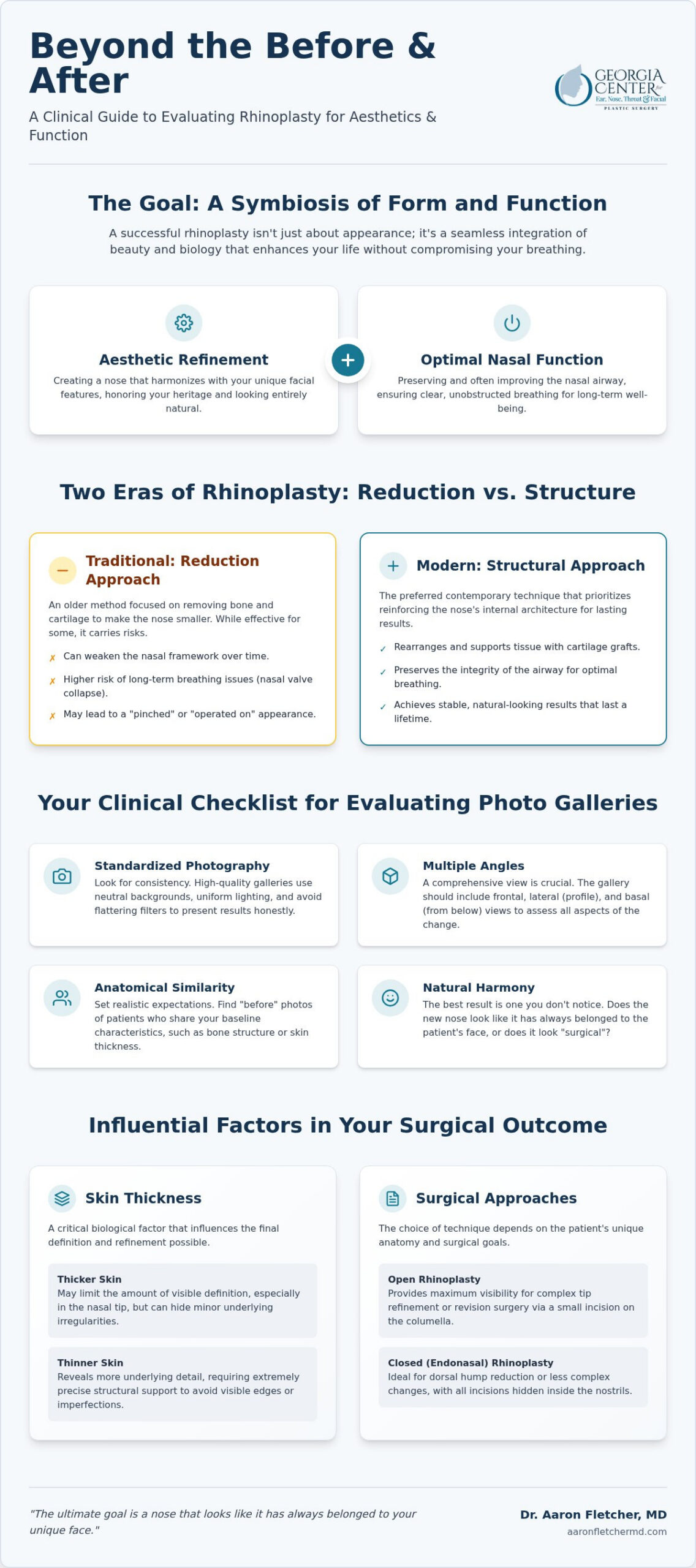
As you examine different cases, your focus should be on finding patients who share your baseline characteristics. It’s helpful to identify individuals with similar bone structures or skin thickness to your own. For instance, thicker skin may limit the amount of definition achievable in the nasal tip, while a thin skin type requires more delicate structural support to avoid visible edges. Understanding these biological factors helps you move past the pursuit of an idealized image and toward a result that’s truly harmonious with your features. In facial plastic surgery, the “perfect” nose is often the enemy of the “harmonious” face.
The Importance of Standardized Surgical Photography
A professional gallery is distinguished by its consistency. You should look for standardized lighting and neutral backgrounds. These elements ensure the results are presented honestly without the distortion of shadows or flattering filters. A comprehensive nose surgery before and after sequence typically includes several standard views, such as the frontal, lateral profile, and basal angles. These perspectives allow you to assess symmetry, bridge height, and nostril shape accurately. Digital imaging often complements these photos during your consultation. It acts as a collaborative tool, helping us visualize potential changes and align our expectations. By using these standardized methods, we ensure that the transparency of our process matches the precision of our surgical technique.
The Anatomy of Transformation: Structural vs. Cosmetic Changes
The external aesthetic achieved in any nose surgery before and after sequence is fundamentally a reflection of the internal framework. To achieve a result that lasts a lifetime, a surgeon must treat the nose as a complex architectural structure rather than just a cosmetic feature. Traditionally, many procedures relied on a “reduction” approach, which involved removing bone and cartilage to create a smaller profile. However, modern techniques favor a “structural” approach, where we rearrange existing tissues and use grafts to reinforce the nasal foundation. Thinking about rhinoplasty? It’s crucial to recognize that narrowing the nose for beauty must never compromise the internal nasal valve. This area is the narrowest part of your airway, and preserving its integrity is where dual expertise in otolaryngology and plastic surgery becomes essential. By prioritizing both form and function, we ensure your new profile doesn’t come at the cost of your breathing.
Open vs. Closed Rhinoplasty: Impact on the Final Profile
Choosing between an open or closed technique depends on the complexity of your anatomical needs. Open rhinoplasty involves a small incision across the columella, providing maximum visibility for intricate tip refinement or revision cases. In contrast, closed (endonasal) rhinoplasty places all incisions inside the nostrils, which is often ideal for dorsal hump reduction without external scarring. While the open approach may involve a slightly longer initial healing timeline for tip swelling, both methods aim for a seamless “after” appearance that looks entirely natural. If you’re considering a functional and aesthetic change, scheduling a consultation can provide clarity on your unique anatomy.
Balancing the Bridge and Tip for Harmonious Proportions
Achieving facial harmony requires a delicate balance between the nasal bridge and the tip. When addressing a dorsal hump, we use precise sculpting to create a smooth, straight, or slightly curved bridge that aligns with your forehead and chin. Tip refinement focuses on correcting bulbousness or asymmetry by carefully suturing and reshaping cartilage. A critical metric here is the nasolabial angle, the space between the nose and the upper lip. We ensure this angle is meticulously maintained so the nose looks refined but never over-rotated or “piggy.” This attention to detail ensures the transition from the “before” state to the “after” result feels like a natural evolution of your existing features.
Tailoring the Outcome: Specialized Rhinoplasty Variations
Success in nasal surgery is not a singular destination; it’s a personalized target defined by your specific goals and cultural heritage. When you examine a portfolio of nose surgery before and after cases, you’ll notice that the most impressive results aren’t those that look identical, but those that look uniquely appropriate for the individual’s face. Achieving these nuances requires a level of rhinoplasty mastery that respects your underlying anatomy while meticulously correcting your specific concerns. Whether the goal is to refine a tip or straighten a bridge, the surgical approach must be as unique as the patient’s own DNA.
Ethnic Rhinoplasty: Preserving Heritage While Enhancing Form
Refining the nose without erasing cultural markers is a delicate art form that requires specialized experience. Patients of African, Asian, or Hispanic descent often present with specific anatomical traits, such as a wider nasal base, thicker skin, or a flatter bridge. A generic approach often fails these patients by producing results that look “pinched” or unnatural. Instead, we focus on structural grafting to provide definition and support where it’s needed most. This technique allows us to narrow a wide base or lift a bridge while carefully honoring your heritage. Because thicker skin can hold swelling longer, understanding the rhinoplasty recovery and results timeline is essential, as the final, refined contour may take a full year to emerge completely.
Functional Improvements: When Breathing Better Looks Better
The relationship between how a nose looks and how it works is inseparable. Many patients seeking aesthetic changes also suffer from a deviated septum or enlarged turbinates, which can cause chronic breathing issues. We often perform a septoplasty in conjunction with cosmetic refinement to straighten the internal wall of the nose. This doesn’t just improve the airway; it often provides a more symmetrical foundation for the external bridge. Turbinate reduction can also be integrated to further clear the breathing passage. When the internal structure is straightened and supported, the external symmetry naturally improves, proving that a nose that functions better almost always looks better too.
Specialized variations also extend to gender-specific goals. In male rhinoplasty, the objective is typically to maintain a strong, masculine profile. We avoid over-rotating the tip or creating an overly narrow bridge, which can feminize the face. By focusing on straight lines and distinct angles, we achieve a refined appearance that remains robust and balanced. This methodical, patient-centered approach ensures that every “after” photo represents a version of you that feels authentic and confident.
How to Critically Evaluate a Nose Surgery Gallery
When you begin reviewing a nose surgery before and after gallery, it’s easy to be swept up by dramatic transformations. However, a critical eye is your best tool for ensuring your own expectations remain grounded in reality. A professional gallery should function as a transparent record of a surgeon’s technical range and aesthetic philosophy. You aren’t just looking for a “smaller” nose; you’re looking for evidence of surgical precision, structural integrity, and facial balance. High-quality galleries prioritize honesty over marketing, showing results from multiple angles and under consistent, clinical lighting.
Be cautious of galleries that rely heavily on social media filters or inconsistent backgrounds. These “over-filtered” images often mask the very details you need to see, such as skin texture, subtle asymmetries, or surgical scars. An authentic presentation will show the nose in its true state, allowing you to assess how the new profile interacts with the patient’s chin, forehead, and cheeks. To help you navigate these visual records, use the following checklist to identify high-quality results:
- Consistency: Are the lighting, background, and camera angles identical in both the before and after shots?
- Standard Views: Does the gallery include frontal, profile, and basal (looking up from the nostrils) views?
- Diversity: Does the surgeon show a variety of nasal structures, skin types, and ethnicities?
- Longevity: Are there examples of patients at the one year mark or beyond?
Identifying Natural-Looking Results vs. Over-Operated Noses
The hallmark of a superior result is a nose that doesn’t look “operated on.” You should look for soft transitions between the bridge and the tip, rather than harsh, geometric lines. One common red flag in less successful cases is “The Pinch.” This occurs when the nasal tip is narrowed too aggressively, often causing the nostrils to look collapsed or out of proportion with the bridge. Another warning sign is “The Scoop,” an overly aggressive reduction of the nasal bridge that creates an artificial, concave appearance. These outcomes often suggest that the surgeon prioritized a specific “look” over the patient’s underlying anatomy. A harmonious result preserves your unique facial character while refining the features that concern you most.
The Timeline of Healing: When Are ‘After’ Photos Truly Final?
Patience is a requirement in rhinoplasty because the nose changes significantly over time. When viewing a nose surgery before and after sequence, it’s vital to know how far post-op the “after” photo was taken. At the one month mark, most bruising has faded, but significant swelling still hides the fine details of the surgery. By six months, the bridge usually settles, and the new definition begins to emerge clearly. However, the final result isn’t truly visible until 12 to 18 months after the procedure. This is especially true for the nasal tip, where swelling is the most persistent. Understanding this timeline prevents premature frustration and helps you appreciate the steady progression toward your final profile.
If you’re ready to see how meticulous planning and clinical expertise can transform your profile, we invite you to explore our surgical gallery and see the results of our form and function philosophy firsthand.
Achieving Your Ideal Profile with Dr. Aaron Fletcher
Selecting a surgeon for your rhinoplasty is a decision that fundamentally impacts both your visual identity and your daily comfort. Dr. Aaron Fletcher approaches each procedure with the meticulous eye of a scholar and the steady hand of a seasoned technician. When you examine a nose surgery before and after portfolio, the objective isn’t to find a “new” nose that looks out of place. Instead, you’re looking for a better-proportioned version of yourself. This philosophy centers on the belief that the most successful results are those that enhance your natural beauty while ensuring your respiratory health is never compromised. We believe that true excellence in plastic surgery is found in the subtle details that create a sense of effortless harmony.
A Dual Focus on Aesthetic Excellence and Nasal Health
Dr. Fletcher’s nearly a decade of specialized surgical experience is anchored by a unique dual board certification in both Otolaryngology and Facial Plastic Surgery. This distinction is vital for your safety. It means your surgeon understands the intricate plumbing of the nose just as well as its external architecture. Every aesthetic refinement we make is built upon a foundation of healthy nasal function, ensuring you breathe as well as you look. Many patients find that their journey toward a more balanced profile inspires them to consider full facial rejuvenation. If you’re exploring how a refined nasal contour complements your other features, you might also consider the benefits of a facelift or blepharoplasty. Our commitment is to provide results that stand the test of time, prioritizing your long term quality of life through meticulous clinical care.
Your Consultation: Mapping Your Future Result
The path to your ideal profile begins with a thorough, collaborative consultation. We encourage you to bring inspiration photos to help us understand your aesthetic preferences, though we’ll always ground our discussion in what’s anatomically possible for your unique face. Dr. Fletcher conducts a detailed evaluation of your internal airway and your external skin quality, as these factors dictate the surgical techniques required for success. This isn’t a one-size-fits-all process; it’s a personalized design session where we map out your structural needs and aesthetic goals. We take the time to answer every question with transparency, ensuring you feel secure and informed before any decisions are made. By combining your vision with our clinical expertise, we create a surgical plan that moves you toward an “after” result that feels both transformative and authentic.
Your Journey Toward Facial Harmony
A successful rhinoplasty is a transformative experience that extends far beyond the surface. By learning how to critically evaluate a nose surgery before and after gallery, you’ve equipped yourself with the tools to find a result that is both beautiful and functional. We’ve explored how structural integrity is the foundation of aesthetic success and why your cultural heritage should be refined, not erased. True excellence in this field requires a meticulous balance of form and function, ensuring your new profile feels like a natural extension of your identity.
As a double board-certified specialist and expert in aesthetic and functional nasal surgery, Dr. Fletcher is dedicated to providing natural, harmonious outcomes that stand the test of time. Your journey is personal, and it deserves a surgical plan that is just as tailored as your goals. We invite you to schedule your personalized rhinoplasty consultation with Dr. Aaron Fletcher today to discuss your structural needs. You don’t have to navigate this decision alone; we’re here to guide you toward a result that brings you lasting confidence and clarity.
Frequently Asked Questions
How long after nose surgery can I see the final results?
Final results typically emerge between 12 and 18 months post-surgery. While you’ll see a significant change after the initial swelling subsides in the first three weeks, the fine details of the nasal tip require more time to settle. This gradual refinement is a normal part of the biological healing process. Your nose surgery before and after journey is a marathon, not a sprint, requiring patience as the skin and underlying cartilage fully adapt to their new framework.
Will I have visible scars after my rhinoplasty?
Scarring is usually minimal and often completely invisible to the casual observer. In a closed rhinoplasty, all incisions are placed inside the nostrils, leaving no external marks. An open rhinoplasty involves a small, precise incision across the columella, the narrow strip of tissue between the nostrils. When performed with meticulous technique, this scar typically fades into a faint line that’s very difficult to detect once the healing process is complete.
Is it possible to improve my breathing and the look of my nose at the same time?
It’s entirely possible and often recommended to address both breathing issues and aesthetic goals in a single procedure. This integrated approach, often involving a septoplasty or turbinate reduction alongside cosmetic refinement, ensures that your results aren’t just visually pleasing but also functionally sound. By prioritizing the internal airway, we provide a stable foundation for the external changes, ensuring that your nose surgery before and after results represent a true improvement in your quality of life.
What are the signs of a ‘bad’ rhinoplasty result?
A suboptimal result often manifests as a “surgical” look that lacks facial harmony. Common red flags include a bridge that appears overly scooped, a nasal tip that looks pinched or unnaturally narrow, or nostrils that seem collapsed. Beyond aesthetics, persistent breathing difficulties or a feeling of internal nasal obstruction are significant signs of a result that failed to prioritize function. True success is defined by a nose that looks natural and breathes effortlessly.
How much does a typical nose surgery cost in 2026?
As of September 2026, the average all-inclusive cost for a primary rhinoplasty in the United States is approximately $11,880. This figure typically encompasses the surgeon’s fee, anesthesia, and facility costs, though individual cases can range from $8,000 to over $20,000 depending on complexity. It’s important to remember that these are industry averages and not specific quotes. A personalized consultation is the only way to receive an accurate estimate based on your specific structural requirements.
Can rhinoplasty be customized for my ethnic background?
Specialized ethnic rhinoplasty is designed to refine the nose while carefully preserving your unique cultural heritage. We focus on enhancing features like the nasal bridge or tip without erasing the markers of your background. This requires an expert understanding of different anatomical traits, such as varying skin thicknesses or wider nasal bases. The goal is always to achieve a more balanced appearance that remains authentic to your identity and honors your heritage.
What happens if I am unhappy with my ‘after’ results?
If you’re dissatisfied with your initial outcome, the first step is to wait for the full 12 to 18 month healing period to conclude. Swelling can distort the final shape for many months, making early judgments unreliable. If functional or aesthetic concerns persist after full recovery, a revision rhinoplasty may be considered. This complex procedure requires a high degree of expertise to correct structural issues and achieve the harmonious profile you originally envisioned.
How do I choose the best rhinoplasty surgeon for my needs?
The most critical factor in choosing a surgeon is their specific expertise and board certification. Look for a practitioner who is double board-certified in both Otolaryngology and Facial Plastic Surgery, as this ensures they understand both the aesthetic and functional aspects of the nose. Carefully review their nose surgery before and after galleries to ensure their artistic style aligns with your preference for natural, harmonious results. Transparency and educational focus are also key indicators of quality care.