What if the secret to a beautiful nose isn’t found in the profile line, but in the intricate, often damaged architecture beneath it? For many, the journey toward a successful revision rhinoplasty begins with a difficult realization: the primary surgery failed to deliver the expected harmony or, worse, compromised the ability to breathe. It’s completely natural to feel a sense of trepidation after a surgical disappointment. You’re likely dealing with the physical discomfort of a blocked airway alongside the emotional weight of a pinched or asymmetrical appearance that doesn’t feel like you.
We understand that you aren’t just looking for a cosmetic fix. You’re looking for a restoration of your quality of life. This specialist’s guide is designed to navigate the complexities of secondary nasal surgery with a focus on structural integrity and aesthetic refinement. We’ll examine how a dual board-certified approach addresses scar tissue and compromised cartilage to rebuild a nose that functions as beautifully as it looks. By focusing on a methodical, ENT-first philosophy, we’ll preview the advanced reconstructive techniques and personalized planning required to finally achieve the balanced, natural result you deserve.
Key Takeaways
- Understand the fundamental differences between primary and secondary procedures, specifically how scar tissue and diminished tissue elasticity necessitate a complex, reconstructive strategy.
- Explore the critical role of autologous grafting in rebuilding a compromised nasal framework to ensure long-term structural stability and optimal breathing function.
- Prepare for the unique healing trajectory of a revision rhinoplasty, which often requires up to 24 months for the final aesthetic and functional results to fully stabilize.
- Learn why the dual expertise of an ENT and facial plastic surgeon is the gold standard for correcting previous surgical disappointments and restoring facial harmony.
- Discover how meticulous surgical planning can resolve common aesthetic concerns like a “pinched” tip or asymmetry while prioritizing the health of your airway.
The Complexity of Revision Rhinoplasty: Why a Second Procedure Differs
A Rhinoplasty is widely recognized as the most technically demanding procedure in facial plastic surgery. When a primary surgery fails to meet expectations, whether through aesthetic dissatisfaction or a new breathing impairment, a revision rhinoplasty offers a path toward correction. It’s vital to understand that this isn’t a minor “touch-up.” Instead, it’s a meticulous reconstructive mission. The surgeon must navigate an environment that has been fundamentally altered, making the second journey quite different from the first.
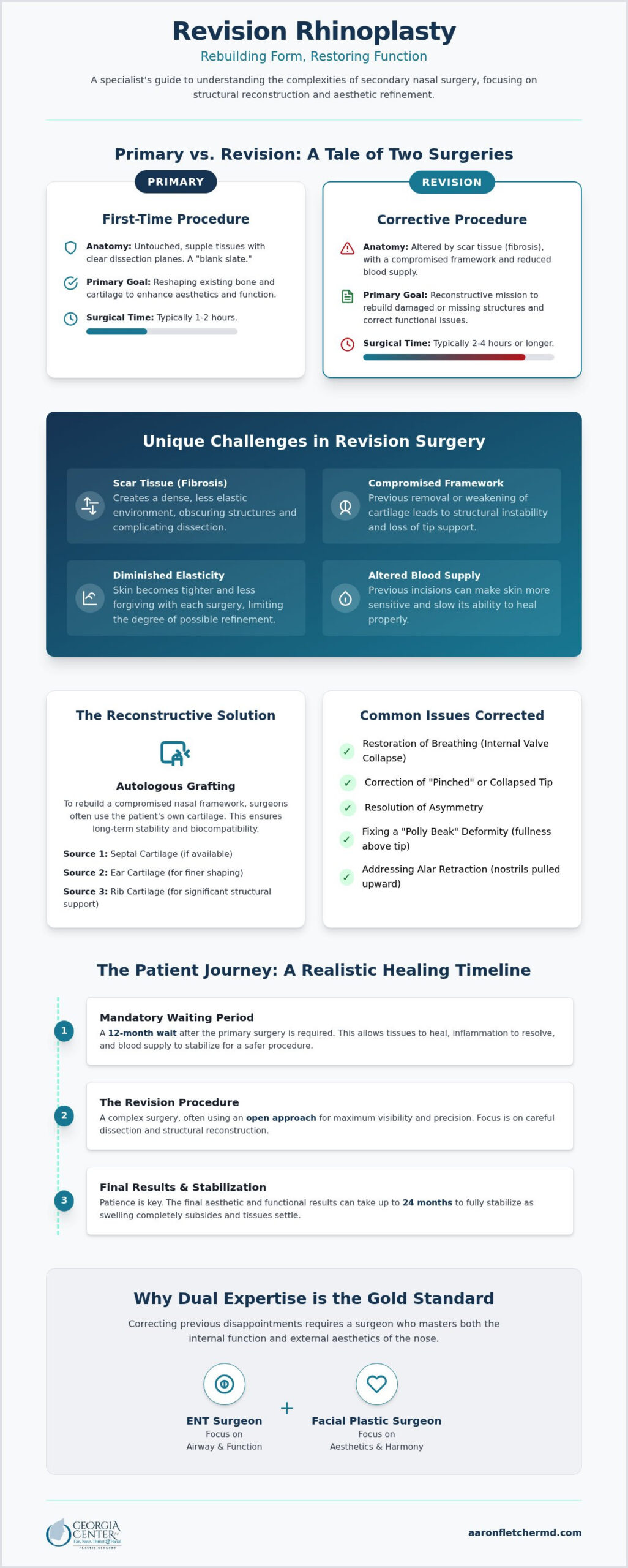
Patience is the first requirement for any successful corrective surgery. We typically require a 12-month waiting period after the initial procedure before performing a revision. This timeframe allows the delicate nasal tissues to fully heal, the blood supply to stabilize, and the internal inflammation to resolve. Operating on “immature” tissue is risky; waiting ensures that the surgeon is working with a stable foundation rather than a shifting landscape of post-operative swelling.
The primary hurdle in secondary cases is the presence of fibrosis, or scar tissue. In a primary surgery, the tissues are supple and the planes of dissection are clear. In a revision, scar tissue creates a dense, less elastic environment that can obscure vital structures. This leads to what we call “diminishing returns” of tissue elasticity. With every subsequent surgery, the skin becomes tighter and less forgiving, which limits the degree of refinement that can be safely achieved without risking the health of the tissue.
Anatomical Challenges: Scar Tissue and Altered Framework
Previous incisions often change the blood supply to the nasal skin, making it more sensitive and slower to recover. When the original cartilage has been aggressively removed or weakened, the underlying framework becomes unpredictable. Nasal tip support refers to the structural arrangement of cartilage and ligaments that maintains the tip’s position and keeps the nostrils open. When this support is compromised in a primary surgery, the tip may eventually droop or appear “pinched,” requiring advanced grafting to rebuild what was lost.
Functional Failure vs. Aesthetic Dissatisfaction
A specialist must treat the nose as a single unit where form and function are inseparable. Internal valve collapse is a common functional issue where the narrowest part of the nasal airway is weakened, causing it to cave inward during inhalation. Aesthetically, we often see the “polly beak” deformity, a persistent fullness above the tip, or alar retraction, where the nostrils appear pulled upward. Correcting these issues simultaneously is essential. We don’t just aim for a balanced profile; we ensure that the structural integrity of the airway is restored so you can breathe with ease.
Primary vs. Revision Rhinoplasty: A Comparative Analysis
While a primary nasal surgery often deals with a “blank slate” of untouched anatomy, Understanding revision rhinoplasty requires recognizing its fundamentally reconstructive nature. The surgeon isn’t simply refining a shape. They’re often correcting a structural deficit. Because of this complexity, surgical time for a revision typically extends to 2-4 hours or longer. This duration reflects the time needed to carefully navigate scar tissue and identify what remains of the original framework. Most corrective cases necessitate an “open” approach, which involves a small incision on the columella to provide the surgeon with maximum visibility. This high level of transparency is essential for the advanced structural planning required to ensure both aesthetic success and a clear airway.
Surgical Goals and Technical Precision
Primary procedures typically focus on reshaping existing bone and cartilage to achieve a desired profile. Revision cases shift the focus toward rebuilding missing or damaged structures. Meticulous dissection is the hallmark of a specialist’s approach. By moving slowly through the fibrotic tissue, the surgeon avoids further trauma to the skin and preserved cartilage. This precision is what allows for a predictable outcome even when the previous surgery left behind significant anatomical distortions. It’s about restoring a foundation that was previously compromised, ensuring that the new shape is stable enough to last a lifetime without shifting or collapsing.
The Role of Grafting in Secondary Procedures
A common reason patients seek a revision rhinoplasty is because their first surgery was too “reductive,” meaning too much tissue was removed. This often leads to a “pinched” look or internal collapse. Consequently, the second procedure is usually “additive.” We use structural grafts to provide support and prevent future collapse, while camouflage grafts smooth out minor irregularities. Balancing these two types of grafts is a core component of Rhinoplasty Mastery. These grafts are often harvested from the patient’s own septum, ear, or rib to ensure biocompatibility. If you’re concerned about how previous changes have affected your breathing, it’s helpful to schedule a comprehensive evaluation to discuss a personalized reconstructive plan.
Advanced Reconstructive Techniques: Restoring the Nasal Framework
A successful revision rhinoplasty depends on the surgeon’s ability to rebuild a foundation that has often been depleted or destabilized by previous procedures. While some practitioners might suggest synthetic implants, our approach prioritizes autologous grafting, which involves using your own biological tissue. This method significantly reduces the risk of infection or rejection while providing the structural integrity needed to prevent future collapse. According to the American Society of Plastic Surgeons on revision rhinoplasty, the complexity of these cases often stems from the need to replace missing support structures to achieve a lasting, natural result.
Managing the “over-resected” nose requires a fundamental shift from reduction to restoration. When too much bone or cartilage was removed in a previous surgery, the nose can appear “pinched” or “scooped,” often leading to functional breathing issues alongside aesthetic concerns. We utilize specialized sutures and medical-grade tissue glues to secure these new grafts with extreme precision. These advanced tools ensure the reconstructed framework remains stable during the long healing process, allowing for both aesthetic refinement and the restoration of a clear airway.
Graft Sources: Rib, Ear, and Septum
Choosing the right material is a critical decision in the surgical planning phase. Rib cartilage is often considered the gold standard for significant structural support because it’s abundant and exceptionally strong. It’s particularly useful for lengthening a shortened nose or rebuilding a collapsed bridge. For softer contouring needs, such as refining the nasal tip, ear cartilage provides the necessary pliability without the rigidity of the rib. We also frequently employ the Septal Extension Graft, a powerful tool that anchors the nasal tip to the septum, providing a permanent solution for tip support and stability.
Tissue Handling and Scar Management
Working with thick fibrosis requires a delicate touch to avoid compromising the skin’s blood supply. We use meticulous techniques to thin out obstructive scar tissue, creating space for the new, refined framework. For patients needing a smoother bridge transition, Diced Cartilage in Fascia (DCF) offers a sophisticated solution. This technique involves wrapping finely morselized cartilage in a layer of the patient’s own tissue, creating a supple, natural-looking graft that blends seamlessly with the surrounding anatomy. The skin possesses a biological memory of its previous shape, requiring the surgeon to meticulously redrape and secure it to the new framework to ensure the underlying structural changes are accurately reflected on the surface.
The Patient Journey: Recovery and Realistic Expectations
Recovery from a revision rhinoplasty is a marathon, not a sprint. While a primary procedure might show its near-final form within a year, a secondary surgery often requires 18 to 24 months for the tissues to fully settle and the swelling to resolve. This extended timeline is a direct result of the complex reconstructive work and the altered lymphatic drainage caused by previous surgical trauma. It’s essential to prepare for an emotional rollercoaster during this period. You aren’t just healing physically; you’re navigating the psychological shift of trusting a new surgical outcome after a previous disappointment.
Immediate post-operative care is focused on protecting the new structural framework. You’ll wear an external splint for the first week, and in some cases, internal packing or silastic splints are used to support the airway. Activity restrictions are strict; you must avoid strenuous exercise, heavy lifting, and any activity that increases blood pressure for at least three weeks. To manage localized, persistent swelling that can obscure your results, we often utilize targeted steroid injections during your follow-up appointments. These injections help refine the nasal contour and prevent the development of excessive scar tissue.
The First 30 Days: Managing the Physical Transition
The first major milestone occurs at the end of week one with the removal of the surgical cast. It’s vital to remember that this initial reveal is not your final result. The nose will appear significantly swollen and may even look slightly distorted or “pushed up” initially. Between weeks two and four, you’ll reach the socially acceptable phase where most bruising has subsided. You can typically return to work and light social engagements, though internal congestion and a feeling of firmness in the nasal tip will persist as the internal membranes continue to heal.
Long-Term Refinement: The Path to the Final Result
The nasal tip is consistently the last area to reach its final shape. Because the skin is thickest in this region and the underlying grafts are often most complex here, the last 10% of swelling takes the longest to dissipate. Consistent follow-up appointments are mandatory so we can monitor for scar contracture, a process where healing tissue can potentially pull on the underlying framework. For a broader perspective on how the body manages long-term healing, you may find it helpful to review our guide on Understanding the Facelift Recovery Timeline, which emphasizes the necessity of surgical patience. If you’re ready to move forward with a specialist who prioritizes your long-term health, schedule a comprehensive evaluation with our team today.
Choosing a Revision Specialist: Why Dual-Board Certification Matters
Selecting the right practitioner for a revision rhinoplasty is the most critical decision in your corrective journey. This procedure isn’t merely a cosmetic adjustment; it’s a high-stakes reconstructive effort that demands a specific set of clinical skills. Dual board certification in both Otolaryngology (ENT) and Facial Plastic Surgery is the gold standard for these cases. This dual expertise ensures your surgeon understands the delicate internal mechanics of breathing as intimately as they understand the principles of facial balance. Dr. Fletcher adopts a scholar-led approach to patient education, ensuring you understand the “why” behind every surgical decision before you ever enter the operating room.
Transparency is the foundation of our practice. When you evaluate a specialist, it’s vital to view “before and after” photographs of actual revision cases rather than just primary surgeries. Revisions present unique challenges, and a surgeon’s portfolio should reflect their ability to restore symmetry and function to noses that have undergone significant trauma or previous surgical intervention. Seeing a track record of success in complex cases provides the reassurance you need to move forward without the fear of another disappointment.
The Synergy of Form and Function
A nose that appears attractive but restricts your breathing represents a fundamental surgical failure. Our “ENT-first” philosophy ensures that the structural integrity of your airway is never sacrificed for aesthetic refinement. An ENT background allows for the identification of subtle internal collapses that a generalist might miss. We focus on stabilizing the “house” of the nose to ensure the “curb appeal” remains stable for decades. This holistic approach means you don’t have to choose between looking your best and breathing with ease.
Preparing for Your Consultation
Coming prepared for your consultation will help you gain the clarity you need to move forward with confidence. We encourage you to ask detailed questions about graft sources, the management of scar tissue, and what realistic outcomes look like for your specific anatomy. If possible, providing your previous surgical records allows us to plan with a higher degree of precision. Open communication is essential for managing expectations and achieving a result that restores your confidence. To begin this partnership, schedule a consultation with Dr. Aaron Fletcher to discuss your revision goals.
Reclaiming Your Confidence and Nasal Health
Choosing to undergo a revision rhinoplasty is a significant step toward reclaiming both your self-image and your physical comfort. Throughout this guide, we’ve emphasized that a successful outcome relies on a sophisticated understanding of nasal architecture and a commitment to structural restoration. By addressing the underlying issues caused by previous procedures, you can achieve a balanced profile that supports effortless breathing. While the journey requires patience, especially during the extended refinement phase, the clarity and resolution gained are well worth the wait.
Dr. Fletcher’s dual board certification in ENT and Facial Plastic Surgery ensures a meticulous approach to complex airway reconstruction. Our philosophy centers on providing natural, subtle results that prioritize your quality of life. You don’t have to navigate the frustration of a failed surgery alone. We invite you to Request a Private Consultation for Revision Rhinoplasty with Dr. Fletcher to discuss a personalized plan tailored to your needs. Take the first step toward a future where you can breathe freely and feel truly confident in your appearance.
Frequently Asked Questions
How long should I wait after my first rhinoplasty before seeking a revision?
You should wait at least 12 months before undergoing a revision rhinoplasty. This interval allows the initial post-operative inflammation to fully subside and the nasal tissues to regain their natural elasticity. Operating too early on immature scar tissue increases the risk of complications and unpredictable healing. Patience ensures that your surgeon works with a stable anatomical foundation, which is essential for achieving the precise reconstructive results required in secondary procedures.
Is revision rhinoplasty more painful than the first procedure?
Most patients find the level of discomfort during a secondary surgery comparable to their primary procedure. While the surgical time is longer due to the complexity of navigating scar tissue, modern anesthesia and pain management techniques keep the experience manageable. You might experience a different sensation of “heaviness” or increased congestion if significant grafting is required. We prioritize gentle tissue handling to minimize trauma, which helps facilitate a smoother and more comfortable transition through the early recovery weeks.
Will my insurance cover revision rhinoplasty if I have trouble breathing?
Insurance providers typically distinguish between the functional and aesthetic components of nasal surgery. If your revision includes the correction of a deviated septum or internal valve collapse to restore breathing, that portion of the procedure may be eligible for coverage. However, any modifications made purely for cosmetic refinement are considered elective and aren’t covered. We recommend a thorough functional evaluation to document medical necessity, which can assist in the pre-authorization process with your specific insurance carrier.
What are the risks of using rib cartilage for a nose job revision?
Utilizing rib cartilage is a highly effective method for rebuilding structural support, though it does carry specific considerations. Potential risks include warping, where the graft slightly curves over time, or resorption, where the body gradually absorbs a portion of the tissue. There is also a small risk of discomfort at the donor site on the chest. We utilize advanced carving and stabilization techniques to mitigate these risks, ensuring the graft provides a permanent and robust framework for your nasal reconstruction.
Can a revision fix a nose that was made too small or ‘scooped’ out?
A scooped or overly reduced profile can be corrected through additive reconstructive techniques. We use autologous grafts, often harvested from the rib or ear, to rebuild the nasal bridge and restore a natural, balanced height to your profile. This process isn’t just about aesthetics; it also reinforces the internal structure to prevent the collapse often associated with over-resected noses. Meticulous planning allows us to create a profile that looks harmonious while significantly improving your overall nasal function.
What happens if I am still unhappy after a second or third revision?
Cases involving multiple previous surgeries require an exceptionally high level of specialized expertise due to the cumulative presence of scar tissue and depleted cartilage. If you’ve had several procedures, the focus shifts toward achieving the most stable and functional result possible while managing realistic aesthetic expectations. We take a scholarly approach to these tertiary cases, performing a comprehensive analysis of your surgical history to identify exactly why previous attempts failed and how to provide a lasting, healthy resolution.
How do I know if my breathing issues are caused by my previous surgery?
Breathing difficulties that arise or worsen following a primary surgery are often linked to structural changes made during that procedure. Common causes include internal valve collapse, where the airway narrows during inhalation, or the unintended weakening of support cartilage. As a dual board-certified ENT and facial plastic surgeon, Dr. Fletcher performs a detailed internal examination to determine if your symptoms stem from anatomical obstructions or functional deficits. Identifying these specific structural failures is the first step in designing an effective revision rhinoplasty.
Will there be visible scarring if an ‘open’ approach is used for my revision?
The open approach involves a tiny, inverted-V incision across the columella, the narrow strip of tissue between the nostrils. While this incision is visible immediately after surgery, it’s meticulously placed and closed with fine sutures to ensure it heals into a nearly imperceptible line. Most patients find that the scar becomes virtually invisible within a few months. This approach is preferred for revisions because it provides the visibility necessary to perform complex reconstructive work with the highest degree of accuracy.